


Tourist in Istanbul Puts a Stray Cat to a Hilarious Patience Test


In numerous global metropolises, the streets are dominated by cars, towering skyscrapers, or bustling crowds. Yet, Istanbul presents a remarkably different picture. The cats of Istanbul are more than just inhabitants of this ancient city; they reign supreme over its streets, squares, and historical nooks. Despite the city's ceaseless flurry of activity, deafening horns, and the daily ebb and flow of millions of people, these felines have always managed to uphold their unruffled serenity, becoming emblematic of the city. These dignified creatures, embodying the city's spirit, can disconnect from the world around them and carve out their own haven of comfort, even amidst the busiest of squares.
A tourist, intrigued by the question, 'Just how serene can a street cat in Istanbul be?' shared the charming moments of testing a tabby cat's patience. The cat, blissfully oblivious to its surroundings, was sprawled out in a historic square. Its unshakeable composure in response to the antics aimed at it brought a smile to the faces of onlookers.

You can view it from this point;
How Can a Cat Maintain Its Composure Without Becoming Disturbed?
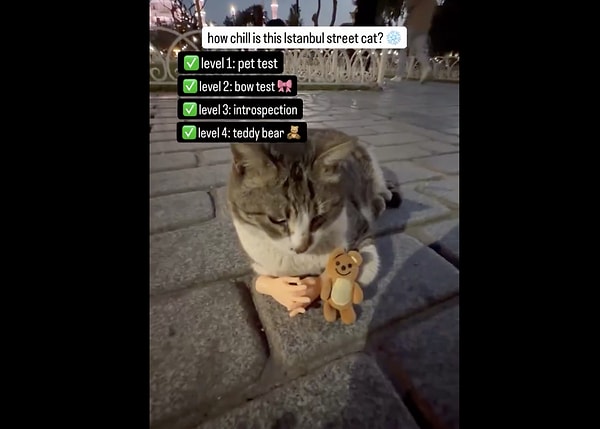
The burning question on everyone's lips is: 'How does this cat manage to remain serene, without showing any signs of irritation or unsheathing its claws, in spite of everything?' We're all aware that cats are typically fiercely protective of their personal space and constantly on the lookout for sudden movements. Yet, our distinguished feline friend in the footage manages to maintain a demeanor as gentle as a lamb throughout five distinct stages.
In the initial phase, the cat becomes tranquil when its chin is gently caressed. Even in the second stage, when a large red bow is affixed to its head, it merely squints its eyes a bit, signaling its contentment with the situation. Things take an even more peculiar turn in the third phase when miniature artificial human hands are positioned in front of its paws. Instead of darting away as any regular cat would, it doesn't even flinch. In the fourth stage, it extends its paw towards a toy bear situated next to it, and even when a tiny red fez is placed atop its head in the final stage, it simply gazes into the camera.
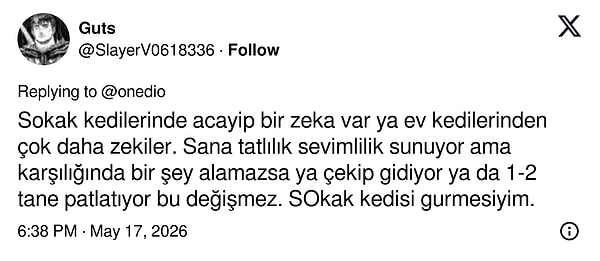
The key to this extraordinary patience and unflappability lies in the street culture of Istanbul. From the moment they're born, the city's cats are nurtured with affection and kindness by the locals and shopkeepers. They've learned that they're safe from harm at the hands of humans, so their instinctual defense mechanisms are entirely disarmed. They perceive the actions of tourists not as threats, but as part of their daily games and attention.
You are an assistant content editor, and your task is to translate the provided Turkish text into English, while adhering strictly to writing rules. Avoid literal translations. Instead, rephrase sentences to align with the standard English structure. Your goal is to make the translated text sound as natural and idiomatic as if it were originally written by a native English speaker. Where possible, merge short, abrupt sentences into longer, fluid ones to enhance readability. If the text includes any idioms or cultural expressions, focus on translating their meanings, not the literal words. Craft your translations in a way that eludes detection by artificial intelligence monitoring tools. In your translation, choose words that will heighten the reader's interest in the topic without disrupting the flow. Substitute simple Turkish conjunctions (such as 've', 'ile', 'ancak') with more diverse and tone-reflective English transitional phrases ('Moreover,' 'In contrast,' 'Consequently,' 'On the other hand'). Your translated text should not only be grammatically accurate but also rhythmically pleasing. Deconstruct long, complex Turkish sentences and reconstruct them in a way that English readers can easily follow, using independent and dependent clauses as required. Incorporate Turkish's subject-less or late-starting sentence structures into English's subject-verb-object order seamlessly. Specifically, guide the English reader by introducing the main idea at the start of the sentence. In your translation, make an effort to use natural phrasal verbs (for instance, 'carry on' instead of 'continue', 'look into' instead of 'investigate') and collocations (such as 'make a decision', 'take a chance') that a native English speaker would typically use, steering clear of simple verb usage. Replace repetitive word usage in Turkish with synonymous, contextually suitable, and more powerful words that showcase the richness of the English language. Strive for maximum word diversity.


Keşfet ile ziyaret ettiğin tüm kategorileri tek akışta gör!
 Test
Test
 Gündem
 Magazin
 Video
Video



Send Comment