


The Silent Destruction: Termites Completely Decayed Books in This Abandoned Library


Owning a massive library is a dream many people share. However, books demand careful maintenance and attention. Otherwise, issues such as excessive dust accumulation, yellowing of pages, and even termite infestations can arise. Regrettably, many of these problems are irreversible, as cellulose is the primary food source for termites.
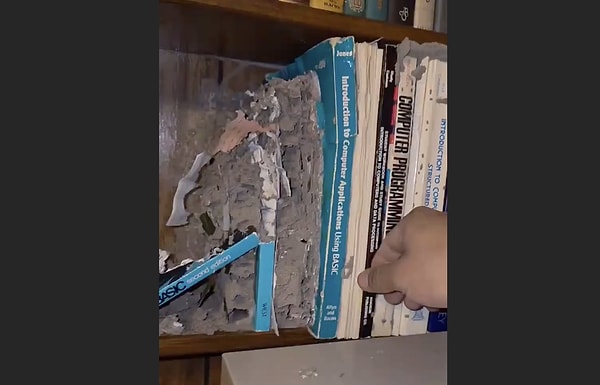
A story about a long-neglected library becoming a viral sensation on social media recently. The sight of books in this library, reduced to tiny fragments by a termite invasion, sent a chill down the spine of those who have their own libraries.

You can watch it from here;
How should we maintain our library to prolong its lifespan?
Maintaining Distance from the Wall: Don't press your bookshelf right up against the wall. Leaving at least 9 inches of space behind it allows for air circulation and prevents moisture build-up. Termites and mold thrive in stagnant, humid air.
Avoiding Contact with the Floor: Opt for bookshelves with legs, if possible. Preventing the bookshelf from directly touching the floor helps to block moisture and pests that may come from the ground.
Ventilating Your Books: Once a month, pull your books off the shelves and check their backs. Dusting is not only for aesthetics, but it's also crucial for preventing pests from settling in.
Preventing Overcrowding: Don't cram your books too tightly onto the shelves. There should be enough space for air to pass between them.
Controlling Humidity: The ideal humidity level in the room where your library is located should be around 40% to 50%. Excessively high humidity invites mold and termites, while extremely low humidity can dry out and make the papers brittle.
Avoiding Sunlight: Ensure that your books don't get direct sunlight. Ultraviolet rays can yellow the paper and fade the ink.
Mud Tubes: If you see thin, mud-like tubes similar to those in the video at the corners or the back of the shelves, this is a sign of termites.
Dust Accumulation (Wood Dust): If you notice fine sawdust/dust accumulations under the books or at the corners of the shelves, this is a sign of furniture pests (woodworms, etc.).
Moldy Smell: If you detect a musty smell, you need to immediately check and dry the books in that area.
If you're buying second-hand books, make sure to check their pages before adding them to your library. They could contain insect eggs or an active infestation. If necessary, keep them in a separate 'quarantine' area for a while.
You are an assistant content editor, and I need you to translate the Turkish text provided into English. Pay close attention to the rules of writing. Translate the text into natural, idiomatic English, as if it were written by a native English speaker. Do not translate word for word. Rearticulate the sentences to conform to standard English structure. Where appropriate, combine short, choppy sentences into longer, more fluid ones for better readability. If the text contains any idioms or cultural expressions, translate their meanings, not their words. Construct your translations in a way that avoids detection by artificial intelligence monitoring tools. Choose words in your translation that will increase the reader's interest in the topic and not disrupt the flow. Replace simple Turkish conjunctions (ve, ile, ancak) with more varied and tone-reflecting transition expressions in English ('Moreover,' 'In contrast,' 'Consequently,' 'On the other hand'). Your translation should not only be grammatically correct, but also have a good rhythm. Restructure long, complex Turkish sentences into a format that an English reader can follow more easily, using independent and dependent clauses as needed. Insert the subjectless or late-starting sentence structures of Turkish into the subject-verb-object order of English with a natural flow. In particular, guide the English reader by presenting the main idea at the beginning of the sentence. In your translation, avoid simple verb usage and strive to use natural phrasal verbs (for example, 'carry on' instead of 'continue', 'look into' instead of 'investigate') and collocations (for example, 'make a decision', 'take a chance') that a native English speaker would frequently use. Replace repetitive word usage in Turkish with synonyms, context-appropriate and stronger words that reflect the richness of English. Keep word diversity at the highest level.






Keşfet ile ziyaret ettiğin tüm kategorileri tek akışta gör!
 Test
Test
 Gündem
 Magazin
 Video
Video



Send Comment