


Einstein's "Biggest Blunder" Questioned: New Cosmological Data Could Rewrite the Fate of Universe


The cosmological constant, which Einstein once abandoned, came back into the agenda with the understanding that the universe is expanding at an accelerating rate. New observations, however, have raised an even bigger question: Is dark energy really constant, or does it change over time as the universe expands?
Here are the details.

How Did The Idea Einstein Abandoned Return?
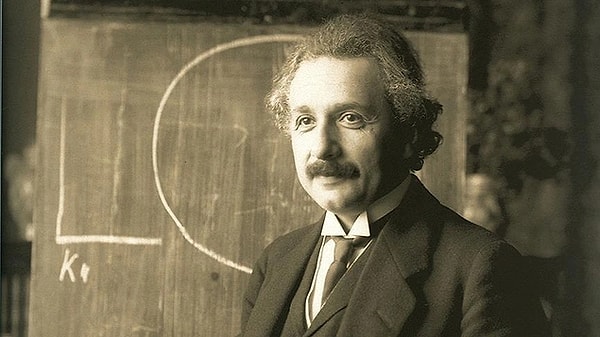
Einstein added Lambda, known as the 'cosmological constant,' to the General Relativity equations in 1917, during a period when the universe was believed to be static. This term was thought to be a mechanism that would keep the universe stable by balancing the inward pull of gravity.
However, with the understanding that the universe was expanding, the need for this idea disappeared. At this point, the rumor that Einstein described the cosmological constant as his 'biggest mistake' comes to mind. However, there is no definitive record of this statement in Einstein's own written documents; the expression is based on the later narration of physicist George Gamow.
The real surprise came years later.
In the late 1990s, two research teams studying distant supernovae revealed that the expansion of the universe was accelerating, not slowing down. This discovery brought the cosmological constant back into importance and made it one of the fundamental elements of the standard cosmology model used today.
Now The Same Idea Is Being Questioned Once Again
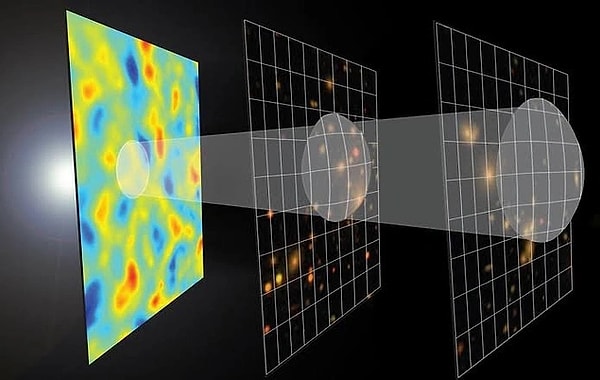
In today's standard model, dark energy is considered as the cosmological constant. In other words, it is assumed that the density of dark energy does not change over time.
However, new observations are challenging this assumption.
The six-year data from the Dark Energy Survey (DES) were examined along with different measurements such as supernovae, galaxy clustering, baryon acoustic oscillations, and weak gravitational lensing. The results pointed out that a model of dark energy that changes over time could better match the data.
The deviation from the cosmological constant in only DES data remained at the 2.2 sigma level. When DESI data and other cosmological measurements were added, this difference rose to approximately the 3 sigma level.
Although this is a quite interesting result, it does not yet mean a definitive discovery. In physics, a new discovery is generally sought at the 5 sigma level.
Can the Future of the Universe Change?
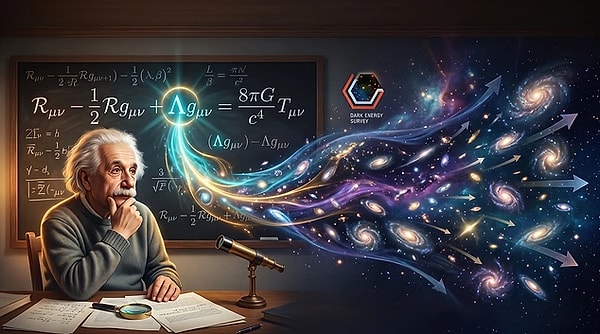
So what does all this mean? If dark energy is indeed not constant, the current model explaining the expansion story of the universe may need to be reconsidered.
Because how dark energy changes over time also affects how the universe will expand in the future. This situation could lead to the investigation of a new physical field, an unknown interaction, or a deficiency not yet noticed in the theory of gravitation.
However, scientists are not yet saying 'the ΛCDM model has collapsed'. For now, there is only a striking sign challenging the standard model.
In the coming years, next-generation observations such as DESI, Vera C. Rubin Observatory, Euclid, and Nancy Grace Roman Space Telescope may determine the direction of this debate.
If the same signs are confirmed with independent observations, one of the most fundamental assumptions of cosmology may have to be rewritten.
Keşfet ile ziyaret ettiğin tüm kategorileri tek akışta gör!
 Test
Test
 Gündem
 Magazin
 Video
Video
Read More






Send Comment