


No Wings, Still Airborne: 13 Surprising Animals That Glide And Leap Through The Air


Some animals have no wings and still travel many metres through the air. Some shoot out of the water like a rocket, some jump from a treetop and turn their body into a parachute, and some flatten themselves and ripple through the air like a ribbon.
What they have in common is that none of them developed the skill for fun. They use it to escape, to hunt, or to move through the forest without wasting energy.


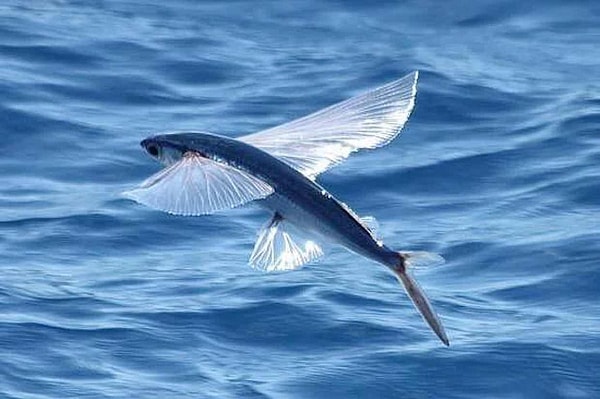
The flying fish gets its lift-off from its tail.
1. Flying Fish
Underwater, a flying fish beats its tail fin dozens of times a second to build speed, then spreads its pectoral fins wide the moment it breaks the surface. The lower lobe of the tail is long, so it can dip back into the water mid-glide and give the fish a fresh push. That is why one jump can turn into a long chain of glides.
The longest recorded flights have lasted more than 40 seconds. The goal is to get away from fast hunters such as tuna, mahi-mahi and swordfish. When a light is shone from a boat at night, some of them land on deck. Barbados is still closely associated with the flying fish, which shows how much the animal matters to that region.
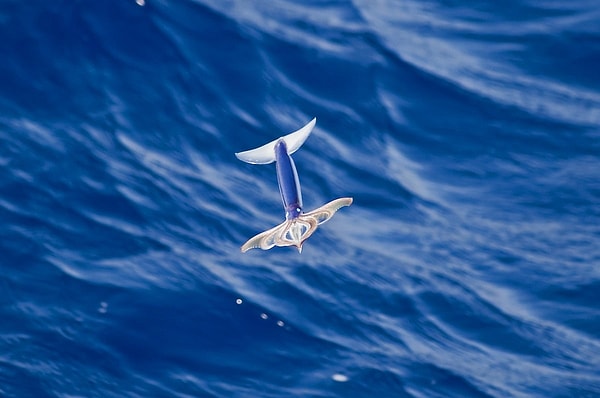
The flying squid runs on jet propulsion.
2. Flying Squid
A flying squid moves by squirting water out of the funnel in its body, so its engine is a kind of jet. That thrust lifts it above the water, where it fans out its arms, uses its fins like wings and can glide for about 30 metres. It travels the opposite way to a flying fish: the tail end of the body goes first.
There is footage of several hundred squid launching out of the water at the same time. Scientists interpret the behaviour both as a way to escape predators and as a way to pick up speed by getting free of the water's drag. Very few invertebrates can glide through the air, which is why this one draws so much interest from biologists.
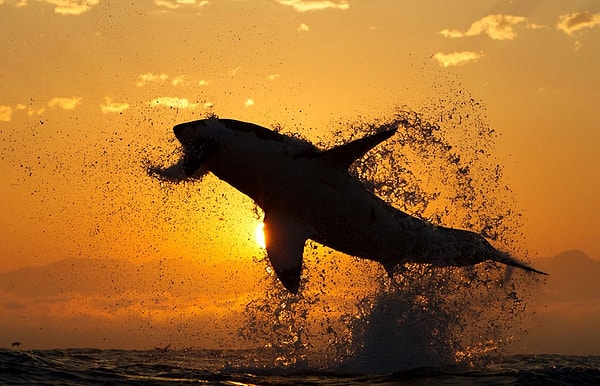
Some sharks and rays burst clear of the surface.
3. Leaping Sharks
Some sharks, the spinner shark in particular, leave the water while they hunt. The spinner shark swims up at high speed from beneath a school of sardines, spins through the fish and shoots into the air with its catch. The leap reaches about 3 metres.
The spinning keeps the shark balanced and helps it hold on to its prey. It can rotate three or four times on its own axis during a single jump. Divers and fishermen who have seen it during the sardine run off South Africa describe it as one of the most impressive hunting scenes in nature.
4. Leaping Rays
Eagle rays use their broad, wing-like pectoral fins much as a bird uses its wings, so they appear to fly through the water. From time to time they also break the surface and rise into the air. Why they jump is not fully understood. Escaping a predator, shaking off parasites and sending a social signal are among the explanations.
The spotted eagle ray, which lives in tropical waters, can weigh more than 200 kilograms. A large ray landing in a boat is therefore a real danger. Such incidents are extremely rare, but marine biologists urge boat drivers to slow down in areas where rays gather.
In the forest canopy, frogs, reptiles, ants and mammals all take to the air.
5. Wallace's Flying Frog
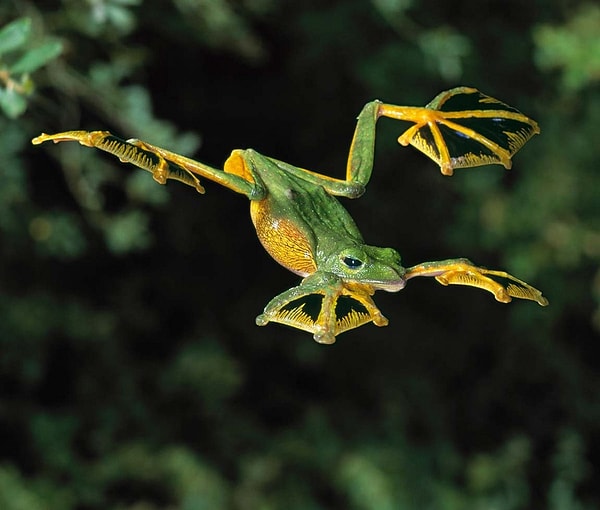
This frog is named after the naturalist Alfred Russel Wallace, who was surprised when he first saw it in Borneo and recorded it as a flying frog. The toes on all four legs are joined by huge webs. When the frog jumps and spreads them, it gains four extra surfaces and can travel through the air. It lives in the treetops, steers in mid-air and grips its target branch with sticky toe pads. Its glides reach 15 metres.
6. Flying Snake
Before it jumps, a flying snake goes to the end of a branch, lets its body hang down in a J shape and launches itself. In the air it spreads its ribs to flatten its body into a ribbon and keeps its balance by undulating. These snakes live in the forests of Southeast Asia and India and can glide for tens of metres. Their mild venom is enough for lizards, frogs and rodents and does no serious harm to people. Because they can change direction while gliding, researchers use the movement as a model in robotics.
7. Draco Lizard
The wings of Draco lizards are made of rib bones. The long ribs normally lie against the body, then swing out during a jump so that the skin between them stretches like a wing. The tail and a small flap under the throat help with steering and balance. These Southeast Asian lizards can cover about 60 metres and land right on the target trunk. Males use the orange-yellow throat pouch to show off to rivals and females.
8. Parachute Gecko
The skin flaps along this gecko's sides, tail and legs erase its shadow when it presses against tree bark, so it is almost impossible to spot. When danger approaches, the same flaps open and catch the air like a parachute, and the webbing between its toes does the same job. It lives in Southeast Asian forests, is active at night, feeds on insects and measures about 15 to 20 centimetres. Collection from the wild for the exotic pet trade puts some local populations at risk.
9. Gliding Ants
Some tree ants in Peru's rainforests change direction in mid-air when they fall instead of hitting the ground. In this behaviour, first described in 2005, the ant steers with its hind legs and body and slides toward the tree trunk, often landing back on the trunk it came from. Predators and rival colonies wait on the forest floor, so an ant that does not return has little chance of survival. Because the animal has no wings, the movement is described as a controlled fall.
10. Colugo
The colugo's skin membrane is one of the widest among mammals. It runs from the neck to the fingertips and on to the tip of the tail, and it covers the webbing between the fingers too. Colugos live in Southeast Asia and can travel more than 70 metres in a single glide while spending very little energy, a big advantage for an animal that eats leaves. Although it is also called the flying lemur, it is not related to lemurs. It is counted among the closest relatives of primates.
11. Flying Squirrel
Before jumping, a flying squirrel moves its head from side to side to judge the distance and angle to its target. Then it spreads its legs, stretches its membrane and uses its tail as a rudder. Large species cover distances of up to 90 metres. There are more than 50 species, and most are active at night, which is why people rarely see them. It was recently discovered that some species glow pink under ultraviolet light.
12. Sugar Glider
This small animal is a marsupial, like kangaroos. It is not related to squirrels and only developed a similar body because of a similar way of life. With the membrane between its front and hind legs it can glide up to 50 metres. It lives in the forests of Australia, New Guinea and Indonesia, weighs about 100 to 150 grams and feeds on sweet foods such as acacia sap and nectar, which is where the name comes from. It usually lives in groups of 7 to 10.
13. Flying Fox
This is the only true flier on the list. The flying fox is a giant relative of bats, with a wingspan of more than 1.5 metres in some species. Unlike small bats, it does not hunt insects by echolocation. It looks for ripe fruit with its strong eyes and nose and flies tens of kilometres in a night to find fruit trees. By carrying seeds over long distances and pollinating flowers, flying foxes play a big part in renewing the forests they live in. On some islands they are endangered because of hunting and habitat loss.
Keşfet ile ziyaret ettiğin tüm kategorileri tek akışta gör!
 Test
 Gündem
 Magazin
 Video



Send Comment