


China Approves World's Longest Undersea Tunnel to Connect Two Major Cities


China has officially embarked on one of the world's most ambitious infrastructure projects, pushing the boundaries of engineering. The project, a 120-kilometer undersea tunnel that will connect two giant industrial cities by passing beneath the Bohai Strait, received approval from the Chinese government. With a colossal investment of approximately 28 billion dollars, the project, once completed, will overturn all existing world records.

At present, passengers and logistics companies wishing to cross the Bohai Strait are faced with the daunting task of enduring a grueling journey that lasts between 6 to 8 hours, either by ferry or overland.

With the new tunnel project, high-speed trains capable of reaching speeds of 240 km per hour will reduce this distance to just 40 minutes. This speed will even surpass that of the famous Eurostar trains (160 km/h) that utilize the Channel Tunnel.
Approximately 90 kilometers of the tunnel's total length of 120 kilometers will run underwater. This ratio will indisputably crown the project as the world's longest submarine tunnel.
When juxtaposed with the current record holders, the magnitude of the project becomes more discernible:
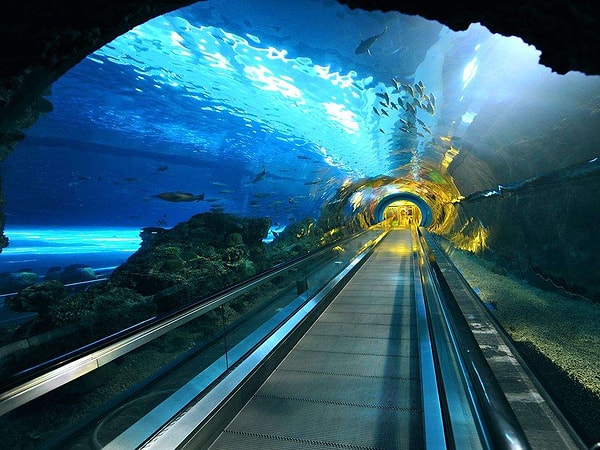
The Channel Tunnel (UK-France): Total length of 49.6 km
The Seikan Tunnel (Japan): Total length of 83.85 km (with 23.3 km under the sea)
The Bohai Strait Tunnel: Total length exceeding 120 km (with 90 km under the sea)
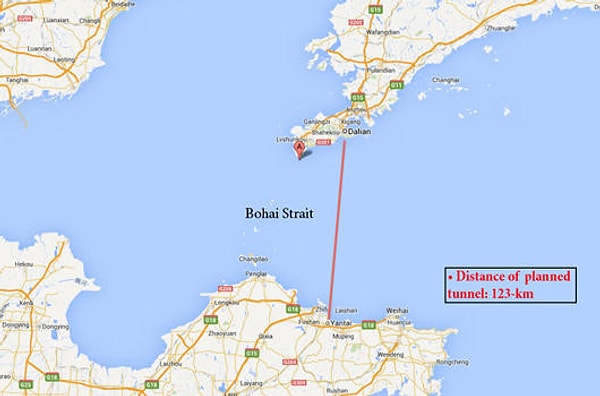
The tunnel is set to connect Dalian, a significant financial and logistics hub, with Yantai, a city renowned for its petrochemical, automotive, and advanced technology industries. This strategic move will not only alleviate the burden on the railway networks surrounding Beijing and Tianjin, but it will also integrate the industrial regions in the northeast with the economic centers in the south.
One of the most formidable challenges facing the project is that the route is situated atop one of the world's most seismically active fault lines.

Chinese engineers are equipping the tunnel with advanced sensors, waterproof compartments, and specialized technologies resistant to earthquakes, all in an effort to prevent potential disasters. Moreover, within this colossal structure stretching 123 kilometers, they plan to construct advanced longitudinal ventilation shafts to maintain air quality. On top of that, hundreds of shelters will be built to provide refuge in case of emergencies such as fires or floods.
In the Western world, similar projects can be delayed for decades due to environmental studies and political disputes.
For instance, while a mere 3-kilometer bridge project planned to be built over the Strait of Messina in Italy is still on the drawing board, China has long since commenced excavation works for a tunnel project roughly 40 times larger, having resolved the funding issues.
This mega project, which is expected to span between 10 to 15 years in construction, anticipates the passage of its first train towards the end of the 2030s.
Keşfet ile ziyaret ettiğin tüm kategorileri tek akışta gör!
 Test
Test
 Gündem
 Magazin
 Video
Video



Send Comment