


Fuel-Free Starwisp Probe Aiming to Fly Non-Stop for 21 Years at 60,000 KM/S


The 'Starwisp' project, proposed by scientist Robert L. Forward, is shattering norms in interstellar travel with its fuel-less propulsion and ultra-light structure. The net sail, weighing only 20 grams and spanning a kilometer, aims to reach the neighboring star system Alpha Centauri in 21.5 years by accelerating to a speed of 60,000 kilometers per second using microwave energy.

The necessity for traditional rockets to carry tons of heavy fuel has been seen as the biggest obstacle in the way of interstellar explorations.
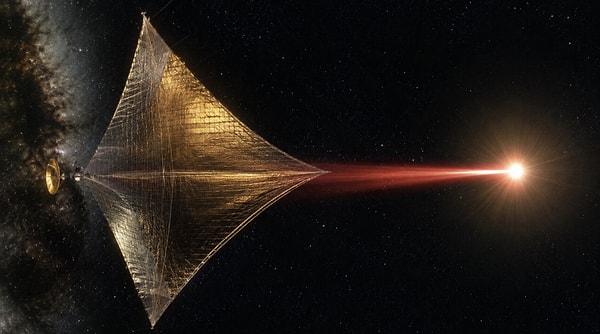
The 'Starwisp' concept, published by physicist Robert L. Forward in the Journal of Spacecraft and Rockets, completely revolutionized the conventional approach by extracting energy from within the spacecraft and storing it in the Solar System. The project, which is based on a directed energy propulsion system, aims to make it possible to reach another star system within a human lifetime.
The most radical aspect of Starwisp is its design that takes lightness to an extreme. The spacecraft, stripped of fuel tanks and heavy engines, was designed as a sail made of ultra-thin aluminum wires spanning one kilometer. While the mass of the net is calculated as 16 grams, microcircuits and sensors placed at the intersection points of the wires add another 4 grams, bringing the total mass to only 20 grams. This extensive network structure also serves as an antenna, camera, computer, and sensor array, effectively taking on the role of a standalone scientific laboratory.
The system is envisioned to operate with a 10 Gigawatt (GW) microwave source to be placed in the Solar System, coupled with a colossal Fresnel lens approximately four times the diameter of Earth (50,000 km).
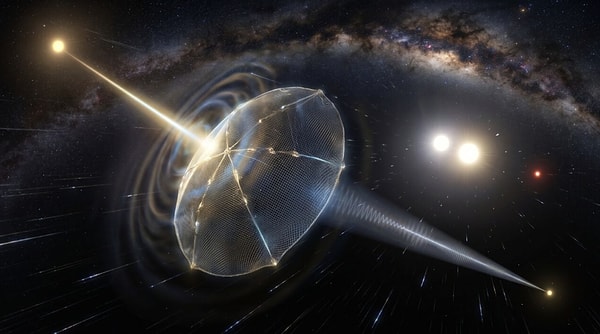
By applying microwave radiation to its sail, the spacecraft accelerates at a rate 115 times that of gravity. After approximately a week of thrust, Starwisp reaches 20% of the speed of light (60,000 km per second) and takes 21.5 years to reach the Alpha Centauri system, which is 4.3 light years away.
Lacking any mechanism to stop or slow down in deep space, Starwisp passes through the target system at an extremely high speed. It covers the examination area of 60 astronomical units in about 40 hours. The spacecraft then flings back the infrared, ultraviolet, and visible light data it has collected to Earth, using the microwave radiation sent from the Solar System like a phased antenna. When the data reaches Earth, the total mission duration extends to 25.8 years.
The concept, which has been examined in technical reports by NASA and the European Space Agency (ESA), was reassessed by Geoffrey A. Landis due to the risk of aluminum melting at high temperatures. Landis proposed a carbon fiber mesh as a potential solution.
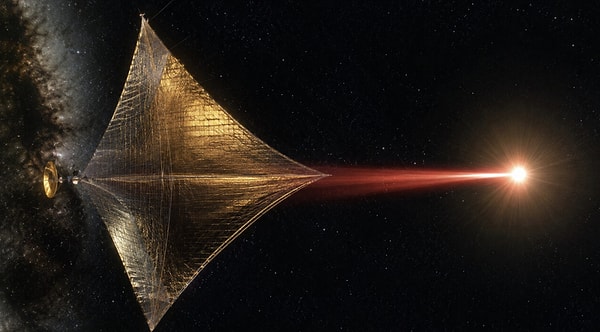
Although Starwisp presents a paradox of pitting a pocket-sized spacecraft against planetary-scale launch infrastructures, it is considered one of the most crucial engineering calculations theoretically enabling interstellar travel.
Keşfet ile ziyaret ettiğin tüm kategorileri tek akışta gör!
 Test
Test
 Gündem
 Magazin
 Video
Video



Send Comment