


From Highway to Oasis: How Seoul Replaced 170,000 Cars a Day With a Eco-Friendly River


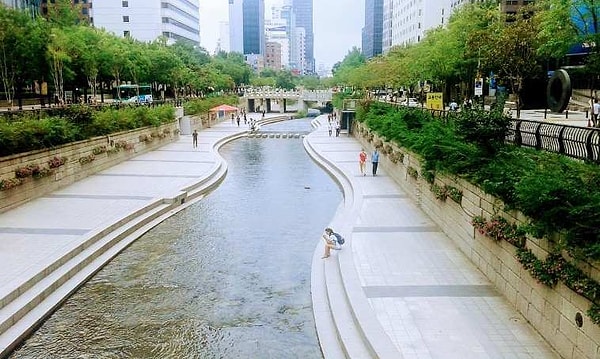
In the early 2000s, Seoul, the capital of South Korea, made one of the most radical decisions in the history of modern urban planning. A massive elevated highway that carried the burden of approximately 170,000 vehicles daily and ran through the heart of the city was replaced with a 5.8-kilometer linear park and an artificially fed stream. Despite ongoing debates over artificial ecosystems, the 'Cheonggyecheon Restoration Project' is today recognized as a major benchmark in global urban transformation.

At the onset of the 21st century, urban planners in Seoul were confronted with a pivotal question: Should a city be governed by cars or by people?
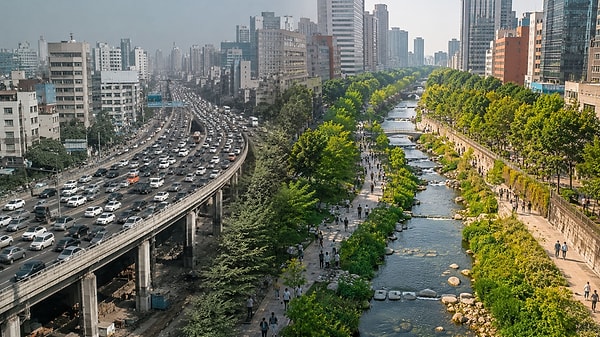
During the era of the Joseon Dynasty, the historic Cheonggyecheon stream, where women used to wash laundry on stone bridges and daily life unfolded, had become a cancerous blight on the city due to the population explosion, slumification, and environmental pollution following the Korean War. The solution found by the authorities of the time was to completely cover the stream with concrete. The massive highway, constructed between 1958 and 1978, was seen as a symbol of South Korea's economic miracle and progress for decades.
However, by the late 1990s, this symbol had transformed into a burdensome chokehold on Seoul's throat. The concrete blocks were trapping heat, air pollution was stifling breath, and the cost of repairing the aging highway structure was skyrocketing.
The figurehead behind the project was none other than Seoul Mayor Lee Myung-bak, a former CEO who, in a twist of fate, had spent nearly 30 years of his life constructing concrete, roads, and bridges for the Hyundai group.
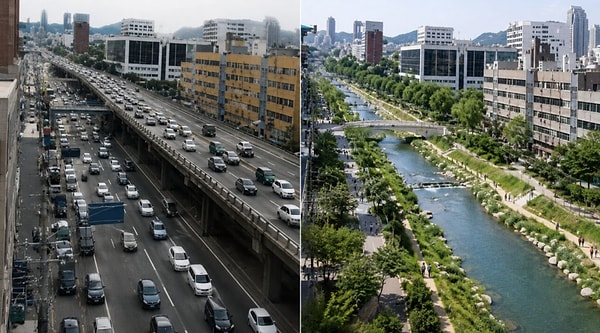
Emerging from a past that symbolized the industrialization of the country, Lee made one of the boldest urban decisions in Asia as soon as he took office: The highway would be demolished, and the stream would be restored. Lee, who marketed the project to the world as a flood discharge channel and a sustainable development initiative, would later sit in the Presidential seat of South Korea following this success.
The demolition that began in July 2003 transformed Seoul's busiest financial center into a massive construction site. City planners likened this operation, carried out amidst decades of accumulated electrical, water, sewage, and telecommunication networks, to 'performing heart surgery on a living body'.
Following 27 months of rigorous efforts:
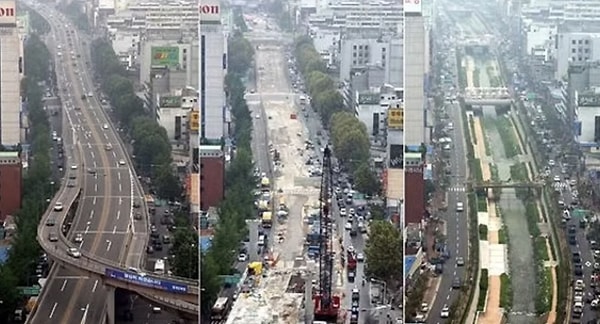
Over 680,000 tons of concrete and steel were dismantled (This amount is equivalent to the dismantling of dozens of skyscrapers in a financial center).
A budget of $281 million was expended.
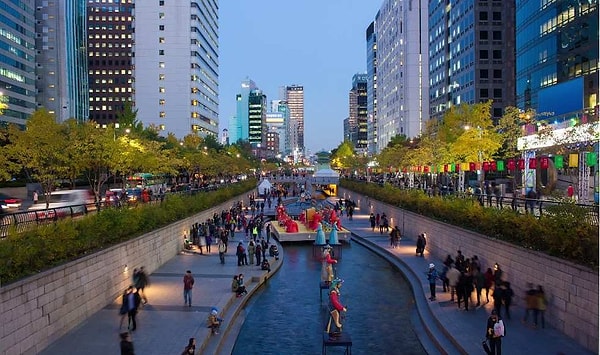
On October 1, 2005, a 5.8-kilometer water corridor, featuring 22 bridges and pedestrian paths on both sides, was opened to public use.
The technical reality behind the stories told about Cheonggyecheon is quite astonishing: This is not a naturally flowing river. Since its original basin has been completely urbanized, the stream is entirely dependent on artificial water pumping to sustain its existence.
In order to maintain a constant flow, 120,000 tons of water are pumped daily from the Han River, its tributaries, and the underground water drainage systems of subway lines, and the water depth is kept at a constant 40 centimeters. The city spends millions of dollars annually to maintain this flow. Academic circles emphasize that the project is more of a colossal urban garden designed with modern engineering, rather than an ecological restoration.
Despite being artificially supported, the project demonstrated that every penny spent was worth it, given the tangible benefits it brought to the environment and quality of life.
According to data from the Seoul Institute:
Biodiversity around the creek skyrocketed by 639% between 2003 and 2008.
Plant species leaped from 62 to 308, insect species surged from 15 to 192, and fish species climbed from 4 to 25. Herons and dragonflies, long unseen, made a comeback to the heart of the city.
With the removal of the concrete highway, air circulation improved and the level of nitrogen dioxide in the area dropped by 35%.
Most significantly, the creek and green spaces broke the urban heat island effect, making the surrounding streets 3.5 °C cooler than neighboring concrete areas.
At the outset of the project, local shopkeepers were apprehensive about losing customers, while engineers feared the city would come to a standstill.
However, as Seoul's administration was demolishing the highway, it simultaneously revolutionized public transportation; it expanded special bus lanes and renovated the subway system.
In urban planning literature, the phenomenon known as 'traffic evaporation' (the reduction in traffic when a road is removed as drivers change their habits) was experienced firsthand in Seoul. Between the years 2003 and 2008, bus passengers increased by 15.1%, and subway users by 3.3%. Today, the mechanical noise of hastily passing vehicles has been replaced by human voices: An average of 64,000 people visit Cheonggyecheon daily to walk, relax, and breathe.
This bold step taken by Seoul was deemed worthy of the Veronica Rudge Green Urban Design Award given by Harvard University, and it skyrocketed real estate values in the area. More importantly, it sparked a global trend known as 'daylighting,' which involves reopening covered rivers.
Keşfet ile ziyaret ettiğin tüm kategorileri tek akışta gör!
 Test
Test
 Gündem
 Magazin
 Video
Video



Send Comment