


Decomposed and Stacked: Archaeologists Open Ancient Jar to Find Grim Surprise


Archaeologists excavating in the 'Plain of Jars' in Laos, one of Southeast Asia's greatest mysteries, were met with a horrifying sight when they lifted the lid off a massive stone jar. Stacked one on top of the other, the giant 'death jar' contained the bones of no less than 37 individuals.

The mountainous plateaus of Laos, harboring mysteries that have remained unsolved for centuries, serve as the backdrop for one of the most chilling and enigmatic discoveries in human history.
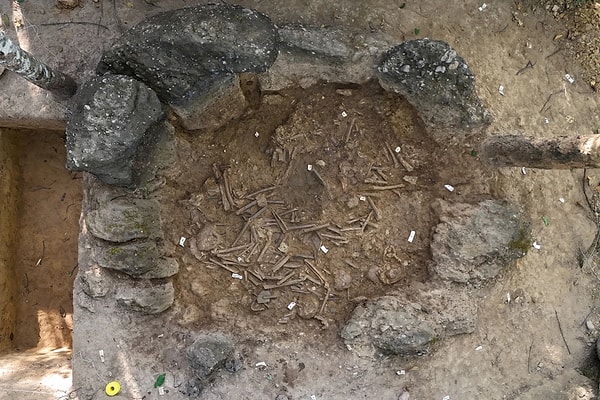
Under the guidance of Dr. Nicholas Skopal from James Cook University and Souilya Bounxayhip, a specialist in Laotian cultural heritage, a research team made a groundbreaking discovery in a region scattered with ancient stone jars weighing tons. The study, published in the journal Antiquity, announced to the world the unprecedented discovery of an intact stone jar, filled entirely with human remains for the first time in history.
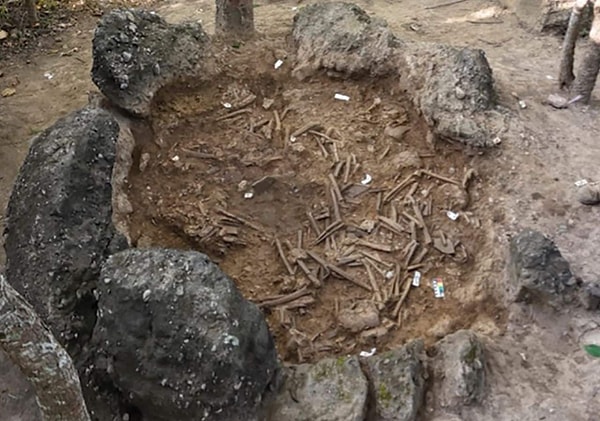
When archaeologists began to excavate a colossal stone vessel with unusually thick walls, standing at 1.3 meters high and spanning over 2 meters wide, they were met with a veritable labyrinth of bones within.
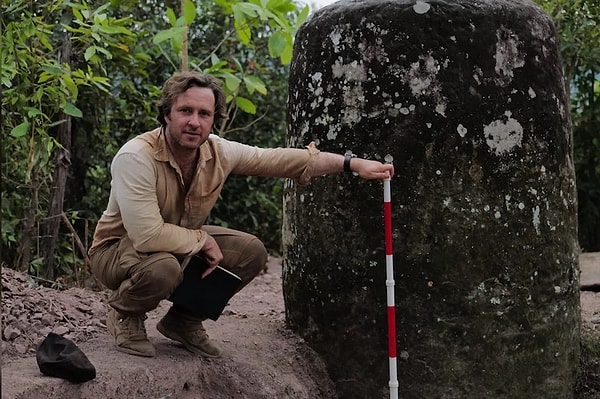
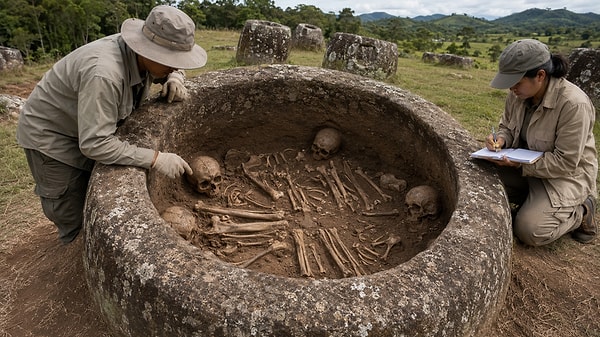
The arrangement of bones inside the cube left scientists in utter shock:
Skulls had been meticulously lined up along the outer perimeter of the cube.
Meanwhile, arm and leg bones were amassed in a colossal pile right at the heart of the vessel.
Experts unravelled the chilling secret behind this arrangement: This cube was not a place where people were directly buried after death. In this savage and mystical tradition known as 'secondary burial ritual', bodies were initially left to decompose elsewhere. Subsequently, bones that were completely stripped of flesh were selected and stacked inside this massive death cube.
The scientific community had been under the impression that these colossal stone jars were in use and subsequently abandoned during the Iron Age, specifically between 500 BC and 500 AD.
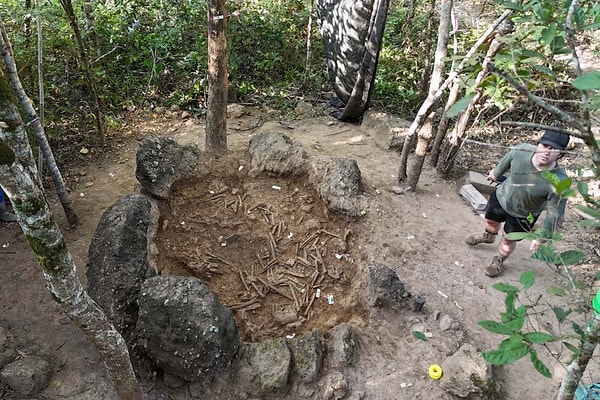
However, radiocarbon dating tests conducted on the teeth extracted from the cube revealed a significant surprise.
It was determined that the bones in the cube dated back to between AD 890 and 1160, approximately 1,200 years ago from today. Moreover, these 37 individuals did not die at the same time. The cube had been repeatedly opened and new bones were placed inside over a period of about 270 years. It was used like a 'memorial shrine' that was passed down from generation to generation by the same tribe or extended family groups.
Archaeologist Anna Pineda summarized the importance of the discovery in these words: 'Until now, the function of these cubes was merely a guess. Finding undisturbed human bones in situ for the first time conclusively proved that these vessels were used for secondary funeral rituals.'
The discovery illuminated not only the terrifying burial customs, but also the hidden map of the ancient world.
Among the remnants, a profusion of vibrant glass beads was discovered. Chemical analyses indicated that these beads originated from South India and Mesopotamia.
Thanks to these beads, it was proven that the ancient communities in the untouched mountain highlands of Laos were connected to the massive international trade networks supported by the Song Dynasty in China and the Khmer Empire in Cambodia during that era.
Archaeologists are now rolling up their sleeves for the next phase of the project, which involves Ancient DNA analyses.
Once these analyses are concluded, the biological kinship ties among the 37 individuals inside the cube, as well as their precise racial affiliations, will be unveiled.
Keşfet ile ziyaret ettiğin tüm kategorileri tek akışta gör!
 Test
Test
 Gündem
 Magazin
 Video
Video



Send Comment