


Don't Try This at Home: Man Uses Lighter to Remove Attached Tick and Stuns Viewers


One of the biggest nightmares for nature enthusiasts is undoubtedly encountering an uninvited guest on their body when they return home. Even if we tread carefully in forested, grassy, and bushy areas, it may not always be enough. Tucking trouser legs into socks or dressing in closed clothing often works for protection, but sometimes a single overlooked spot can render all efforts futile. It is critically important not only to prevent tick attachment but also to handle it correctly afterwards.
A video shared on social media created astonishment with an unusual and dangerous method applied by a man, along with his friends, to remove a tick attached to his leg. In the footage shot in a forested area, the man was seen using a lighter to get the tick off his leg. Those who watched the video could not make sense of the method used at all.

You can watch it from here;
Acting on hearsay when encountering a tick attachment in nature can lead to irreversible health problems!
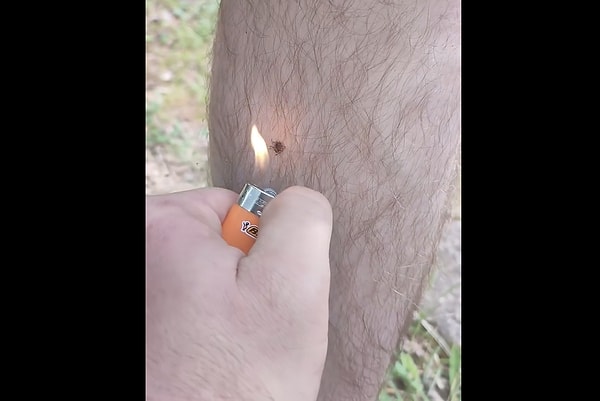
It is commonly believed among the public that methods such as holding a lighter to a tick, pressing a cigarette against it, pouring alcohol or cologne, or rubbing it with a soapy cloth will force the tick to let go on its own. However, medical experts unanimously agree that such interventions based on heat and chemicals should absolutely not be performed. Ticks develop a defense mechanism when they are exposed to heat or feel the threat of suffocation. During this stress moment, the creature involuntarily regurgitates all the fluid in its stomach, which harbors deadly viruses, back into the body of the host from which it has drawn blood. Deadly diseases like Crimean-Congo Hemorrhagic Fever, which are prevalent in our country and around the world, are transmitted precisely when the tick injects this virus-laden fluid into the bloodstream during this stress moment.
Another misconception is the attempt to remove the tick by twisting or crushing it. The breaking off of the tick's head or the fragmentation of its body accelerates the spread of the virus. The only thing that needs to be done for a safe evacuation is to grasp the tick from the closest point to the skin, i.e. its head, with a pair of fine-tipped tweezers and pull it out in one move at a right angle, without crushing it. If there is a health institution nearby, it would be the best option to have this intervention performed by a specialist physician.
Keşfet ile ziyaret ettiğin tüm kategorileri tek akışta gör!
 Test
Test
 Gündem
 Magazin
 Video
Video



Send Comment