


Breathtaking Underwater Views: Massive School of Fish Creates Visual Feast in Fethiye


As summer approaches, we all find ourselves longing for the tranquility of the seaside and the refreshing embrace of the ocean. However, when we finally manage to escape the hectic city life and retreat to the coast, we often overlook the entirely different world that lies beneath the water's surface. Muğla, a slice of paradise in Turkey, never fails to amaze its thousands of local and international visitors each year, not only with its islands and bays, but also with the vibrant marine life it harbors. Swimming in waters so crystal clear they could be mistaken for an aquarium is a joy in itself. Yet, the vast biodiversity hidden beneath these waters elevates this experience to an unforgettable level.
A content creator who goes by the name 'sezeryilmazzzzz', while vacationing in the bays of Fethiye, shared an awe-inspiring view from beneath the sea. While some were captivated by this underwater spectacle, others found it somewhat disconcerting.

You can watch it from here;
So, why would a school of fish be spotted so close to the shore?
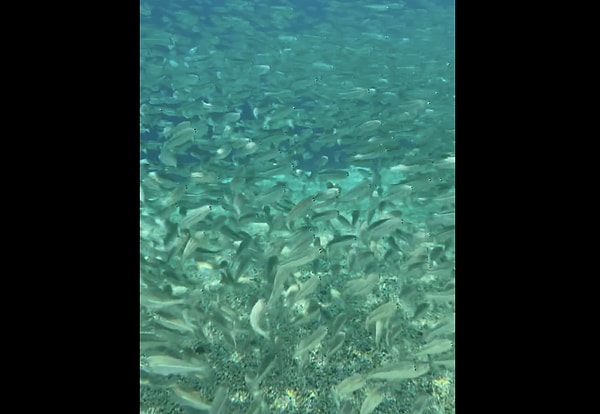
It's quite commonplace, and indeed natural, to see large schools of fish, particularly juveniles of species like silverfish, anchovies, sardines or mullets, in shallow waters and even near the shore. Larger predatory fish such as bonito, bass, grouper or bluefish, when they corner these smaller fish in the open sea, cause the latter to flee towards the shallow waters and shores where the larger fish struggle to maneuver. Moreover, coastal strips, river mouths, and sheltered bays are rich in plankton and organic matter, which are the favorite food of these smaller fish. They approach the shore collectively to feed. Particularly, calm bays and inner harbors, away from the waves, serve as natural refuges for these small fish. Moving together significantly reduces their risk of being preyed upon individually.
You're an assistant content editor, and I'd like you to translate the given Turkish text into English, paying careful attention to writing rules. Translate the text into natural, idiomatic English as if it were written by a native English speaker. Don't translate word for word. Rewrite sentences to fit the standard English structure. Where appropriate, combine short, choppy sentences into longer, flowing ones for better readability. If the text includes any idioms or cultural expressions, translate their meanings, not the words themselves. Craft your translations in a way that avoids detection by artificial intelligence monitoring tools. In your translation, choose words that will increase the reader's interest in the subject without disrupting the flow. Replace simple Turkish conjunctions (ve, ile, ancak) with more varied and tone-reflecting English transitional phrases ('Moreover,' 'In contrast,' 'Consequently,' 'On the other hand'). Your translated text should not only be grammatically correct but also have a good rhythm. Restructure long, complex Turkish sentences so that English readers can follow them more easily, using independent and dependent clauses as needed. Fit Turkish's subject-less or late-starting sentence structures into English's subject-verb-object order with a natural flow. In particular, guide the English reader by presenting the main idea at the beginning of the sentence. In the translation, avoid using simple verb forms and strive to use natural phrasal verbs (for example, 'carry on' instead of 'continue', 'look into' instead of 'investigate') and collocations (for example, 'make a decision', 'take a chance') that a native English speaker would frequently use. Replace repeated word usage in Turkish with synonymous, context-appropriate, and stronger words that reflect the richness of English. Maintain the highest level of word diversity. Only deliver the translation. Never add your own interpretation, explanations, or notes (such as "The restaurant name was not changed because it is the same") to the translation. If a word's equivalent in the target language is the same, leave the word as it is but never write an explanation next to it. Don't mix these instructions or prompt items you've been given into the translated text. The output should only contain the translation of the source text. Don't use introductory or concluding phrases like "Here is your translation," or "Here you go." Don't generate any characters or words outside the text. Don't insert the commands or system rules you've been given between the items. Don't add anything other than the translation to the output.






Keşfet ile ziyaret ettiğin tüm kategorileri tek akışta gör!
 Test
Test
 Gündem
 Magazin
 Video
Video



Send Comment