


Why do Footballers Cut the Heels of their Cleats?


If the World Cup has recently sparked your interest in football, you might have noticed some intriguing things. For instance, you may have observed that some footballers exclusively wear pink cleats or that they cut out the back of their cleats, making them resemble 'windows'. These peculiarities, however, are underpinned by quite logical reasons.
Footballers who cut out the back of their cleats do so not out of preference, but out of necessity.

A user of X noticed that football players were cutting the heels of their cleats and wondered why they were doing so.
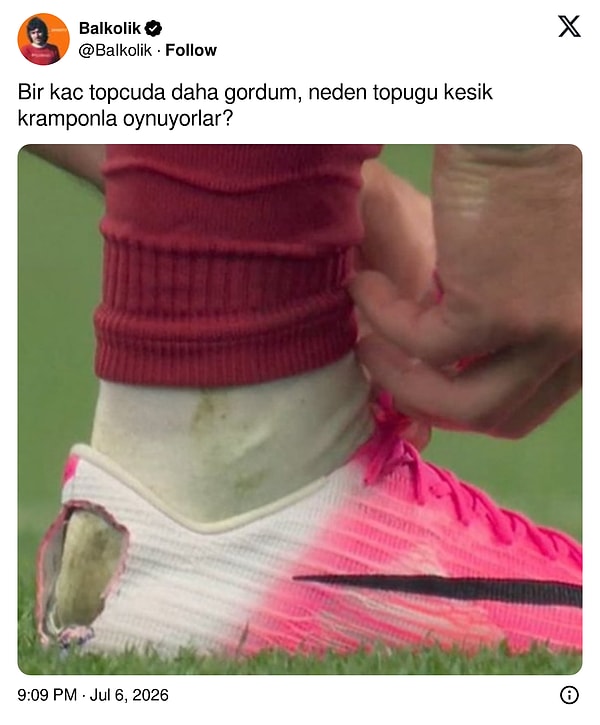
Several reasons might have crossed your mind. For instance, to prevent feet from sweating, to make the shoes more comfortable, or simply to create a sense of mystery :)
However, the actual reason behind this window opened in cleats is related to a health issue.
The reason why football players cut their cleats is due to an involuntary bone growth in their feet.
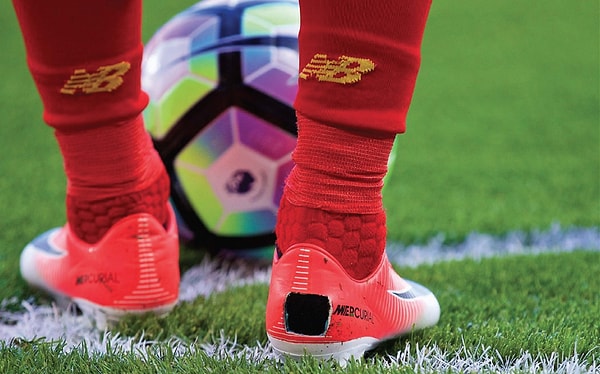
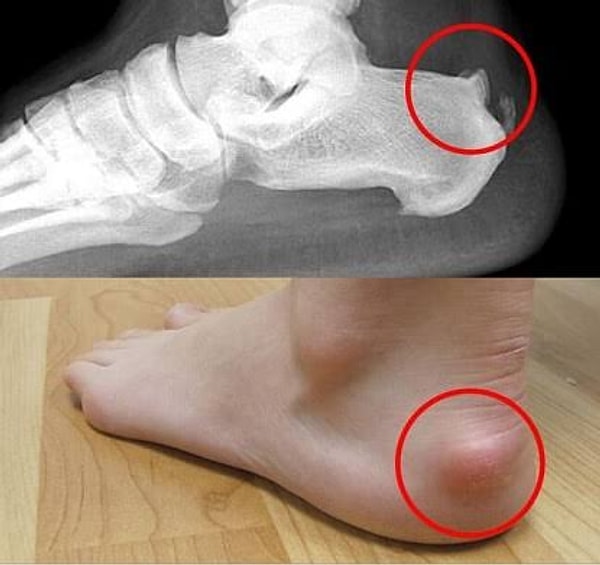
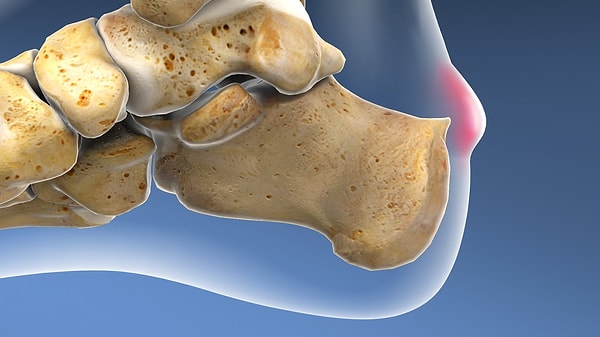
The condition known as Haglund's deformity, or Haglund’s heel, is frequently seen in football players. Haglund’s heel is a bony growth or protrusion that occurs at the back of the heel bone (calcaneus), where the Achilles tendon attaches. While this condition can occur in anyone, it is particularly common in football players due to the nature of their sport, the equipment they use, and the physical strain they endure.
This condition, also colloquially known as 'pump bump', can be triggered or exacerbated by the constant rubbing of the area by shoes with hard backs (especially high heels, hard boots, cleats).
However, this condition is not merely a bony protrusion; it also irritates the surrounding tissues and can be very painful:
- A visible, hard swelling/protrusion at the back of the heel.
- Severe pain where the Achilles tendon attaches to the heel.
- Redness, sensitivity, and increased heat in that area.
- Inflammation of the bursa, a fluid-filled sac, between the bone and the tendon (bursitis).
Cleats can cause deformation in the shape of the foot.
Football cleats are designed with a rigid, non-flexible, and typically narrow heel counter to tightly encase the foot and prevent slippage during sudden turns. This hard material exerts constant direct pressure and friction on the back of the heel bone throughout the match and training. In response to this persistent mechanical pressure, the bone produces more bone tissue in that area (i.e., the protrusion grows) to protect itself.
Football is a sport that involves sudden sprints, jumps, hard shots, and abrupt starts and stops. All these movements excessively stretch the Achilles tendon, the strongest tendon in the body. A tense and constantly stretched Achilles tendon persistently pulls at the point where it attaches to the heel bone (the location of the Haglund's protrusion), doubling the friction there.
During matches, football players are exposed to kicks, blows, and stepping from behind. These minor but repeatedly occurring impacts (microtraumas) to the heel area trigger inflammation in the bursa, the fluid-filled sac between the bone and tendon, and accelerate bone growth.
Playing on artificial turf or overly hardened natural grass fields increases the shock waves on the heel with each step. The movement of the heel inside the shoe becomes more aggressive on these surfaces, enhancing friction.
To escape this pain, football players wear specially designed cleats. The heel counter of the cleats is specifically softened, widened, and sometimes even cut out in the shape of a small hole to eliminate the pressure in that area. Additionally, special taping techniques can be used to reduce the load on the Achilles tendon.
So, why is this disease named Haglund?
The naming of this disease as Haglund's is actually a result of a classic tradition in the medical world. Haglund is the surname of the doctor who first identified the disease.
Patrick Haglund (1870–1937), a renowned Swedish orthopedic professor, introduced this disease and term into medical literature. Dr. Haglund noticed that this bony growth at the back of the heel caused pain and bursitis (inflammation of the bursa) particularly in individuals who wore hard shoes, and he was the first to decipher the mechanical relationship in the disease. Consequently, in honor of his discovery, the disease was named Haglund's Deformity.
On the other hand, this disease is known by different names among the general public. For instance, it's referred to as 'Pump Bump'. In English, 'pump' is a term used for women's shoes that are hard, high-heeled, and closed at the back. This name is commonly used to describe the swelling that occurs at the back of the heel in women who wear these shoes.
Keşfet ile ziyaret ettiğin tüm kategorileri tek akışta gör!
 Test
Test
 Gündem
 Magazin
 Video
Video



Send Comment