


When the Mine Began Swallowing the City, Buildings Were Moved One by One


The expanding iron mine in Kiruna, located in northern Sweden, poses a threat not only to a handful of buildings, but to the entire city center. The structures that are deemed too valuable to demolish are being individually relocated to safer areas. The most significant among these was the historic Kiruna Church, weighing in at a hefty 672 tons.

As the mine deepened, the ground of the city center ceased to be safe.
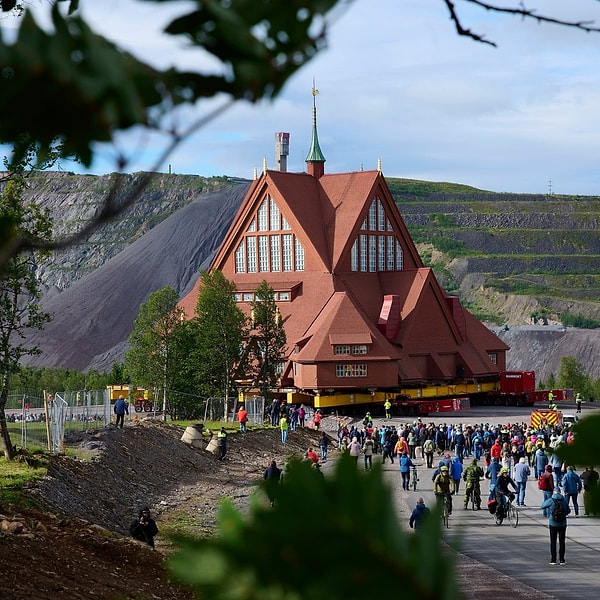
Kiruna is a city that was established around one of the largest underground iron ore mines in Europe. The expansion of the mine into deeper layers is causing movements underground and the formation of cracks on the surface. This transformation implies that the buildings in the old city center will not be safe for use in the long term.
In 2004, the mining company informed the local government that the city center needed to be relocated. Subsequently, a decades-long transformation program covering houses, public buildings, roads, and cultural structures was launched. The Kiruna Church, one of the city's landmarks, also fell within the boundaries of the risk zone.
Dismantling the church could inflict further damage on the historical structure.
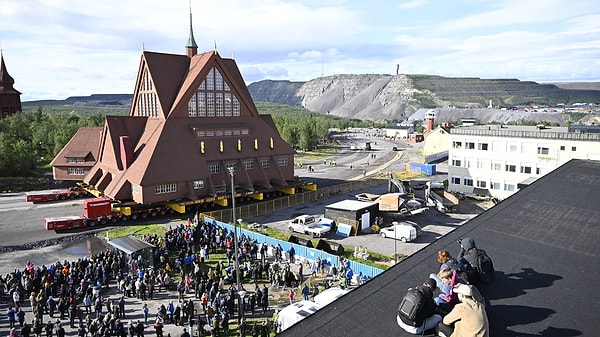
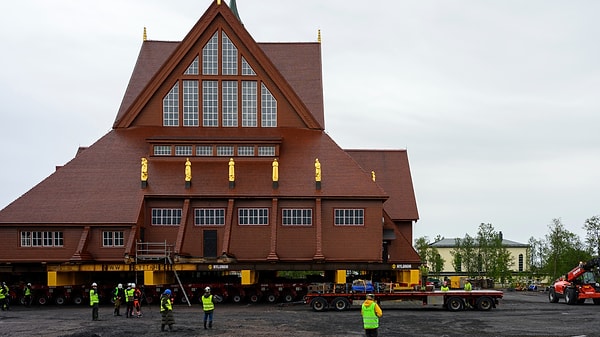
The wooden church, which was opened for worship in 1912, is considered one of Sweden's most beloved historical structures. The building, which is approximately 40 meters wide, weighed in at 672.4 tons before it was moved. Due to the structure's cultural heritage status, strict conservation rules had to be adhered to at every stage.
Initially, the idea of dismantling the church and reassembling it at the new location was considered. However, the risk of damaging the historical materials and compromising the authenticity of the structure during the disassembly process was deemed too high. Consequently, it was decided to move the entire church as a single piece.
Planning for the operation took eight years and the cost exceeded 500 million Swedish kronor. Roads were widened to allow the church to pass, some obstacles were removed, and the route was reinforced to bear the heavy load. The building was first lifted onto steel beams, then placed onto multi-wheeled remote-controlled carriers.
The two-thousand-pipe organ and the historic altar have been preserved for relocation.
Not only the outer walls of the church, but also the historical artifacts within were a significant part of the operation. The organ with over two thousand pipes and the historical altar piece prepared by Prince Eugen were carefully wrapped and secured to prevent them from being affected by vibrations and dust.
The bell tower, which stood separately from the church, was not moved at the same time. A different operation was planned for it. The new location of the church was determined between the cemetery and the new city center of Kiruna, and the structure was placed in a way to establish a similar relationship with its surroundings as in its old location.
The church is just one of the 23 cultural structures planned to be preserved and relocated as part of the city transformation. While some buildings are being moved in their entirety, others are planned to be dismantled and reassembled. For those living in risky areas, financial compensation or a new housing option is being offered.
Keşfet ile ziyaret ettiğin tüm kategorileri tek akışta gör!
 Test
Test
 Gündem
 Magazin
 Video
Video



Send Comment