


They 3D-Printed a 12-Unit Apartment Building: It Took Only 34 Days


The completion of the ViliaSprint² project in France has once again showcased the advancements in construction technologies. The foundational structure of a three-story apartment building, consisting of 12 social housing units, was printed using a 3D printer in just 34 days. Introduced as the largest 3D printed apartment in Europe, the building stands out for its significantly faster completion time compared to traditional construction methods.

The walls of the apartment complex, consisting of 12 units, were fabricated using a 3D printer.
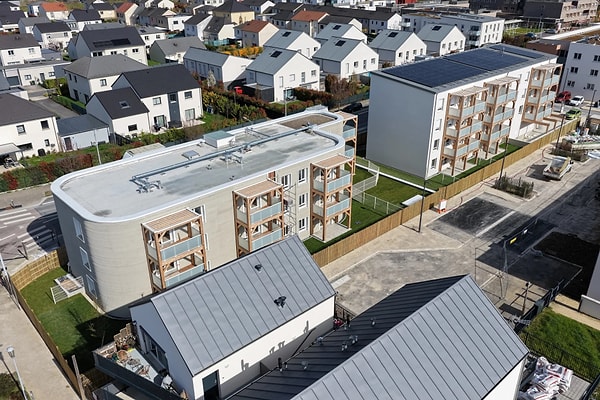
The ViliaSprint² project is fundamentally based on the 3D printing process carried out on-site, marking a departure from traditional apartment construction. The building's load-bearing structure and all walls were manufactured directly on the construction site using a printer.
Initially, the printing process was expected to span 50 days. However, the task was completed in just 34 days. The remaining parts of the building, including the roof, windows, electrical installation, and other traditional tasks were completed by human workers.
The three-story apartment offers a total of 800 square meters of living space. Each of the 12 social housing units within the building features a balcony. In this regard, the project stands out not merely as an experimental structure, but as a residential complex designed for real-life living.
It was completed 3 months faster than traditional construction.
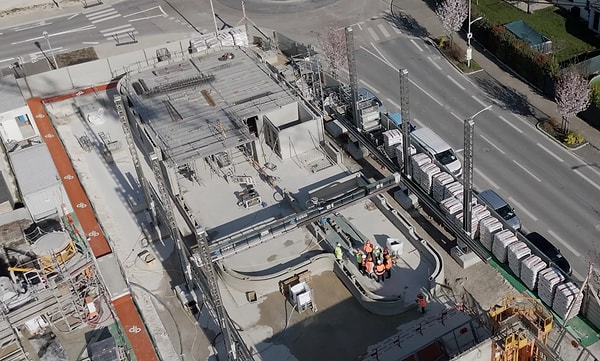
ViliaSprint², a striking example of 3D printed residential technology, sits adjacent to a similar building constructed using traditional methods by the same developer. According to New Atlas, this 3D printed apartment was completed approximately three months faster than its conventionally built neighbor.
The building's curvilinear facade and rounded layout are highlighted as one of the advantages offered by 3D printing. Complex forms, which could be more costly with traditional mold systems, can be produced without incurring additional costs using a 3D printer.
The project also incorporates approximately 500 square meters of solar panels, perlite insulation, wooden balcony structures, and a hybrid gas/heat pump system. Consequently, it's designed to meet roughly 60% of the building's energy needs on its own.
For now, ViliaSprint² stands out as one of the most notable examples of 3D printing housing technology. On the other hand, the team behind the project plans to produce a larger project of around 40 apartments using two 3D printers simultaneously in the future.
Keşfet ile ziyaret ettiğin tüm kategorileri tek akışta gör!
 Test
Test
 Gündem
 Magazin
 Video
Video



Send Comment