


The World's Largest Living Organism: Exactly 8,650 Years Old!


Residing in Oregon's Malheur National Forest, the giant honey mushroom (Armillaria ostoyae) holds the title of being the largest single living organism on the planet, spanning an area of 9.6 square kilometers. This enigmatic organism, weighing in at 600 tons and having lived for 8,650 years, is shaping the forests from beneath the soil.
Source

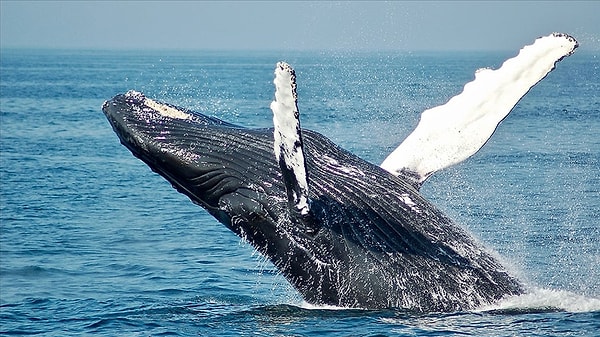
The largest living creature in the world isn't a whale!
In 1998, Catherine Parks, a researcher from the United States Department of Agriculture (USDA), began investigating a peculiar phenomenon that had caught her attention in Oregon's Malheur National Forest. Trees were mysteriously dying off across vast areas, as though the forest landscape was being sculpted by a giant hand. When Parks and her team examined samples taken from the dead trees through genetic analysis, they were confronted with a startling revelation: a single fungus was responsible for all these deaths.
DNA analyses revealed that all the Armillaria ostoyae samples found across a 9.6 square kilometer area were genetically identical. This meant that an area equivalent to 1,665 football fields was the habitat of a single fungus.
Just How Big Can a Honey Mushroom Really Get?
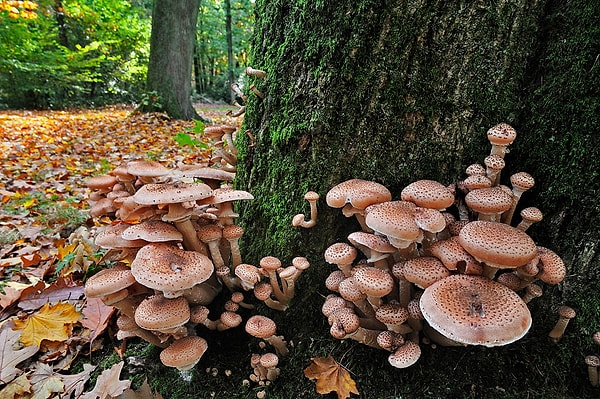
The organism discovered by Catherine Parks holds the record as the largest known living entity. To comprehend its dimensions, consider the following comparisons:
Area: 9.6 square kilometers (approximately 965 hectares)
Comparison: Equivalent to the size of 1,665 football fields
Weight: Estimated at 600 tons
Age: Approximately 8,650 years old (has been living since the Bronze Age)
Dr. Sylvia Chestnut, a mycologist (fungus expert) at Oregon State University, noted in her 2019 research that the true dimensions of this fungus are still not fully known, as the boundaries of the mycelial network beneath the soil cannot be definitively determined.
How Does the Hidden Network Beneath the Soil Operate?
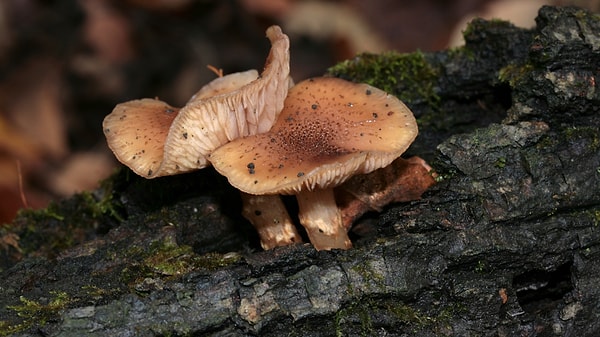
The true body of the Armillaria ostoyae is not the small mushrooms we see above the ground, but the massive mycelial network beneath the soil. This network, composed of thin white threads known as hyphae, establishes its feeding system by attaching to tree roots.
According to research published in the Forest Pathology journal in 2020, the fungus's root system operates as follows:
- The mycelial threads penetrate into tree roots
- It parasitizes by absorbing the tree's nutrients
- The infected tree weakens and eventually dies
- The dead tree debris provides more nutrients for the fungus
Through this cycle, the fungus has been directing the forest ecosystem and continuing to grow for thousands of years.
The Story Behind the 'Humongous Fungus' Nickname
The giant fungus in Oregon became famous as the 'Humongous Fungus' after its discovery. This nickname started to be used not only in popular culture but also in the scientific world. Dr. James Anderson from Michigan Technological University stated in his 2001 article that although this nickname overshadowed the true scientific significance of the fungus, it increased the public's interest in the microscopic world.
The fungus is so large that it can be detected even in NASA's satellite images. The patterns created by dead trees are distinct enough to be seen from space.
Bioluminescence: Relatives that Glow in the Dark
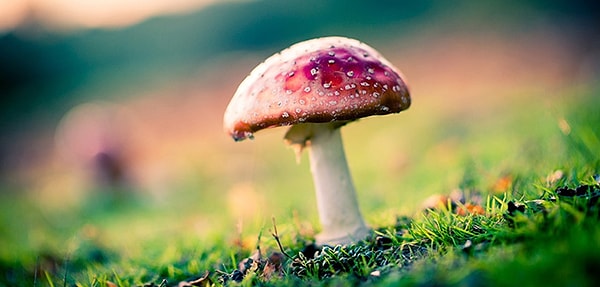
Armillaria ostoyae itself does not exhibit bioluminescence, yet some species of the same genus radiate a greenish glow in the dark. Related species such as Armillaria mellea (honey fungus) and Armillaria tabescens produce a natural light known as 'foxfire'.
According to research conducted by Dr. Dennis Desjardin from the University of California, Berkeley in 2021, this light is produced through the luciferin-luciferase reaction, akin to the process observed in fireflies. The reason behind the evolution of bioluminescence in fungi is still not fully understood, although it is speculated that it could serve to attract insects or disperse spores.
But what is its impact on the ecosystem?
The giant fungus in Oregon is not merely a parasite, but also a significant regulator of the forest ecosystem. It clears space for young plants by killing off old and weak trees, and it enriches the soil by decomposing dead wood residues.
According to a study by Dr. Robert Edmonds from the Pacific Northwest Research Station in 2018, Armillaria species are a natural part of forest health. 'Fungi are like the forest's janitors. They maintain the balance of the ecosystem by cleaning up diseased trees.'
However, due to climate change and drought, the activity of the fungus is increasing, which poses new challenges for forest management.
Keşfet ile ziyaret ettiğin tüm kategorileri tek akışta gör!
 Test
Test
 Gündem
 Magazin
 Video
Video



Send Comment