


Behind the Scenes of School Shootings: Are Monster Video Games to Blame?


Turkey has been shaken by a series of school attacks. Initially, a 19-year-old named Ömer Ket launched an attack on a school in Şanlıurfa, followed by a fatal attack by 14-year-old İsa Aras Mersinli, claiming the lives of nine people. In the aftermath of these incidents, the focus has shifted towards social media and video games. Academic Associate Professor Akın Ünver shared findings from their TÜBİTAK project, which examined the influence of digital radicalization, video games, social media, and online factors on extreme ideologies, violence, and armed behavior. In a post from his X account, Ünver stated, 'I would like to share some observations that may contribute to the discussion.'

Akın Ünver initiated his post with these words:

'We concluded a comprehensive TUBITAK1001 project last year, which was a long-term investigation into the impact of computer games, social media, and online factors on radical ideologies, violence, and armed behaviors, a phenomenon we refer to as digital radicalization.
The recent incidents have deeply saddened all of us; numerous esteemed colleagues have shared significant findings from their respective fields. In light of this, I would like to share some observations from our large-scale TUBITAK project, which we completed after gathering original data over a span of 89 years and comparing different countries. I hope that these insights will contribute to the ongoing discussion.'
What is it that drives a person from anger to violence?
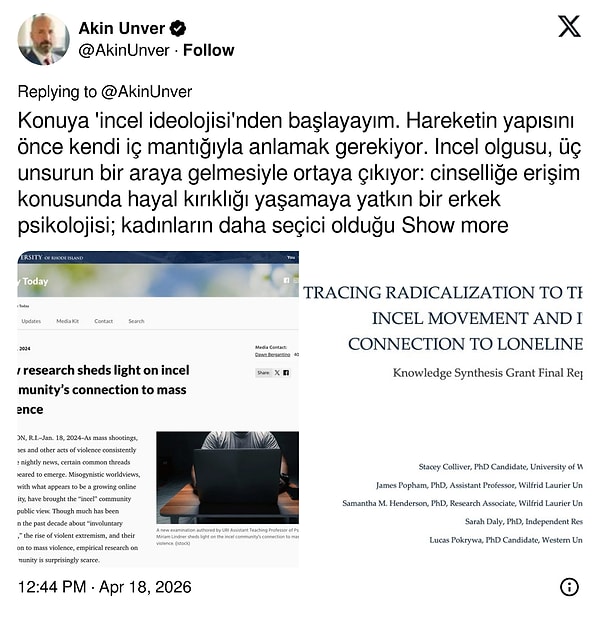
Let's kick off with the concept of 'incel ideology'. It's crucial to first understand the structure of the movement within its own logic. The phenomenon of incel emerges from the confluence of three elements: a male psychology prone to disappointment in terms of sexual accessibility; a modern pairing system where women are more selective; and technology that makes all these patterns more visible and provides a platform for men with a similar sense of loneliness to express their grievances and, moreover, to find validation for them.
One of the key points to note is this: the ideology inherently possesses a transnational character. Although the term has been in use for quite some time, incel communities that emerged in the mid-2000s transformed it into a more unified, homogenous, and cross-border identity. Consequently, a 14-year-old boy in Kahramanmaraş, Turkey, can draw inspiration from someone who committed an attack in California in 2014, and can connect with others 'inspired' by the same event in a shared digital community. Because this movement has evolved into a structure that easily circulates across borders and cultures. Even when we take into account covariates like religion, language, race, geography, etc., the culture I referred to as 'a male psychology prone to disappointment in terms of sexual accessibility; a modern pairing system where women are more selective' is becoming a common, universal culture.
So, what propels an individual from a state of passive anger to violence? Research points to several different mechanisms here. Active participation in online extremist communities is considered a stronger indicator of radicalization than merely viewing or consuming such content. Therefore, the term 'lone wolf,' which we used to describe the digital presence of groups like ISIS, is actually incomplete and misleading. These individuals may be physically alone, but within their phones and computers, there exists a community that thinks the same way. Behind each radicalized lone actor, there is a broader network that has undergone cognitive radicalization online; which is, in fact, something we expect from the findings of digital radicalization literature.
There's also a striking finding regarding the relationship between ideological commitment and behavior: a strong adherence to Black Pill ideas does not meaningfully predict violent or radical intentions. The only variable that seems significantly associated with incel ideology is what we call 'activist intentions,' the intent to transition to actual action. In other words, those most tightly bound to the ideology are not drifting towards violence, but rather towards legal activism. Therefore, the small fraction that turns to violence is not the group most committed to the ideology. Typically, these are individuals who have additional risk factors layered onto the ideological framework. This is also the case in religious radical organizations, for example, the person who carries out a suicide attack.
"Research indicates that nearly 70 percent of the participants are grappling with depression."
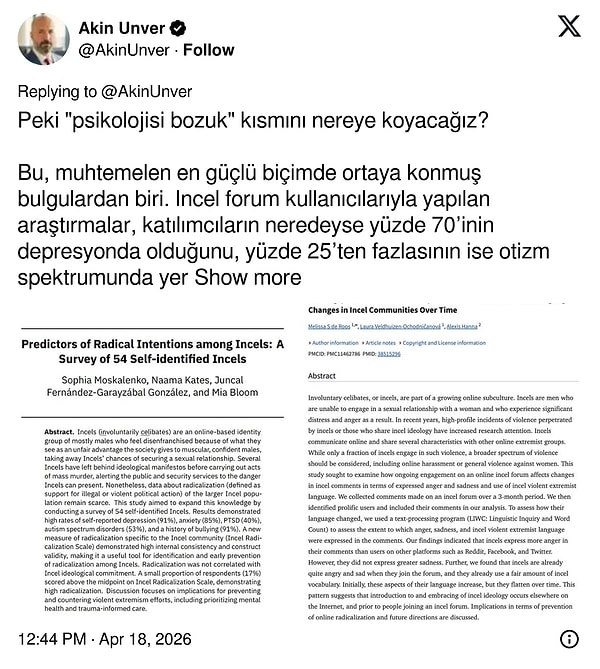
'So where do we place the 'mentally disturbed' aspect?
This is perhaps one of the most compelling findings. Research conducted with Incel forum users reveals that nearly 70% of participants are suffering from depression, with more than 25% falling within the autism spectrum. In some samples, self-reported rates of depression and anxiety soar to extremely high levels, 95% and 93% respectively. Over 48% of those leaning towards ideological extremism have experienced trauma, with more than 35% reporting childhood abuse. We also observe consistently high rates of bullying and exclusion.
Naturally, this scenario transforms into a self-perpetuating vicious cycle: individuals experiencing social isolation become more prone to 'problematic internet use'. These symptoms are more closely linked to increasing loneliness. Hence, those who are already lonely tend to gravitate towards even more isolating, isolationist communities. Here, the belief that their loneliness is the fault of others is camouflaged with a distorted self-confidence (I'm superior, everyone else is mediocre, that's why I'm lonely). They internalize these fundamental beliefs and as a result, they further detach from 'real life' relationships or their behavior in real life morphs into a simulation; they're mentally not present, thus their behaviors take on the form of 'simulated behaviors'.
The emotional landscape is also unique. In Incel communities, the primary linguistic signal is not sorrow, but anger. Moreover, as the level of anger escalates, so does the use of extremist language (which is to be expected). However, the problem lies here: are angry people drawn to these digital platforms, or are these digital spaces like computer games and forums merely reflecting what has already transpired in their family, friend, and social life?
The latter; in other words, the initial contact with extremist ideas similar to Incel and the process of adopting this ideology often gain momentum in other corners of the internet, where young people who can't find their place in social life and human relationships meet before joining these specific forums. Computer games, social media, and the internet are not powerful explanators on their own, but rather places where young people who can't find their place among family, friends, and relatives express and make their behaviors visible. That's why they are perceived as the 'main cause'.
This situation is crucial for early intervention. Because if someone has arrived at Incel forums, the radicalization process is often already well underway.'
"The age range of 13-16 is a period where emotions are more dominant, but executive control has not yet fully matured."

'So why the age group of 12-16?
The research in this area is not exactly heartening. It clearly indicates that early adolescence carries its own unique vulnerabilities, which is consistent with the findings we've seen in the literature on digital radicalization, and our own research has yielded similar results.
Firstly, the part of the brain responsible for decision-making and self-control is not yet fully matured at these ages. The age range of 13-16 is a period where emotions are more dominant, but executive control has not yet fully developed. As a result, emotional responses become stronger, impulse control weakens, and sensitivity to social status and exclusion increases. The Incel ideology specifically targets and exploits these weak points. However, this alone is not a sufficient explanation.
Another issue is identity. This period is when the concept of masculinity is most intensely formed and at the same time, most fragile. The 'Black Pill' offers a ready-made narrative of masculinity to boys who feel inadequate. It provides not only an idea, but also a sense of belonging, ideology, and purpose.
Another gateway is violent and shocking content. In a previous study of ours, we found that the number of individuals under 18 involved in terrorism-related investigations in the UK had tripled in three years. In France, more than 1,700 radical religious videos were found on the devices of numerous children aged 12-16 who were convicted of terrorism-related crimes. Their radicalization began with innocent internet searches related to religion, then algorithms and curiosity led them to encrypted chat groups and extreme violent propaganda materials. This is a dynamic that produces similar results among both Christian and Muslim youths. It's this pattern - the sliding process from ordinary to extreme via algorithms - that makes early adolescence so vulnerable.
Then there's the issue of hero worship. Idolizing someone during adolescence is psychologically normal. What Incel culture exploits is the object of this admiration. The glorification of mass aggressors as 'saints' in digital communication tools is inserted into the naturally occurring search for a hero figure during adolescence.
Some experts evaluate recent incidents as 'not exactly incel, there's another dynamic at play', which is true, but misogyny and hatred towards women (including young girls who join the same social movements) are very significant and ongoing variables at the forefront.'
"If in some schools, 30 to 40 percent of students are already claiming to be victims of bullying, it indicates that bullying alone is not the sole factor..."
'So what's the reason then?
I see people blaming the things they least understand and feel most remote from in public opinion, on news channels, and in debate programs: computer games, 'social platforms' (using this term is like a boomer litmus test for not understanding the topic), and so on. These are the visible parts of the issue. The process starts long before children enter these areas and their behaviors become visible and start influencing each other. The influence of these areas is secondary, often tertiary.
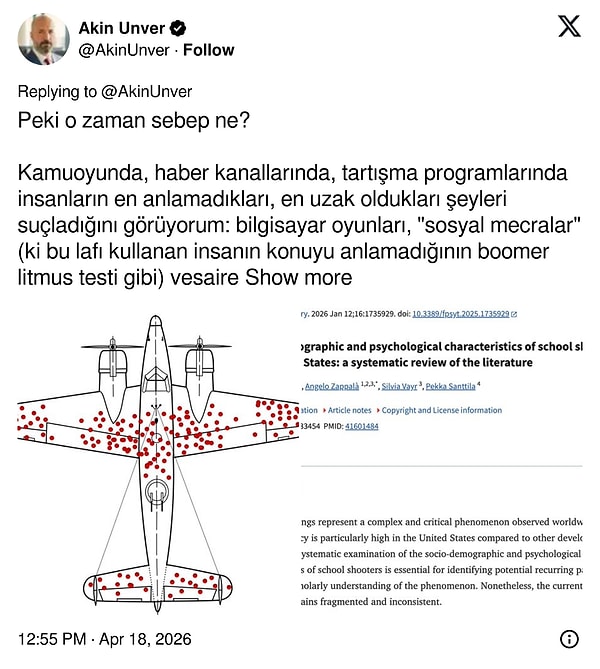
Before blaming a factor we are not experts in as if it were the primary cause, we need to see that almost all studies on school attackers have serious methodological problems. Availability bias is the tendency to over-rely on the most easily recalled, newest, or most striking information when evaluating the likelihood of an event. This is an illusion.
The crux of the matter is this; we study the attackers, but often we don't study those who are not attackers. For instance, if 60% of school attackers are victims of bullying, this may seem striking at first glance. But if some schools report that 30 to 40% of students are already victims of bullying, we should consider that bullying alone is not a factor and needs to be evaluated with other covariates. What matters here is not the raw rate, but the comparative rate. Most of the literature fails right here because it lacks a solid control group. The same applies to computer games; attackers are on internet forums, in computer games, etc., but the overwhelming majority of those who play the same game or spend time on discord do not resort to violence or develop antisocial behavior.
A recent systematic literature review, of which I have included a screenshot, revealed that there is insufficient data in the literature on approximately 75% of the characteristics researchers want to examine. Okay, some common themes keep recurring: social isolation, traumatic experiences, depression, narcissism, lack of empathy. But the findings at hand point not to a single perpetrator type, but to many different patterns.
This changes the very issue we're trying to understand, that we want to analyze. Because research finds what it is looking for. Every characteristic that is already common among adolescent males: social skill deficits, fondness for games, depression, anger, etc., will naturally appear frequently in the sample of adolescent male attackers. If you are conducting a study on 'the impact of computer games on violence inclination' and you are sampling this study on the 12-16 age group, it is impossible for this demographic not to play computer games or browse internet forums.
The real question should always be this: What is the prevalence of these characteristics among equally introverted, long-term computer game-playing, depressive young males who have not shot anyone or resorted to violence? Because the majority of the sample is in this demographic.'
"By the time a child who has been bearing such a burden for years reaches the age of 13-16, they are already setting out with a weakened balance system, even before encountering delicate content."
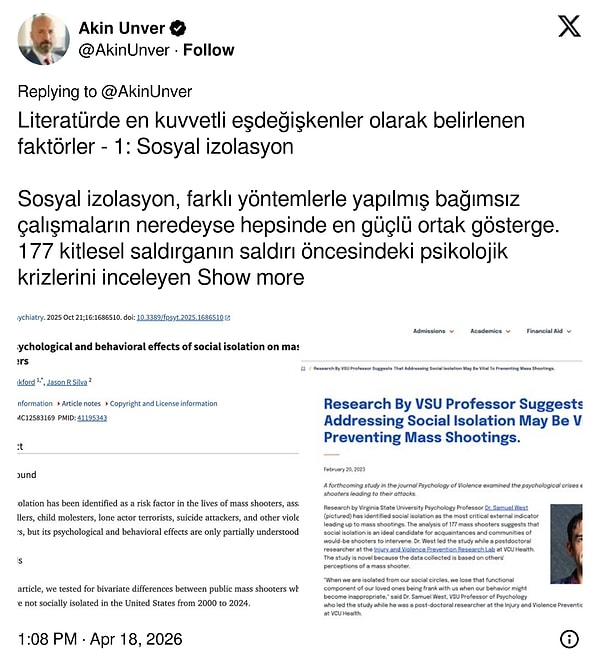
'Social isolation stands out as the strongest common indicator in nearly all independent studies conducted through various methods. A research that examined the psychological crises of 177 mass attackers prior to their attacks revealed that social isolation was the most significant external sign on the path to the attack.
What strengthens this finding even more is another study conducted in 2025 that didn't just look at 'who has how much of it.' This research compares 123 cases between 2000 and 2024, examining the differences between socially isolated attackers and those who are not. The result: isolated individuals have a higher likelihood of being unemployed, single, childless, experiencing sexual disappointment, having mental health issues, having previously undergone psychiatric treatment, having a history of suicidal tendencies, substance use, harboring prejudiced thoughts, chasing fame, and showing interest in past mass violence incidents.
Here, two separate theories actually converge on the same point. One suggests that as losses and deprivations accumulate, the risk of violence increases. The other argues that the main determinant that keeps people away from violence is social ties; when these ties weaken or break, the brake also disappears. The really crucial point from a prevention perspective lies here. Because isolation is not just a matter of 'being psychologically disturbed,' it also facilitates the preparation for an attack. Most pre-attack behaviors such as being able to open gun cabinets, accumulating weapons/ammo, could be noticed and perhaps even stopped if there was someone close to the person. So, isolation both prepares a psychological ground and practically facilitates the attack.
Adverse childhood experiences, or what we call ACE, emerged as the second major cluster in the findings. The research we have at hand here is somewhat more robust. Because there is a broader data base from the general population on this subject, and it's easier to see what's normal and what's not. It's seen that a vast majority of mass attackers experienced serious traumas in childhood: parental suicide, physical or sexual abuse, neglect, domestic violence, severe bullying, and the like. These kinds of experiences often come along with depression, anxiety, thought disorders, and suicidal tendencies later on. In fact, nearly all attackers enter a significant crisis period weeks or months before the attack. The reason why society blames external factors like 'video games, social media' so easily lies somewhat here: the main factors hold up a mirror we never want to look at, related to our family structure, social order, and child-rearing methods. We choose to blame the things we understand the least, the topics we're least expert in.
The biological mechanism here has actually been known for a long time. If a child lives under severe stress for a long time; for example, if there is constant domestic abuse, neglect, physical or psychological violence at home, addictions or severe mental problems among family members, this not only disrupts the mood, it also affects the development of the child's brain. In our own research, we found that young people who joined radical militant groups were neither devout, nor ideologically committed, nor came from poor/uneducated families. The main factor in most was family structure and family traumas. And these are not necessarily things like divorce that come to mind immediately. Isolation can also be observed in children who live close to their non-divorced parents and extended family.
When the stress system is constantly on alert, the structure of the brain and the parasympathetic (fight or flight) systems in the body also take their toll. This is generally called toxic stress. So, the issue is not just about 'having had a tough childhood'; it's about the brain's development process being directly affected during this difficult childhood, along with physiological covariates. The prefrontal cortex, which is related to impulse control, empathy, and the ability to weigh the consequences of one's actions, is easily affected by such long-term stress. In short, a child who has been carrying such a burden for years by the time they reach 13-16 years old, sets off with a weakened balance system even before encountering incel content. Incel is just the part of this mechanism we can see.'
"It should have already been determined by the family how much of which game can be played."
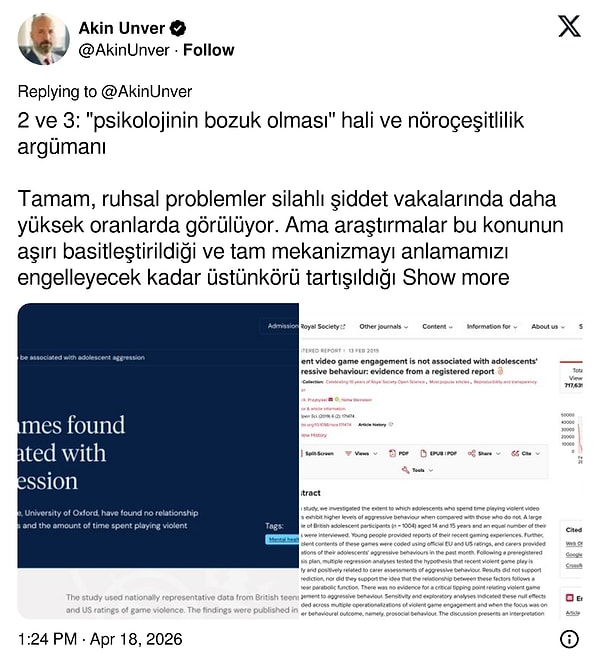
'Indeed, mental health issues are more prevalent in cases of gun violence. However, research concurs that this issue has been overly simplified and discussed too superficially, hindering our understanding of the full mechanism at play. The vast majority of individuals with psychiatric diagnoses do not resort to violence. Clinical symptoms only become problematic when combined with other factors, leading us back to the same point: social isolation, intense stress, traumatic family or environmental history (such as post-disaster or post-war), and easy access to firearms, among others. Thus, having a 'disturbed psychology' is not a standalone explanatory factor; it's the convergence of risk elements that matters.
The third argument touches on neurodivergence, particularly the autism spectrum, which is one of the most sensitive and often misinterpreted areas. Some studies find a higher prevalence of autism diagnoses in socially isolated aggressors. However, the crux of the matter is not autism per se. It's crucial to remember that autistic youths can be more prone to bullying, more easily ostracized, and often lack sufficient support, being pushed into social isolation by their environment, friends, and even schools. The connection breaks down here. The risk is not posed by autism itself, but by the consequences of a neglectful, exclusionary social environment.
If we question the strength of these arguments and ask what could be more explanatory, one answer could be the 'injured sense of entitlement.' When an individual believes they have lost respect, status, or power they thought was rightfully theirs, they can develop feelings of anger, resentment, and a desire for revenge. This is where ideologies like Incel become influential, as they provide a framework for this existing anger: they define an enemy, offer a community to those harboring similar anger, and in some cases, portray violence as a form of heroism.
Some factors have been exaggerated for years, mainly because we fear the unknown. A prime example of this is video games. Research fails to find a convincing link between violent video games and real-world violence. In fact, some findings suggest that games could serve as an outlet for anger. The games themselves are not the issue; it's the social context in which they are played. Socially isolated individuals naturally spend more time alone, so it's not surprising they play more games. Moreover, it should be predetermined by parents which games are suitable for their children based on their age group. If an 11-year-old can access a game designed for 21+, it indicates a lack of a family system that fully understands and systematically guides the child's behavior. Therefore, the game is not the cause, but rather a symptom. As demonstrated in this example, banning a child from playing games can lead them to drugs or other rebellious behaviors; it's not a solution.
The same applies to mental illness. When taken alone, it's not a strong predictive tool. This is because it's already quite common in society, and most mental health profiles make planned mass violence more difficult, not easier.'
"Just as we wouldn't blame red trousers simply because a perpetrator of armed violence happened to be wearing them..."

This turned out to be a lengthy piece, but I firmly believe that matters of societal outrage, which concern us all, should not be discussed in a hasty, superficial manner. If an incident has caused us pain, we need to thoroughly understand it, identify the correct mechanism, and delve deeper, focusing our thoughts, asking tough questions, attempting to comprehend difficult findings, and even confronting answers we might not like. Without doing this, all our actions merely serve to satisfy our egos. I'm not interested in ego gratification; instead, I'm focused on scientifically explaining and understanding painful, challenging societal traumas. I believe that influential figures should also discuss complex, detailed, and long-term answers, rather than resorting to lazy and popular arguments.
At the very least, our responsibility is as follows: when we hear 'the cause of the negative event we experienced is this or that,' we should ask:
1 Can this claim withstand a solid comparison? The vast majority of young people who play games, suffer bullying, or are depressed do not turn to violence. Therefore, what we really need to look at is whether these characteristics are indeed significantly higher in aggressors. When we say 'the cause is this,' are we including in our reasoning the overwhelming majority that does not produce the result we observe when we apply that cause?
2 Is there a reasonable and independently verified cause-effect mechanism in place? For instance, it is now well-known that adverse childhood experiences can disrupt brain development. However, there is no such mechanism showing that autism directly produces violence. Similarly, there is no robust mechanism found to prove that video games create violence. Is the 'guilty cause' we are trying to identify something we thoroughly understand, have a good grasp of its framework, and have experience with? Or are we blaming the causes we least understand, that are farthest from our culture and life practices, and about which we have the faintest idea?
3 Are the findings mentioned to us by people we listen to on television or social media also valid in comparative studies? One of the strongest data sources in this field is the Violence Project database, for instance. It contains numerous data points for each case and comparative data information collected over many years. The strongest findings regarding isolation, childhood trauma, and the process leading to the attack come from here. Case studies based on a single perpetrator are not very reliable for establishing a cause-effect relationship. Just as we wouldn't blame red pants because a perpetrator of armed violence wore them, we need to compare the variables belonging to the perpetrators with the majority who apply the same variables but do not become perpetrators. And those we choose to listen to as 'thought leaders' should also be able to make these comparisons.
4 And perhaps the most important question is: what separates this small group from the millions of young people with the same characteristics who do not resort to violence? The answer given by research usually converges on two points. First, it's not a single risk factor, but accumulated and overlapping risks that determine. Second, the presence or absence of a protective bond is crucial. The existence of at least one strong relationship that connects the individual to reality, provides support, and applies the brakes, like a parent, teacher, mentor, or close friend, seems to be critical. The fundamental reasons are usually found here.
These explanations were long, but I have always shied away from easy explanations of societal problems. I value discussions where we approach traumas with scientific and critical precision, fully establishing cause-effect relationships, rather than processes where we make ourselves feel good in the short term and relegate the trauma of the event to our subconscious. If we are to prevent certain things, our actions and initiatives must come from a place that correctly understands the problem and is not simplistic.
Keşfet ile ziyaret ettiğin tüm kategorileri tek akışta gör!
 Test
Test
 Gündem
 Magazin
 Video
Video



Send Comment