


Sunk 25 Tanks and 198 Trucks Into Ocean: The Shocking Marine Transformation 9 Years Later


25 tanks, 273 train wagons, and 198 garbage trucks, all produced for use in battlefields, were dumped into the sea. The project, designed to create an artificial reef off the coast of Narathiwat in southern Thailand, transformed into a new habitat for marine life over the years. Researchers identified 53 different species of fish in the area.
Here are the details

25 Tanks, 273 Train Wagons, and 198 Trucks Were Sunk into the Sea

In 2010, fishermen in the Narathiwat region in southern Thailand were complaining about the depletion of fish stocks after years of intense fishing. Consequently, an unusual method was implemented to create new habitats in the sea.
25 decommissioned war tanks, 273 train wagons, and 198 garbage trucks were sunk to the bottom of the sea. The aim was to transform these metal structures into artificial reefs to create new areas where fish could inhabit.
The tanks and other vehicles were placed about 9 kilometers off the coast in the Gulf of Thailand, at a depth of 2223 meters. Thus, structures of different shapes and sizes were added to the seabed, which was previously unsuitable for fish to inhabit.
A Completely Different View Under the Sea After 9 Years
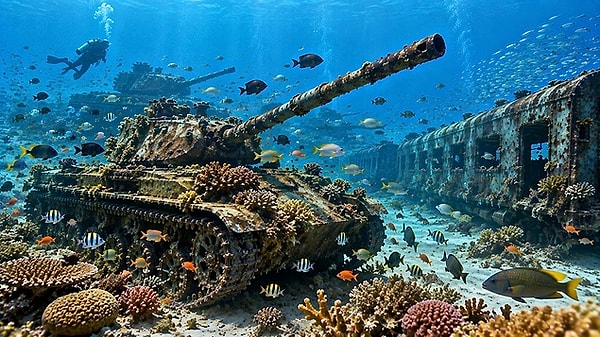
Researchers from Ramkhamhaeng University conducted dives in 2019 to examine the artificial reefs in the region.
Scientists particularly scrutinized the fish communities around tanks and train wagons. The result was striking: 53 species of fish belonging to 21 families were recorded within the scope of the research.
In the region, economically important fish such as grouper and snapper, as well as the humphead parrotfish, which is one of the endangered species, were identified. Researchers also revealed that different structures could attract different fish communities.
Tanks hosted larger fish communities compared to train wagons.
The reason for this was that the tanks had a more complex structure. The voids and recesses inside created areas where small fish could hide. Over time, various marine creatures began to cling to these hard surfaces, and an ecosystem resembling natural reefs emerged.
Keşfet ile ziyaret ettiğin tüm kategorileri tek akışta gör!
 Test
Test
 Gündem
 Magazin
 Video
Video
Read More






Send Comment