


Massive Hoard of 25,000 Roman Coins Discovered Under Floorboards in France


A routine excavation in the town of Senon in northeastern France has unearthed one of the largest coin treasures in history. Archaeologists discovered three giant ceramic jars, hidden in the base of an ancient neighborhood buried under ashes, filled to the brim with Roman coins.

A meticulous excavation spanning 1,500 square meters, conducted by the French National Institute for Preventive Archaeological Research (INRAP) in the town of Senon, culminated in a groundbreaking discovery.
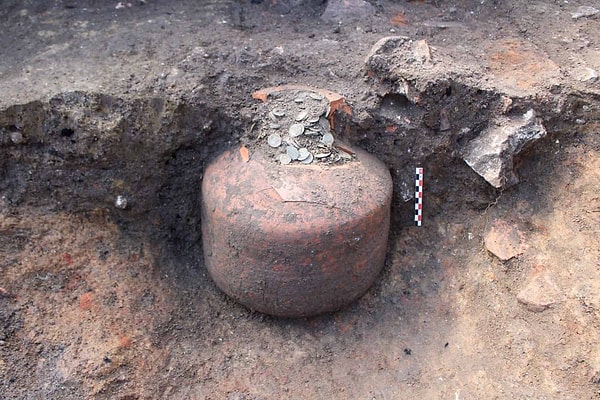
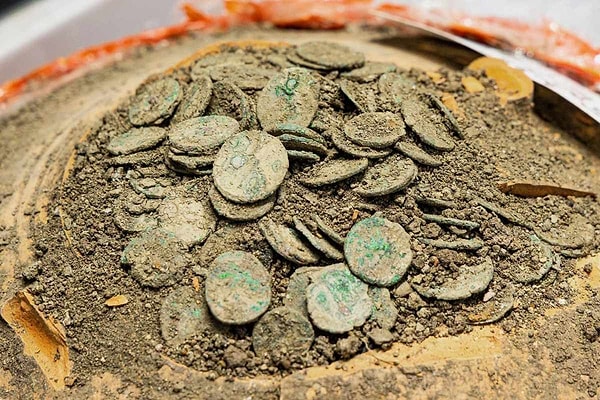
Experts examining the remains of an ancient neighborhood have unearthed at least 25,000 bronze and copper coins, impeccably preserved and hidden beneath floorboards. This colossal treasure, dating back to the 3rd century AD, offers unique insights into how people stored their money and coped with financial crises during the Late Roman Empire.
This excavation, which archaeologists describe as 'peeling back the layers of Senon's past,' also reveals the significant transformation the region underwent from the mid-2nd century BC onwards.
In the deepest layers of the protected site, remnants of wooden walls, clay structures, and trenches belonging to the Celtic people of Mediomatrici, who inhabited the region long before the Romans arrived, were discovered.
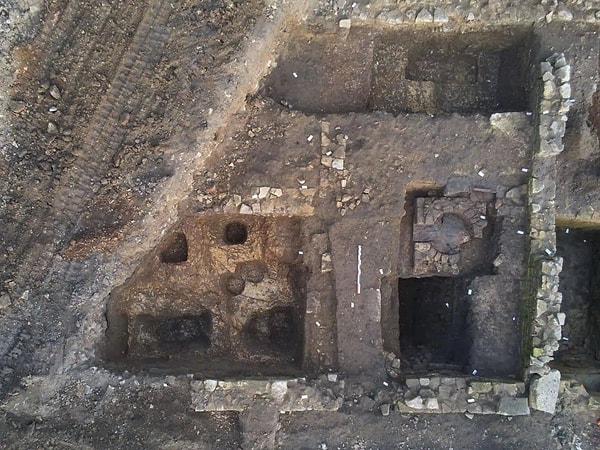
The densely packed layout, with multiple structures per square meter, attests to the fact that Senon was a heavily populated Gallic village even before its conquest by Rome.
The fate of Senon was completely altered with the conquest of the Gauls by the Roman armies under Julius Caesar's leadership. After the Romans settled in the region, they opened limestone quarries that reached depths of up to 3 meters at some points. These stones sparked a construction boom that would last for centuries.
By the end of the 1st century AD, Senon had transformed into a modern Roman city:
Luxurious Living: Stone houses were lined up along the edges of two large streets paved with cobblestones.
Underfloor Heating: The floors of the houses were covered with lime, and hypocaust systems, considered a luxury of the time, were installed to provide underfloor heating.
Wealthy Artisans: Ovens, cellars, and workshops were found in the courtyards behind the houses. This suggests that the city's inhabitants were affluent artisans and merchants.
However, this glamorous era of Senon did not last forever.
The thick layers of ash covering the excavation site bear the traces of the massive fires that devastated the city.
Particularly during the turbulent period between AD 280 and 310, a city dweller made a radical decision to protect his wealth during a major catastrophe or fire. He buried three large amphorae (ceramic jars) in the ground, ensuring their necks were level with the ground, and covered them with wooden planks.
The tens of thousands of coins found inside these ceramic jars bear the busts of rulers like Victorinus, Tetricus I, and Tetricus II, who were part of the short-lived 'Gallic Empire' that broke away from Rome during that era.
It is speculated that the person who buried the coins was unable to survive the fire or return to his home; this is because this immense fortune lay undiscovered in its burial place for a full 1700 years.
Keşfet ile ziyaret ettiğin tüm kategorileri tek akışta gör!
 Test
Test
 Gündem
 Magazin
 Video
Video



Send Comment