


End of Privacy: New Smartphone Technology Can See Through Walls and Obstacles


In recent years, smartphone manufacturers have been utilizing LiDAR (Light Detection and Ranging) sensors in their high-end models to enhance depth perception and support augmented reality (AR) applications. Traditional LiDAR operates by emitting light pulses, measuring the time it takes for the signals to bounce back from objects, and thus creating 3D maps. However, until now, this technology had a significant limitation: it could only detect objects directly in front of the camera, that is, within the line of sight.

Researchers at MIT have ingeniously developed a software algorithm that completely overturns this rule.
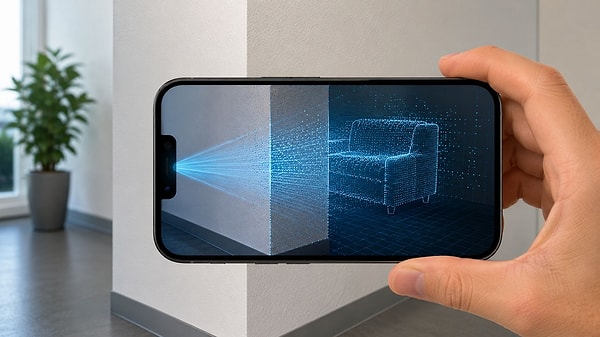
The new system targets very faint light reflections that, typically disregarded as 'noise', scatter upon striking walls, floors, and obstacles.
When the phone or the hidden object behind it moves, the algorithm accumulates these weak reflections over several frames and combines data coming from different angles. Consequently, it can estimate the shape, location, and movement of objects hidden behind obstacles with millimetric precision, without the need for a direct line of sight.
The team utilized a standard consumer-grade LiDAR sensor, available in the market and priced under 100 dollars, to put the technology through its paces.
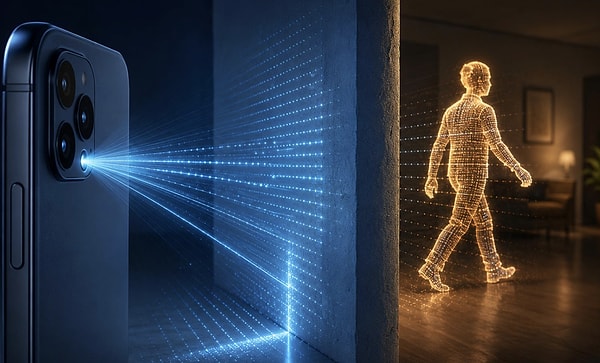
Mobile mannequins, cardboard figures, and letters were strategically positioned behind walls and partitions. Rather than pointing the sensor directly at the object, it was aimed at the floor or wall near the obstacle to capture indirect reflections.
The results left the scientific community in awe: The developed algorithm managed to track the mannequin behind the wall in real time and generated 3D models of hidden objects. In another test, it successfully tracked both hands of a human at a rate of 30 frames per second (30 FPS). Special reflective gloves used during the test separated the signals coming from the hands from the torso, rendering the motion tracking flawless.
The most significant contribution of this technology is its potential to bring Non-Line of Sight Imaging (NLOS), a process previously exclusive to military-grade operations or laboratories with colossal budgets, into the hands of everyday people.
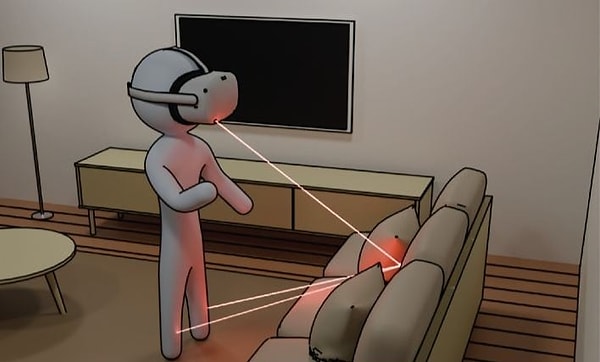
There remains a minor hurdle to fully harnessing technology in consumer devices, robots, and wearable technologies. At present, the software flawlessly operates on objects with predictable shapes, such as humanoid mannequins, letters, and so forth. The next step for scientists is to expand the algorithm to recognize objects with completely unknown or constantly changing shapes.
Once this stage is completed, smartphones will be able to convert seemingly insignificant light reflections into vital visual information, and track objects in blind spots. This will not only enhance the functionality of these devices but also revolutionize the way we interact with our environment.
Keşfet ile ziyaret ettiğin tüm kategorileri tek akışta gör!
 Test
Test
 Gündem
 Magazin
 Video
Video



Send Comment