


A New Era in Road Construction: Making Asphalt From Broken Glass Bottles


Every year, millions of tons of glass waste fill up landfills worldwide, but a revolutionary step that could fundamentally transform the infrastructure and environmental protection sector has been taken. Spearheaded by the United Nations Development Programme (UNDP), a new project has been launched where recycled broken glass bottles, once seen as trash, have begun to be used for repairing potholes and producing new asphalt.
Officially tested in Samoa, this method, dubbed 'Glassphalt,' is considered one of the most unusual examples of the circular economy and sustainable city management.

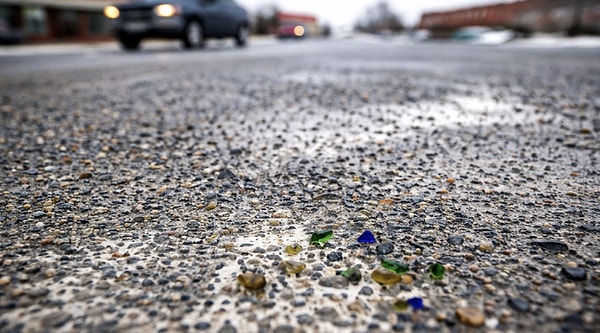
At first glance, the term "Glass Road" might cause a stir of worry among drivers. However, technically speaking, there are no visible shards of glass that could damage tires while walking or driving on the road.
According to experts, the process unfolds as follows:
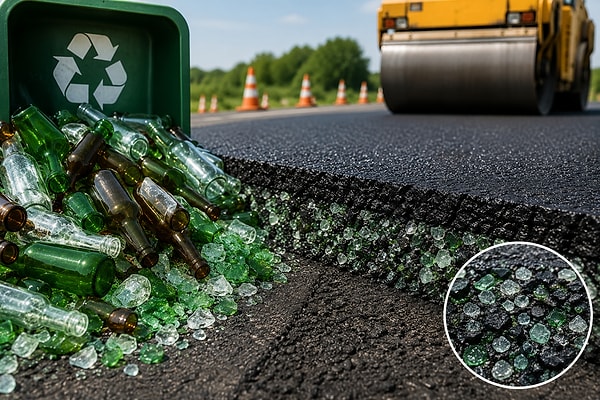
The collected waste glass bottles and jars undergo a meticulous process of crushing and sifting at specialized facilities.
This recycled glass, reduced almost to the size of sand grains, is incorporated into the mixture in place of the natural minerals (aggregate) used in traditional asphalt.
To ensure the material fully adheres to the asphalt and to prevent premature wear, cleanliness and quality checks are carried out in a laboratory setting.
The initial field tests of the project were conducted on the damaged roads at the entrance of the Tafaigata landfill in Samoa.
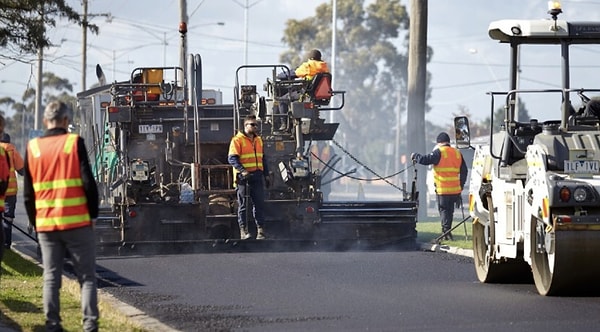
Experts specifically chose the method of 'pothole patching' to observe, on a small scale, how the new material would react to heavy vehicle traffic, sudden temperature changes, and humidity.
One of the primary objectives of this application is to minimize water leakage - the archenemy of asphalt, which allows rainwater to seep underneath - while restoring the smoothness of the road surface. Should the tests prove successful in the long run, glass asphalt will be standardized on all main roads nationwide.
The driving force behind the project was the fact that the Tafaigata landfill had reached its full capacity, necessitating urgent alternative solutions.
According to data shared by the Samoa Recycling and Waste Management Association (SRWMA):
Since mid-2021, over 700 tons of post-consumer glass waste has been saved from ending up in nature or going to waste.
Of this glass, 168 tons have been effectively crushed and started to be used not only in asphalt, but also in molded concrete, paving stones, building blocks, and decorative pieces.
The project, financed in partnership with the British High Commission and UNDP, not only manifested as an environmental investment, but also evolved into a valuable employment model.
Under the scheme, the economy was enriched by employing 7 young individuals, including those with disabilities, in the processes of processing and preparing recycled materials.
Asphalt coating experts caution that such radical changes in the composition of mixtures need to be monitored over many years. The long-term durability performance of areas where fiberglass coating is applied has not yet been fully proven, so for now, the project is kept in a formal and controlled testing phase. However, initial results point to a fascinating future that demonstrates trash can indeed be transformed into a real road.
Keşfet ile ziyaret ettiğin tüm kategorileri tek akışta gör!
 Test
Test
 Gündem
 Magazin
 Video
Video



Send Comment