


Woman Shares Her Honest Reaction Trying a 100-Year-Old Chinese Egg for the First Time


The world of social media continues to astound us daily with bizarre food trends that leave us asking, 'Do they really eat that?' The culinary heritage of various cultures can suddenly transform into global challenge trends thanks to digital platforms. While some bravely taste these unusual flavors and share their experiences with their followers, others are content to watch in astonishment from behind their screens. Particularly, the traditional and unconventional flavors of Asian cuisine consistently prove to be a popular viewing source for content creators in the Western world.
The 'century egg' (also known as the millennium egg), one of the most intriguing and dare I say, courageous flavors of Chinese cuisine, has once again become a trend on social media. A young woman shared her first-time experience of cutting this millennium egg, with its mind-bending color and texture, in half. This peculiar egg, with its countless benefits, was enough to make stomachs churn just by watching. However, it was noteworthy to see the woman devouring the egg with great relish.

You can watch it from here;
So, Is the Century Egg Really a Hundred Years Old?
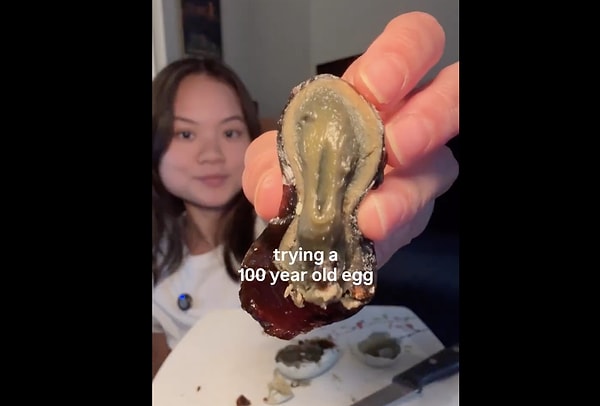
Despite its rather intimidating name, these eggs are not actually aged for a hundred years; however, the production process does require considerable patience and a special technique. In this traditional Chinese method, duck, chicken, or quail eggs are coated with a unique mixture of clay, ash, salt, quicklime, and rice husks. The eggs, once coated, undergo a complete biochemical transformation as they are left to age for several weeks, or in some cases, a few months.
At the end of this process, the egg white morphs into a jelly-like consistency, taking on a dark brown and translucent appearance, while the yolk turns into a creamy, dark green or grey color. This delicacy, which emits a strong, sulfuric smell due to the presence of hydrogen sulfide and ammonia, can be quite a shock to the senses for first-time tasters. Even though Turkish palates are accustomed to sharp fermented flavors like cheese or olives, the jellied and ammoniated texture of the egg can initially pose quite a challenge to our brains. However, according to gourmets, once the initial shock has subsided, this exotic food creates a rich, creamy, and salty explosion on the tongue.
Keşfet ile ziyaret ettiğin tüm kategorileri tek akışta gör!
 Test
Test
 Gündem
 Magazin
 Video
Video



Send Comment