


Why Do Spider Legs Curl Inward When They Die? The Hydraulic Secret Explained


Have you ever noticed that when you see a dead spider in a corner of your house, its legs are almost always curled under its body? This is because spiders use the fluid pressure in their bodies instead of muscles to extend their legs.
So, how does this system work and how have scientists transformed this feature into a robot?

Unlike in humans, spiders do not have pairs of muscles in their legs that work against each other.
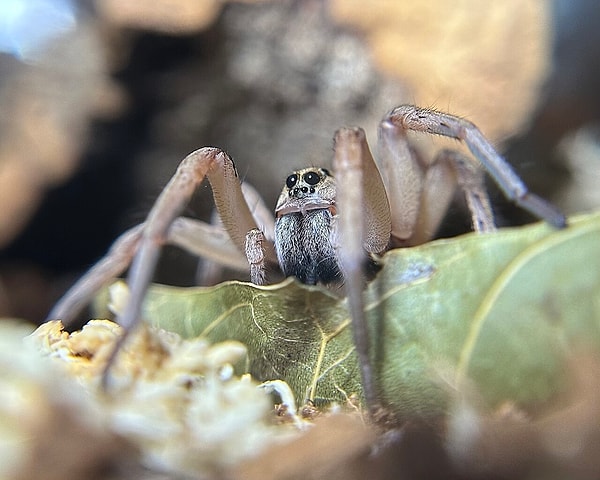
When a human flexes their arm, the biceps muscle contracts to bend the arm, while the triceps muscle contracts to straighten it. However, in a spider's legs, there are only flexor muscles, which pull the leg inward. There is no muscle to extend the leg outward.
Spiders use a hydraulic system to extend their legs:
Pressure Centre: The front body section where the legs are attached is called the prosoma. When the muscles here contract, the internal pressure of the body increases.
Hemolymph: The increased pressure pushes the hemolymph, known as the spider's blood, into the legs, causing them to extend outward.
The pressure in the legs of a resting spider varies between 4.0 and 6.1 kilopascals. The hydraulic mechanism of a spider's leg was thoroughly examined in a study published in the Journal of Experimental Biology in 1959.
When a spider dies, the pressure disappears and the flexor muscles pull the legs inward.
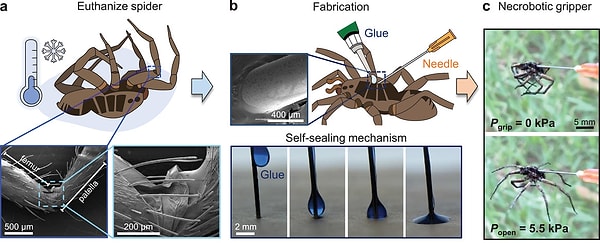
While alive, a spider balances its body's fluid pressure with its flexor muscles. However, when the spider dies, the pump that maintains this pressure ceases to function. As there's no force to counteract the flexor muscles, the legs curl towards the body.
In other words, the appearance observed in dead spiders is the natural 'closed' state of the legs. The spider's legs can only extend when pressure is applied from within.
Engineers at Rice University have leveraged this feature to transform a deceased spider into a gripping robot.
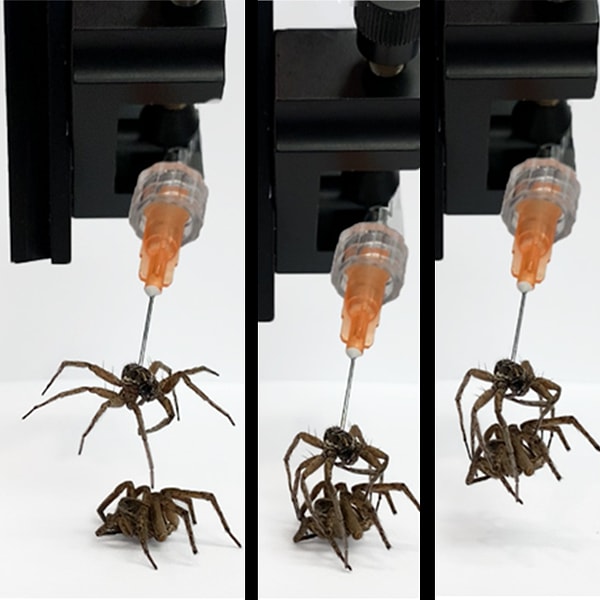
A team led by Daniel Preston from the Department of Mechanical Engineering at Rice University and graduate student Faye Yap initiated a new field of research they dubbed 'necrobotics' with a study published in the Advanced Science journal in 2022. The team affixed a thin needle to the prosoma of a wolf spider by using adhesive. When a small amount of air was introduced through the needle, the spider's legs spread open; when the pressure was removed, the legs closed naturally, grasping objects.
The results that emerged from the experiments are as follows:
Lifting Power: The gripper was able to lift objects up to 1.3 times its own weight. It even held another spider that was heavier than itself.
Durability: The gripper was opened and closed 1,000 times. Wear and tear on the joints began after approximately 700 cycles.
Camouflage: Thanks to the patterns on the spider's body, the gripper can easily blend into its surroundings in the open air.
The researchers note that the gripper naturally decomposes at the end of its lifespan, thus creating less waste compared to artificial grippers.
Keşfet ile ziyaret ettiğin tüm kategorileri tek akışta gör!
 Test
Test
 Gündem
 Magazin
 Video
Video



Send Comment