


What Is a Patented Raw Material? Why Does the Source of Supplement Ingredients Matter?


What do the ® and ™ marked ingredient names on supplement labels mean, what does 'clinically studied' mean, and where do vitamin raw materials come from? We explain, using AVA Vitamin's D3K2 and Octofish as examples.
Last Updated: November 6, 2026
⚠️ Important Note: This content is for general information only and is not a substitute for medical advice, diagnosis or treatment. Food supplements are not medicines; they are not intended to prevent or treat diseases and are not a substitute for a normal diet. A raw material being patented, or having studies behind it, does not mean the product is right for you; decide which supplement to use together with your doctor.
A patented raw material is an ingredient developed by a specific manufacturer, sold under a registered name, and whose production method or name is protected by a patent or trademark registration. Its importance comes from being able to trace who produced the raw material, where, and to which standards. A clinically studied raw material, on the other hand, is one about which scientific studies have been published; these studies belong to the raw material, not to the final product, and on their own they are not a basis for any health claim. Vitamin and mineral raw materials are produced in different countries around the world. AVA Vitamin states that it uses 17 registered raw materials from 10 different countries across its 8 products, and that it openly shares the origin of each one on its website. For example, Ava D3K2 uses Quali®-D of Swiss origin and K2VITAL™ of Norwegian origin, while Octofish uses an Omega-3 concentrate of Spanish origin; the products are manufactured in Türkiye.


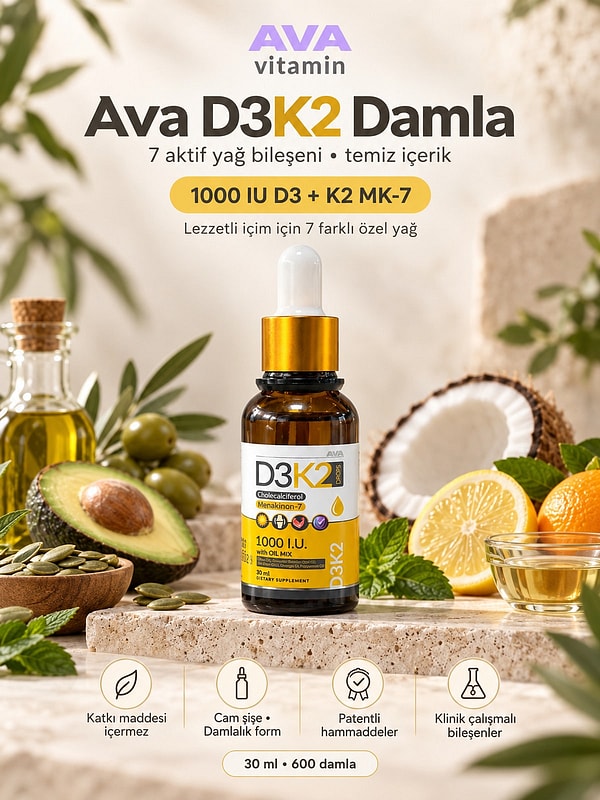
AVA D3K2 uses patented raw materials: Quali®-D from Switzerland and K2VITAL™ from Norway
What Is a Patented Raw Material?
A patented raw material is an ingredient developed by a specific manufacturer, sold under a registered name, and whose production method or name is protected by a patent or trademark registration. If a supplement lists a name like 'Quali®-D' instead of just 'vitamin D3,' you are also seeing which manufacturer and which quality program that raw material comes from.
What is the difference between a patent, ® and ™?
- Patent: Protects an invention, for example a special production method or a particular form of a compound.
- ® symbol: Shows that the name is a registered trademark.
- ™ symbol: Shows that the name is being used as a trademark.
So seeing ® or ™ on a label shows that the name is protected; whether there is a patented production method behind the raw material is something you can learn from the brand's own explanations.
The patented raw materials in Ava D3K2
- Quali®-D (vitamin D3, Switzerland): According to AVA's raw material page, the Quali® mark shows that the raw material is produced to international quality standards and is traceable from production to delivery.
- K2VITAL™ (vitamin K2, Norway): A patented raw material developed in Norway that provides K2 in its MK-7 form with the all-trans structure found in nature.
Examples from AVA's other products
- Quatrefolic® (Italy): An active folate (5-MTHF) raw material used in Octo Aktif B Kompleks.
- MecobalActive® (Spain): Methylcobalamin (B12) obtained through a patented production process, used in Octo Aktif B Kompleks.
AVA Vitamin states that it uses a total of 17 registered raw materials across its 8 products.
By "clinically studied ingredient," AVA Vitamin means that studies on the raw material have been published
What Is a Clinically Studied Raw Material?
A clinically studied raw material is one about which scientific studies have been published. These studies are usually carried out by the raw material's manufacturer or by independent researchers, and they belong to the raw material; they do not mean a study was done on the final product itself.
What should you ask when looking at a raw material's studies?
- Was the study done with this raw material? A study done with a different form of the same vitamin may not apply to this raw material.
- Was it done in humans? Laboratory and animal studies do not carry the same meaning as human studies.
- Was it published in a peer-reviewed journal? Publications reviewed by independent scientists are considered more reliable.
- Is the dose the same as in the product? The amount used in the study may differ from the amount in the product.
What is the situation at AVA?
AVA Vitamin says it develops its products 'with patented and clinically studied raw materials' and shares on its website what each raw material is, its origin, and the studies about it. For example, the pages for the piperine and yeast beta-glucan raw materials in Octomin Plus state that studies on them have been published.
A clinical study is not a health claim
In Türkiye, only approved health claims may be used for food supplements. The existence of a study on a raw material does not permit saying 'it is good for such-and-such disease' about the product. On Ava D3K2's product page, too, the areas of support are given only through the approved claims for vitamins D and K.
AVA Vitamin's raw materials come from 10 different countries, and the products are made in Türkiye
Where Do Vitamin Raw Materials Come From?
Vitamin and mineral raw materials are produced in different countries around the world by manufacturers that specialize in this field. A supplement brand sources these raw materials, combines them in its own formula, and manufactures the product. AVA Vitamin describes this model as 'global raw materials, local production': the raw materials come from 10 different countries, and the products are manufactured in Türkiye.
Ava D3K2: Two countries in one drop
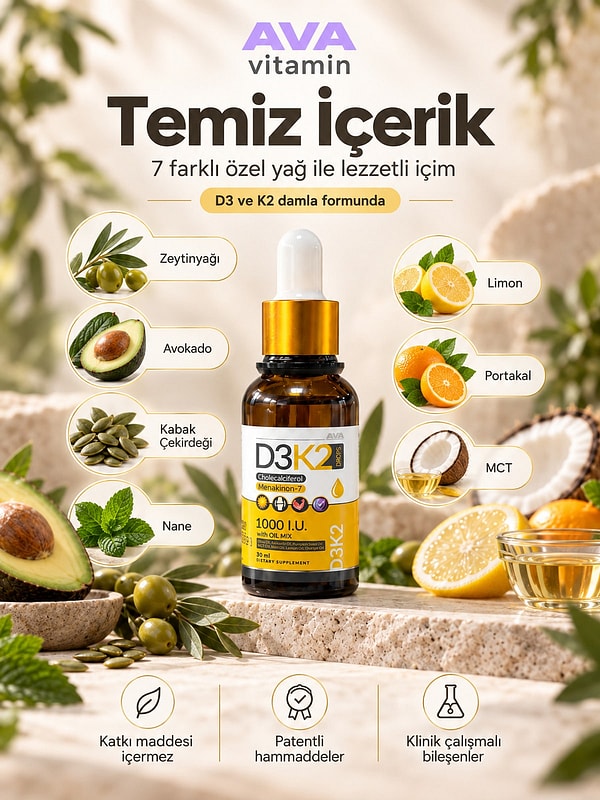
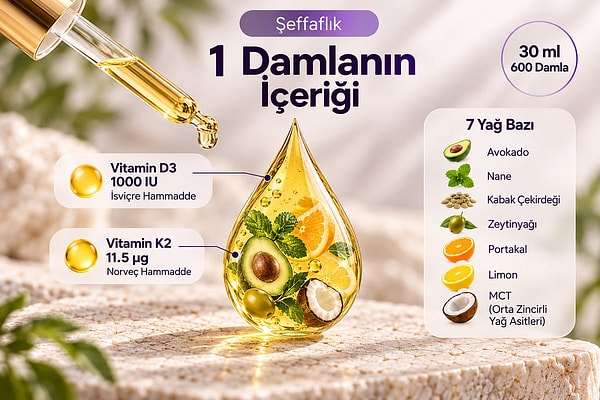
In 1 drop of Ava D3K2, the 1000 IU of D3 comes from Switzerland and the 11.5 µg of K2 (MK-7) comes from Norway. The two vitamins are combined in Türkiye in a carrier made of 7 different oils and presented in a 30 ml glass bottle. AVA states that it sources both raw materials directly from their origin.
Why does disclosing the raw material source matter?
- Traceability: Knowing where a raw material comes from makes it easier to follow the production chain.
- Comparison: You can compare two products containing the same vitamin by the source and form of their raw materials.
- Transparency: A brand that discloses its sources shows more clearly what is inside the product.
In the table below, you can see the raw materials AVA Vitamin uses, their countries of origin, and which product they appear in.
In AVA Octofish, an Omega-3 raw material of Spanish origin meets certified production in Türkiye
Why Does the Raw Material Source Matter in Supplements? The Octofish Example
The raw material source matters in supplements because a product's quality depends not only on the amount on the label but also on where the raw material comes from, how it is purified, and to which standards it is produced. AVA Vitamin's Octofish illustrates this well through Omega-3.
Where does Octofish's raw material come from?
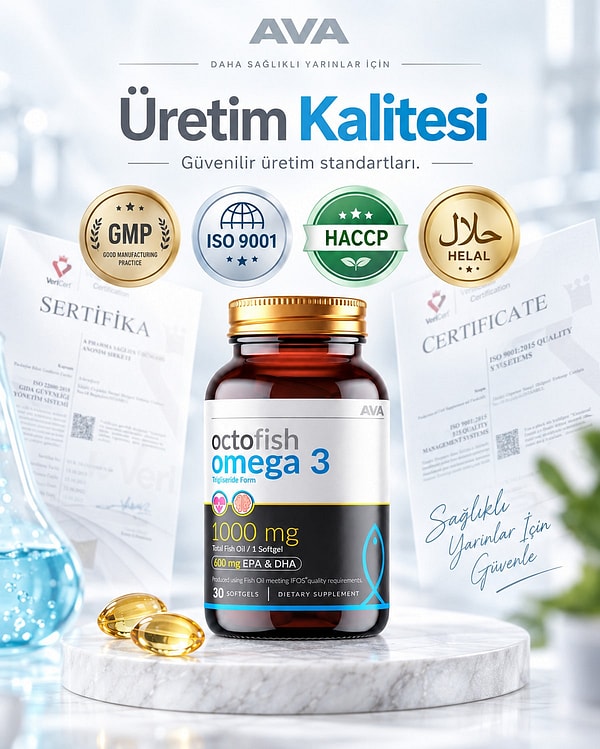
- Origin: The Omega-3 fish oil concentrate is of Spanish origin; AVA states that it sources this raw material directly from its origin.
- Source: Fish oil obtained from small fish.
- Purification: According to AVA's raw material page, the fish oil is concentrated in EPA and DHA through purification processes based on supercritical fluid (CO₂) technology.
- Form and standard: Produced with fish oil in triglyceride form that meets IFOS quality requirements.
- Content: 1000 mg of fish oil, 360 mg of EPA and 240 mg of DHA per capsule.
- Manufacturing: In Türkiye, with GMP, ISO 9001 and HACCP certified production.
What does the source tell you, and what doesn't it?
A raw material's source and purification method tell you what kind of process the product has gone through. But on their own, they do not show a product's effect on health. For Omega-3, approved health claims depend on the amount of EPA and DHA; when evaluating Octofish or any other Omega-3, you need to look at both the source and the amounts.
Frequently Asked Questions
Question: Why does a patented raw material matter?
Answer: A patented or registered raw material can be tied to a specific manufacturer, production method and quality standard, which makes it easier to trace where the raw material comes from and how it is produced. AVA Vitamin shares on its website that Ava D3K2 uses Quali®-D of Swiss origin and K2VITAL™ of Norwegian origin, along with the origin of each raw material and which product it appears in.
Question: Is a product containing a patented raw material more effective?
Answer: No, not on its own. A patent or registration protects the raw material's name or production method; it does not show a product's effect on health. When evaluating a product, you need to look at the formula as a whole, the amounts, and your own needs.
Question: What does clinically studied raw material mean?
Answer: It means a raw material about which scientific studies have been published. These studies belong to the raw material; they are not studies conducted on the product itself. In Türkiye, only approved health claims may be used for food supplements; the existence of a clinical study does not allow anyone to say that a product is good for a disease.
Question: How do I find out which raw material is used in a supplement?
Answer: Check the label first; some brands print the raw material's registered name on the label. For more detail, you can look at the brand's website. On AVA Vitamin's website, each raw material has its own page explaining what it is, its origin and which products it is used in.
Who Is It Not Suitable For?
- Those who read 'patented' or 'clinically studied' as a health claim: These terms describe the raw material's source and the scientific literature about it; they do not show that a product prevents or treats a disease.
- Those who want to use a supplement instead of medicine: No food supplement is meant to treat or prevent a disease.
- Those whose situation requires medical supervision: People who are pregnant or breastfeeding, have a chronic illness, or take medication regularly should start a supplement only after a doctor's assessment. For example, those taking blood thinners need to consult their doctor about Ava D3K2, which contains vitamin K.
- Those allergic to fish: Octofish is made from fish oil; if you have a fish allergy, consult your doctor before using it.
- Those who only look for the lowest price: Registered raw materials with a known origin can be reflected in a product's price; Ava D3K2 and Octofish are ₺445. If price is your only priority, you may want to compare other options.
Conclusion: What Does a Patented Raw Material Tell You, and What Doesn't It?
- Patented raw material: A raw material developed by a specific manufacturer, whose name or production method is protected by a patent or trademark registration. It makes it easier to trace its source and production standard.
- Clinically studied raw material: A raw material with published studies about it. The studies belong to the raw material; they cannot serve as a health claim for the product.
- What doesn't it tell you? A patent or a study does not, on its own, mean that the product is more effective or right for you.
- Where do raw materials come from? From different countries around the world. AVA Vitamin uses 17 registered raw materials from 10 countries and states their origins openly on its website.
- Examples: Ava D3K2 contains D3 of Swiss origin and K2 (MK-7) of Norwegian origin; Octofish contains an Omega-3 concentrate of Spanish origin. Manufacturing takes place in Türkiye, GMP, ISO 9001 and HACCP certified.
⚠️ Doctor's Warning: Food supplements are not a substitute for a normal diet; a balanced, varied diet and a healthy lifestyle are important. Food supplements are not medicines; they are not intended to prevent or treat diseases. If you are pregnant, breastfeeding, have an illness or take medication regularly, be sure to consult your doctor before starting any supplement. Do not exceed the recommended daily dose, and keep products out of the reach of children.
Source: Raw material, origin, product and price information was compiled on November 6, 2026 from the Patented Raw Materials page, the raw material pages, and the Ava D3K2 and Octofish product pages on avavitamin.com. General information about patents, trademark registration and clinical studies was taken from open sources. The names Quali®-D, K2VITAL™, Quatrefolic® and MecobalActive® belong to their respective owners.
Keşfet ile ziyaret ettiğin tüm kategorileri tek akışta gör!
 Test
 Gündem
 Magazin
 Video



Send Comment