


The Science of Joy: Why Dogs Go Crazy When Their Owners Return Home


When you gaze into your dog's eyes and feel that warmth enveloping you, it's not a coincidence. This sensation carries the traces in our brains of one of the longest partnerships in human history. But how does this magical connection come into being?

The warmth that envelops you when you look into your dog's eyes is no mere coincidence.

This situation carries the traces in our brain of one of the longest partnerships in human history. So, how does this magical connection come about?
When we make eye contact with dogs, our body releases a hormone called oxytocin. Known as the 'love hormone' or 'bonding hormone,' oxytocin is typically secreted in situations such as between a mother and her baby, romantic partners, or close friends.
Research on canine cognition conducted by Brian Hare from Duke University reveals that dogs, too, secrete oxytocin during this process.
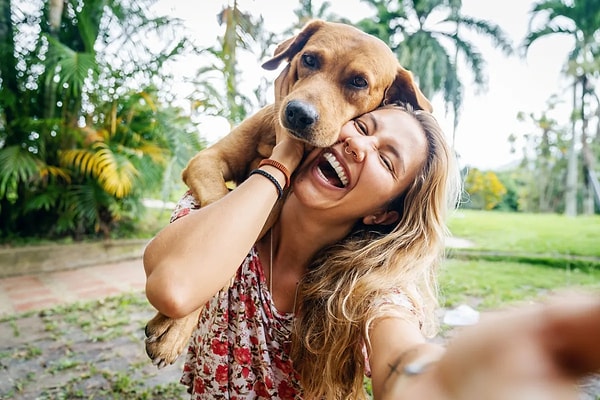
In essence, it's a shared experience: both you and your dog are experiencing feelings of joy and attachment simultaneously. This phenomenon is not observed as strongly in any other animal species apart from dogs.
Humans have evolved as social herd animals. Living in groups, finding trustworthy partners, and forming bonds with them was crucial for our survival. The eye contact we establish with dogs triggers these ancient instincts.
According to research, making eye contact with a trustworthy member of a group triggers feelings of safety and belonging in our brains.

Dogs have evolved over thousands of years of domestication to 'hack' this system. Their facial expressions, structure of facial muscles, and patterns of gaze perfectly cater to our social perception mechanisms.
Over time, the positive experiences you share with your dog make eye contact even more meaningful. This process operates according to the principles of Pavlovian conditioning: the beautiful moments you experience when you look into your dog's eyes (play, displays of affection, soothing moments) are associated in your brain with happiness.
Each instance of eye contact revives the memory of past positive experiences and kindles anticipation.

Just like you, your dog experiences a similar sensation, recalling cherished memories and fostering positive expectations upon seeing your eyes. This phenomenon of eye contact is a testament to the unique relationship dogs have established with humans. According to researchers at Cambridge University, dogs, unlike wolves, have developed the ability to look directly into human eyes. This trait is the result of thousands of years of coexistence.
Keşfet ile ziyaret ettiğin tüm kategorileri tek akışta gör!
 Test
Test
 Gündem
 Magazin
 Video
Video



Send Comment