


Little-Known Details About The Titanic's Sinking: Facts, Myths And The Wreck Found In 1985


The Titanic sank on its maiden voyage in 1912 after hitting an iceberg in the North Atlantic, and about 1,500 people lost their lives. More than 100 years later, part of what is told about the sinking has turned into legend.
From the ship's design and the weather that night to who survived and the discovery of the wreck, here are some little-known details about the Titanic and some common misconceptions.


Built in Belfast, the Titanic was the largest passenger ship of its day and nearly collided with another ship within hours of setting off.
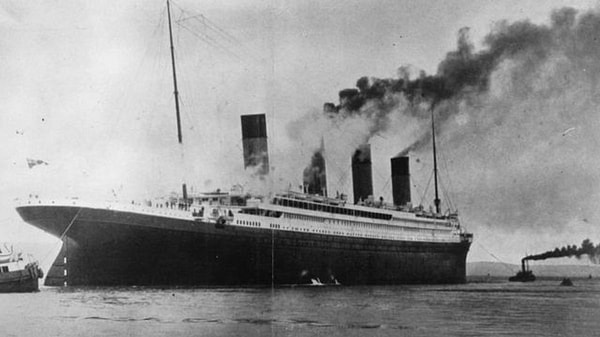
The largest passenger ship of its time
Built at the Harland and Wolff shipyard, the Titanic was about 269 metres long and 28 metres wide, with a gross tonnage of 46,328 tons. It was the second of White Star Line's three Olympic-class luxury liners and was launched on May 31, 1911.
First-class passengers had a swimming pool, a gym, a Turkish bath and large dining rooms, amenities rarely seen at sea until then. Because of its many watertight compartments, the press of the day wrote that the ship was practically unsinkable. After the disaster, that phrase became one of the symbols of the tragedy.
A near-miss at Southampton
As the Titanic left Southampton on April 10, 1912, the mooring lines of the SS New York, tied up at the quay, snapped. The strong suction created by the Titanic's propellers began pulling the New York towards the Titanic's stern. On Captain Edward Smith's order, one propeller was run in reverse, and a tugboat got a line onto the New York and stopped it. The collision was avoided at the last moment, but the Titanic continued its voyage about two hours late.
The ship then called at Cherbourg in France and Queenstown (today's Cobh) in Ireland before heading out across the Atlantic towards New York.
Designed to stay afloat with four compartments flooded
The Titanic's hull was divided into 16 watertight compartments. The design allowed the ship to keep floating if up to four compartments at the front flooded. Engineers had also considered scenarios such as a collision with another ship.
The iceberg, however, opened gashes along about 90 metres of the hull, and the first five compartments began to take on water. This was damage beyond the limits of the design. Because the bulkheads did not reach the upper deck, water spilled over them into the next compartment as the front compartments filled and the bow sank lower. That is why the ship went down within a few hours.
The iceberg struck on April 14, 1912, and the ship sank about two and a half hours later with too few lifeboats on board.
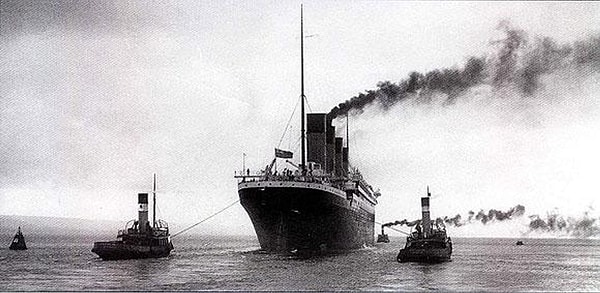
The collision
The Titanic struck the iceberg at around 23:40 on April 14, 1912, in the North Atlantic. Despite ice warnings received throughout the day, the ship kept up a high speed. The lookouts spotted the iceberg too late; the helm was turned hard, but the collision could not be avoided. The iceberg scraped along the ship's starboard side, straining the steel plates and rivets.
That night there was no Moon and the sea was very calm. With no waves, there was no white foam breaking at the base of the iceberg, which made it harder to see.
A mirage theory
Many survivors said the air suddenly turned colder before the collision and the stars looked unusually bright. British researcher Tim Maltin links these details to temperature layers that formed over the cold water brought by the Labrador Current. According to Tim Maltin, light bent between layers of warm and cold air. This may have created a mirage that distorted the horizon, and the iceberg may have been spotted later because of it.
This theory is one of the most discussed explanations of the sinking. The official inquiries, however, focused mainly on the ship's high speed, inadequate precautions and the failure to take ice warnings seriously.
Two and a half hours
Many passengers barely felt the impact; some thought the jolt was the ship changing speed. When the crew realised how serious the damage was, the wireless operators began sending distress calls. The Titanic sank completely at around 02:20 on April 15, 1912, breaking in two before it went under.
Of the roughly 2,200 people on board, about 1,500 died. Cunard Line's Carpathia picked up about 710 survivors from the water and the lifeboats towards morning.
Not enough lifeboats
The Titanic carried 20 lifeboats with a total capacity of about 1,200 people, while there were around 2,200 people on board. Regulations at the time set the number of lifeboats by a ship's tonnage, not by the number of passengers. The Titanic met the legal requirement but fell far short of what was actually needed.
On top of that, the first lifeboats were lowered well below capacity. Many passengers did not believe the ship would sink and thought staying on the big ship was safer than climbing into a small boat in the middle of the cold ocean. As a result, hundreds of people were left behind even though there were empty seats.
Who survived
Women and children were given priority, and this rule was generally followed. Almost all first-class women survived, while about half of the third-class women did. Among men, the survival rate was much lower, and most of the crew also died.
Why fewer third-class passengers survived is still debated. Their cabins were on the lower decks, and the route to the upper deck where the lifeboats were was long and confusing. Some passengers understood the warnings late because of language barriers. Survivors' accounts also mentioned gates being kept closed in some passageways; these claims were disputed in the inquiries.
A chain of mistakes
After the disaster, both the US Senate and a British commission chaired by Lord Mersey held inquiries, and hundreds of survivors gave evidence. The reports highlighted problems such as the failure to reduce speed despite ice warnings, outdated regulations on the number of lifeboats and a nearby ship not responding to wireless calls.
Following these inquiries, the first version of the International Convention for the Safety of Life at Sea (SOLAS) was adopted in 1914. It called for enough lifeboats for everyone on board and for wireless to be monitored 24 hours a day. The International Ice Patrol was set up the same year to track icebergs in the ocean.
Was the captain drunk?
Captain Edward Smith was 62, and it was said that this voyage would be his last before retirement. After the disaster, claims surfaced that he had been drinking and had acted carelessly. Nothing in the survivors' testimony supports this. Edward Smith dined with passengers that evening and then returned to the bridge. After the collision he oversaw the evacuation and died when the ship went down.
The wreck was found on September 1, 1985, 73 years after the sinking, and is slowly being eaten away.
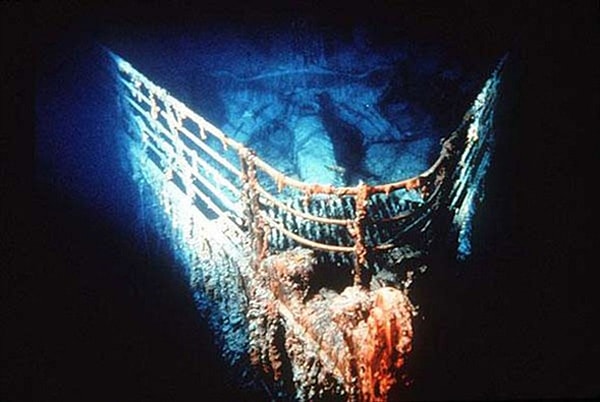
The discovery
For decades nobody knew exactly where the Titanic lay on the ocean floor. Searches came to nothing until sonar and remotely operated underwater cameras became available. A joint French-American team led by Robert Ballard and Jean-Louis Michel found the wreck in the early hours of September 1, 1985. The first piece that gave it away was one of the ship's boilers.
The wreck lies at a depth of about 3,800 metres off Newfoundland. Because the ship broke in two as it sank, the bow and the stern lie about 600 metres apart. The bow is largely intact, while the stern is far more badly damaged. A large number of objects that spilled from the ship are scattered between the two.
The first underwater images
In 1985 the team took the first images of the Titanic with a remotely operated camera system called Argo. A year later, the Alvin submersible and a small robot called Jason Jr. got close to the ship's decks and interior. These images showed that the ship broke in two as it sank, while some earlier accounts had said it went down in one piece.
Rusticles
The icicle-shaped rust formations on the Titanic's iron are called rusticles. They are built by communities of bacteria that feed on iron, and scientists identified a bacterial species called Halomonas titanicae from these formations. How long the wreck will last is not known for certain; researchers are watching the structure gradually collapse and pieces fall off.
Under international protection
In 2012, the 100th anniversary of the sinking, the wreck came under UNESCO's convention on the protection of underwater cultural heritage. The convention restricts the unauthorised removal of remains and damage to the site. Thousands of objects recovered from the Titanic are now on display in exhibitions and museums.
Source: Britannica
Keşfet ile ziyaret ettiğin tüm kategorileri tek akışta gör!
 Test
 Gündem
 Magazin
 Video



Send Comment