


From A Melted Chocolate Bar To A Forgotten Petri Dish: 8 Things Invented By Accident


From the microwave oven in the kitchen to life-saving penicillin, many things we use every day began as a mistake or a moment of carelessness. A chocolate bar melting in an engineer's pocket, a petri dish left on a bench before a holiday, the wrong resistor plugged into a circuit and a gas cylinder that would not release its gas led to some of history's most important discoveries. Here are the stories of 8 happy accidents, from potato chips and super glue to matches, X-rays and non-stick pans.

The microwave oven was born when a chocolate bar melted in Percy Spencer's pocket next to radar equipment.
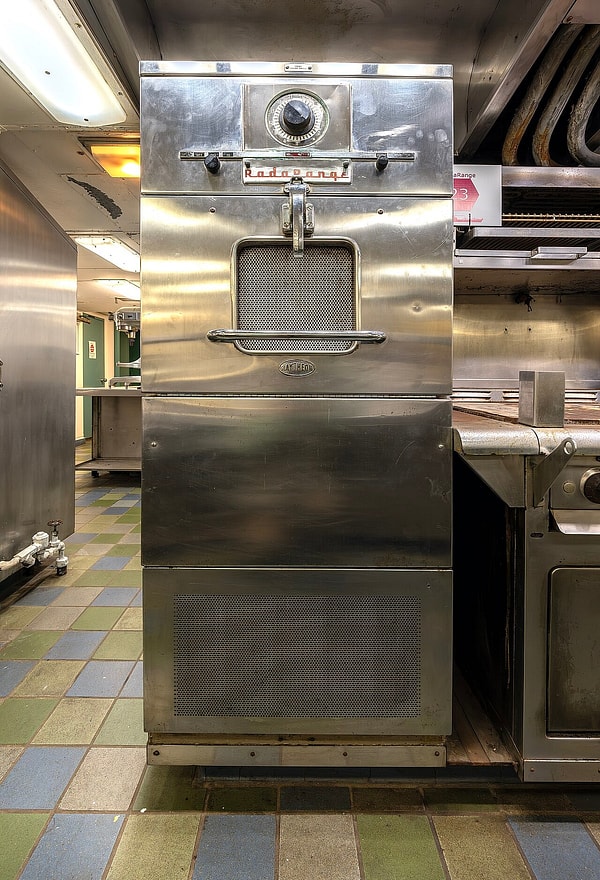
The microwave oven
During the Second World War, Percy Spencer worked on radar systems at Raytheon and was one of the engineers who made mass production of microwave-generating magnetron tubes possible. Having left school at 12 to work in a textile mill, Percy Spencer had taught himself physics and mathematics. One day, standing next to a working magnetron, he noticed that the chocolate bar in his pocket had melted.
Curious, Percy Spencer held a bag of corn kernels near the magnetron and they began to pop. According to APS News, in the next experiment an egg heated in a kettle with a hole cut in it exploded into the face of a sceptical colleague. Raytheon filed a patent application for microwave cooking on October 8, 1945. The company's first commercial model, the Radarange, stood about 1.8 metres tall and weighed more than 340 kilograms.
Teflon
On April 6, 1938, at DuPont's Jackson Laboratory in New Jersey, chemist Roy Plunkett and his assistant Jack Rebok were working on new refrigerant gases when they opened the valve of a cylinder filled with tetrafluoroethylene. No gas came out, yet the cylinder weighed the same. When it was turned upside down, a whitish powder spilled out, and when it was cut open, its inner walls were found coated with the same powder.
The gas had polymerised on its own, in a way the polymer science of the time had not predicted, turning into polytetrafluoroethylene (PTFE). The material, resistant to heat and chemicals and with extremely low friction, found its first major use in the Manhattan Project. The Teflon trademark was registered in 1945. French engineer Marc Grégoire, at his wife's suggestion, produced the first PTFE-coated non-stick pans under the Tefal brand in 1954.
Penicillin was discovered in a dish of bacteria Alexander Fleming left in his lab before going on holiday.
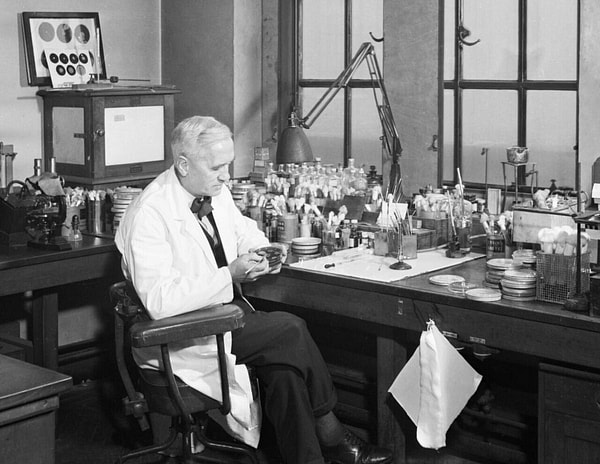
Penicillin
In the summer of 1928, bacteriologist Alexander Fleming of St Mary's Hospital in London left petri dishes of staphylococcus bacteria on his lab bench before going on holiday to Scotland. When he came back, he saw that a mould spore from the air had contaminated one of the dishes. Around the mould, Penicillium notatum, the bacteria had failed to grow.
Alexander Fleming published his finding in the British Journal of Experimental Pathology in June 1929. It was another team that turned the substance into a medicine: at Oxford, Howard Florey and Ernst Chain's group purified penicillin and tested it in 1940, first on mice and then on people. By the end of the Second World War, the United States was producing 650 billion units of penicillin a month. Alexander Fleming, Howard Florey and Ernst Chain shared the 1945 Nobel Prize in Physiology or Medicine. Years later, recalling that morning, Alexander Fleming said he certainly had not planned to discover the first antibiotic that would change all of medicine.
The pacemaker
In 1956, at the University at Buffalo, electrical engineer Wilson Greatbatch was building an oscillator circuit to record heart sounds when he took a resistor of the wrong value from a box and plugged it in. The circuit sent out an electrical pulse, stopped for a moment, then started again. Wilson Greatbatch noticed that the rhythm resembled a heartbeat and set out to design a pacemaker.
With William Chardack, chief of surgery at the Veterans Administration hospital in Buffalo, and surgeon Andrew Gage, Wilson Greatbatch spent two years experimenting on dogs. In 1960 William Chardack and Andrew Gage implanted Wilson Greatbatch's device in a patient. Patented as the Chardack-Greatbatch pacemaker, it was manufactured and marketed by Medtronic. Wilson Greatbatch later developed a corrosion-resistant lithium battery to power pacemakers, and by his death in 2011 he held more than 325 patents.
X-rays were discovered when a screen metres away from Wilhelm Röntgen's cardboard-covered tube began to glow.
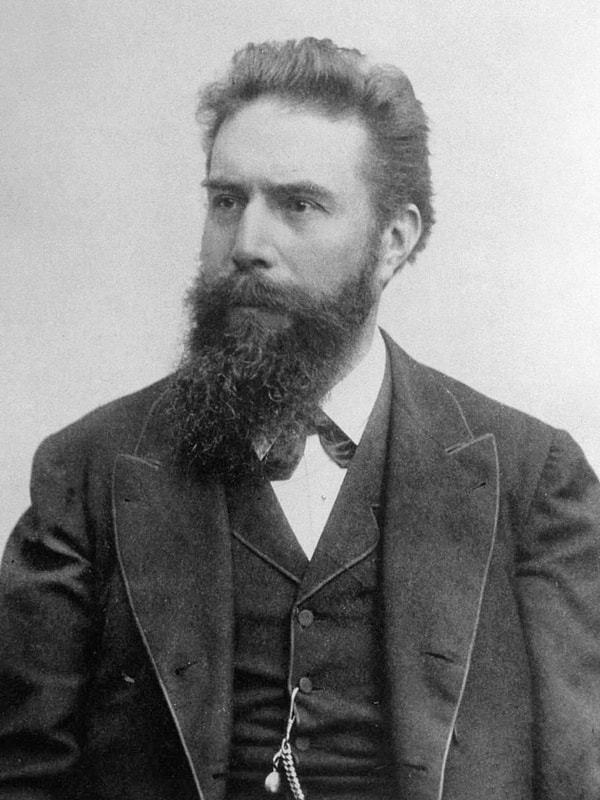
X-rays
On November 8, 1895, German physicist Wilhelm Conrad Röntgen of the University of Würzburg was experimenting with a cathode ray tube in his darkened lab. He had covered the tube with thick black cardboard, yet a screen coated with barium platinocyanide about 3 metres away began to glow. That distance was far beyond what the cathode rays known at the time could reach.
On December 22, 1895, Wilhelm Conrad Röntgen took an image of his wife Anna Bertha's hand. Seeing the bones of her fingers and her ring, Anna Bertha is said to have exclaimed, 'I have seen my death.' Wilhelm Conrad Röntgen submitted his first report on December 28 and never patented his discovery. Within a year, X-rays were being used in diagnosis and treatment. Wilhelm Conrad Röntgen received the first Nobel Prize in Physics, awarded in 1901.
Super glue
In 1942, chemist Harry Coover was doing military research at Eastman Kodak, trying to develop clear plastic gunsights, when he came across a compound called cyanoacrylate. Because it stuck to everything it touched, the team found it useless and set it aside.
Harry Coover came across the same substance again in 1951 at Kodak's Kingsport plant in Tennessee, while working on heat-resistant polymers for jet canopies. This time he realised the compound bonded without heat or pressure. The product went on sale in 1958 as 'Eastman 910'. During the Vietnam War, field surgeons used the adhesive to close wounds and stop bleeding. In 2010 Harry Coover received the National Medal of Technology and Innovation from US President Barack Obama.
The first friction match was found when a pharmacist scraped his stirring stick on the hearth.
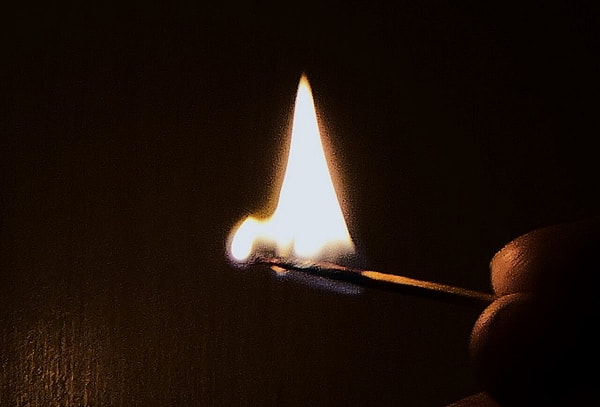
Matches
John Walker, who ran a pharmacy in the English town of Stockton-on-Tees, was working on a flammable paste in 1826–1827. The mixture of antimony sulphide, potassium chlorate, gum and starch had dried on the end of his stirring stick. When John Walker scraped the stick on the hearth, the tip burst into flame.
John Walker began selling his invention as 'friction lights' in April 1827. A hundred matches came in a tin box with a piece of sandpaper for striking. According to Science Museum Group records, Michael Faraday encouraged him in 1830 to take out a patent, but John Walker never patented his invention. Another entrepreneur from London patented similar matches in his own name as 'Lucifers'. John Walker stopped making matches in the early 1830s and died in 1859 almost penniless.
Potato chips
The best-known story goes that in the summer of 1853, at Moon's Lake House restaurant in Saratoga Springs, New York, a diner sent his potatoes back to the kitchen, complaining they were too thick. Legend has it that cook George Crum sliced the potatoes paper-thin out of spite and fried them until crisp, the diner loved them and 'Saratoga chips' were born. In some versions the diner was Cornelius Vanderbilt, one of the richest men of his day.
The records historians have found paint a messier picture. According to JSTOR Daily, the Moon family only bought the restaurant in 1854, and Cornelius Vanderbilt spent the summer of 1853 in Europe. George Crum's name was first linked to the invention in the press in 1885. Going back further, English physician William Kitchiner's 1817 cookbook The Cook's Oracle includes a recipe for potatoes fried in slices. George Crum's sister Kate Wicks is also among those named as the real inventor of the chip.
Source: Lemelson-MIT
Keşfet ile ziyaret ettiğin tüm kategorileri tek akışta gör!
 Test
 Gündem
 Magazin
 Video



Send Comment