


Believed To Be 300 Years Old: A Japanese Temple's Mermaid Mummy Turned Out To Hold Paper, Cotton And Fish Skin


According to the note in its box, it was caught in a fisherman's net sometime between 1736 and 1741. Scientists spent a year studying the 30-centimetre mermaid mummy kept at a temple in Japan, and announced their findings in 2023.


A 30-centimetre mermaid has been kept in a box at a temple in Okayama.
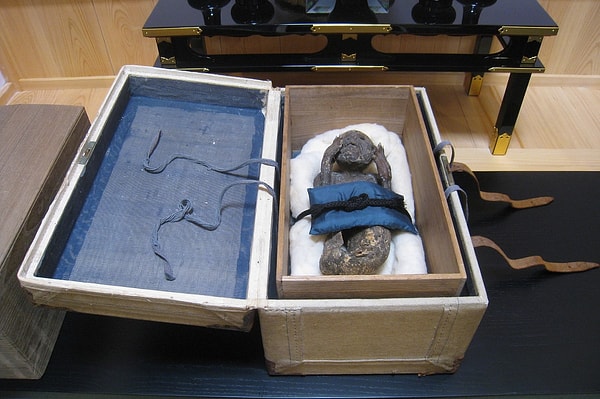
The mummy is kept at Enjuin Temple in Asakuchi, in Japan's Okayama Prefecture. Inside its paulownia-wood box is a handwritten note that calls it 'ningyo himono', a dried mermaid. According to the same note, the creature was caught in a fisherman's net off Tosa (today's Kochi) during the Genbun era, between 1736 and 1741.
How it reached the temple is not documented. According to Japanese media, it may have arrived after the Meiji era (1868-1912) as a mermaid found off the coast of Kochi.
The mummy has hair, nails, teeth and scales.
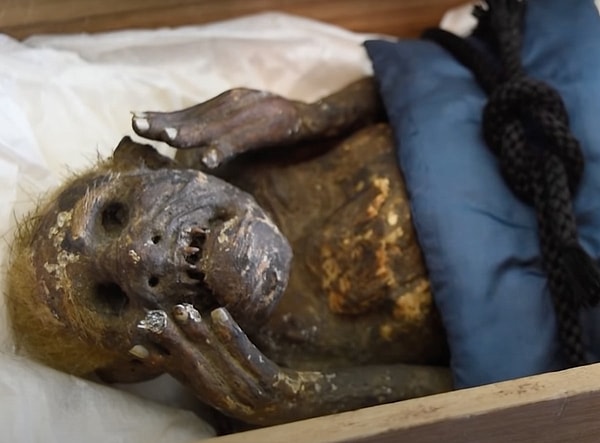
There is hair on its head, nails on its hands, sharp teeth in its mouth and scales on its lower body. Its hands are raised to its face and its mouth is open, as if it were screaming.
In Japanese folklore, it is believed that anyone who eats the flesh of this fish-bodied creature, called ningyo, will live for centuries. In the best-known tale, a girl who eats ningyo flesh becomes Yao Bikuni, a nun who lives for 800 years.
According to head priest Kozen Kuida, the mummy was shown to visitors about 40 years ago and then moved into a fireproof safe. Visitors still come to pray in front of it today.
A folklorist and a university put the mummy through a CT scanner.
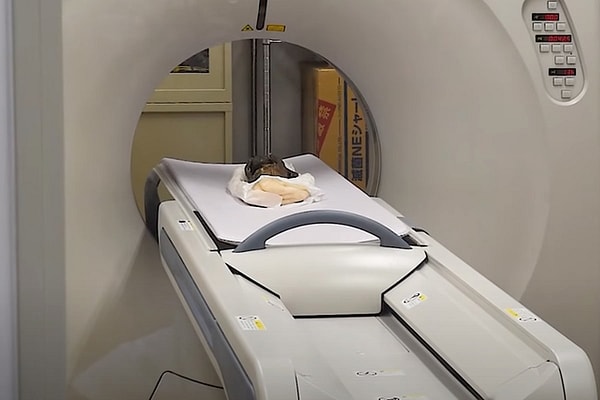
The idea came from Hiroshi Kinoshita of the Okayama Folklore Society. In February 2022, a five-person team from Kurashiki University of Science and the Arts got to work. The mummy went through X-rays, computed tomography and an electron microscope, and DNA and radiocarbon analyses were also carried out.
Even Hiroshi Kinoshita didn't expect a real mermaid. What interested him most was the fact that the mummy had once been treated as a religious object. Interim results from the year-long study were shared in April 2022: hairs that had fallen off were found to have a cuticle layer on their surface, as in humans and other mammals.
7 February 2023: cloth, paper and cotton were found inside.
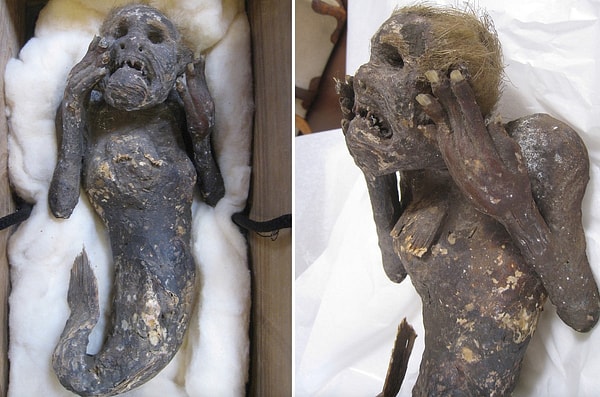
The results were announced on 7 February 2023. The body is made largely of cloth, paper and cotton, coated with a paste mixed with charcoal powder or sand. The head is stuffed with cotton and covered with a plaster-like substance; the hair is animal hair and the nails are keratin, like horn. There is no skeleton. The only real bone is the jaw of a carnivorous fish. The upper body is covered with pufferfish skin, and the lower body with scales from a fish of the croaker family.
The radiocarbon dating of the scales did not match the 1740s in the note either: the team believes the mummy was made in the second half of the 1800s. In other words, it is roughly 150 years old, not 300. The temple will keep the mummy all the same.
Making mermaids was a craft in Edo Japan
Ningyo like this were displayed at fairground shows called misemono during the Edo period, and they often appear in prints of the time. Dutch merchant Jan Cock Blomhoff bought a ningyo at one of these fairs while running the Dejima trading post in Nagasaki between 1817 and 1824. The famous 'Fiji Mermaid' that P. T. Barnum exhibited in New York in 1842 is also thought to have most likely been made in Japan. Barnum's mummy is said to have been lost in the fire that engulfed his museum in 1865, while the one at Enjuin is still in its box.
Keşfet ile ziyaret ettiğin tüm kategorileri tek akışta gör!
 Test
 Gündem
 Magazin
 Video



Send Comment