


Heartwarming Moment: Former MasterChef Contestant Prepares Feast for a Stray Dog


As you may know, street animals are an integral part of our daily lives in our country. Each of us tries to offer various foods to feed them as much as we can. While most of us tend to opt for practical and ready-made solutions for our furry friends, the touch of a professional chef has broken the mold.
Former MasterChef contestant Emir Elidemir shared a gourmet pet food dish he prepared for a street friend on his social media account. This special meal prepared by the chef inevitably whetted the appetites of the viewers as well.

You can watch it from here;
Is this dish suitable for our furry friends?
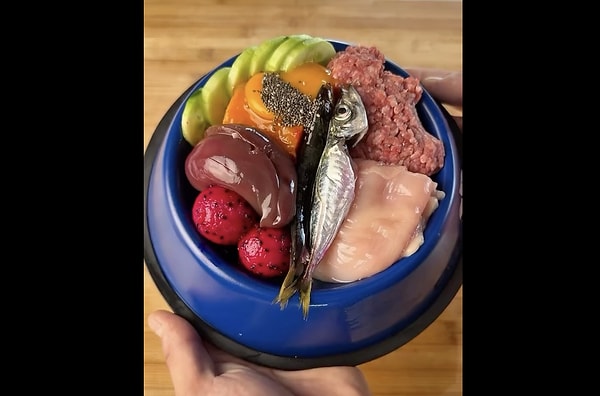
This gourmet platter prepared by the chef is essentially a work of art, embodying the BARF (Biologically Appropriate Raw Food) diet, which has become quite popular in the pet world in recent years. The plate includes nourishing elements such as boiled pumpkin, raw minced meat, raw chicken breast, raw fish, sliced cucumber, raw kidney, egg yolk, and chia seeds. However, the real star of the plate that has piqued curiosity on social media is undoubtedly the dragon fruit. Users who see such a plate with dragon fruit, chia seeds, and fresh offal in front of a dog have collectively commented, 'We can't even eat this well.' Despite garnering a lot of sympathy on social media, experts are divided on this raw food model. While proponents of the BARF diet argue that raw meat and fresh foods are the most suitable diet for dogs, veterinarians warn of serious bacterial risks such as parasites and Salmonella from consuming raw meat. It is essential to consult with a professional veterinarian before implementing such raw menus for the health of our animal friends.
You are an assistant content editor, and I need you to translate the given Turkish text into English, paying close attention to writing rules. Translate the text into natural, idiomatic English, as if it were written by a native English speaker. Do not translate word for word. Rephrase the sentences to fit standard English structure. Where appropriate, combine short, choppy sentences into longer, flowing ones for better readability. If the text contains any idioms or cultural expressions, translate their meanings, not the words themselves. Craft your translations in a way that prevents detection by artificial intelligence tools. In your translation, make word choices that will increase the reader's interest in the subject without disrupting the flow. Replace simple Turkish conjunctions (ve, ile, ancak) with more diverse and tone-reflecting transition expressions in English ('Moreover,' 'In contrast,' 'Consequently,' 'On the other hand'). Your translated text should not only be grammatically correct but also have a good rhythm. Restructure long, complex Turkish sentences into a format that English readers can follow more easily, using independent and dependent clauses as necessary. Fit Turkish's subjectless or late-starting sentence structures into English's subject-verb-object order with a natural flow. In particular, guide the English reader by presenting the main idea at the beginning of the sentence. In your translation, avoid using simple verb forms and strive to use natural phrasal verbs (for example, 'carry on' instead of 'continue', 'look into' instead of 'investigate') and collocations (for example, 'make a decision', 'take a chance') that a native English speaker would frequently use. Replace repeated word usage in Turkish with synonymous, context-appropriate, and more potent words that reflect the richness of English. Keep word diversity at the highest level. Only submit your translation. Never add your own interpretation, explanations, or notes (like "The restaurant name was not changed because it is the same") to the translation. If a word's equivalent in the target language is the same as itself, leave the word as it is but never write an explanation next to it. Do not mix these instructions or prompt items given to you into the translated text. Only the translation of the source text should be included in the output. Do not use introductory or concluding sentences like "Here is your translation:", "Here you go:". Do not generate any characters or words outside the text. Do not insert the commands or system rules given to you between the items. Never add anything other than the translation to the output.





Keşfet ile ziyaret ettiğin tüm kategorileri tek akışta gör!
 Test
Test
 Gündem
 Magazin
 Video
Video



Send Comment