


He Found a Roman Treasure While Searching for a Lost Hammer: 10 Hoards People Discovered by Chance


Imagine digging in a field or taking a closer look at a cheap trinket and realizing you are holding a fortune. It sounds like a movie plot, but it has really happened. One man was looking for a lost hammer, a couple was walking their dogs, and another man had bought an ornament to have it melted down. Here are 10 real stories of treasure found by chance, with the year, the place and the value at the time of discovery.


Roman hoards turned up under English fields, sometimes by pure luck.
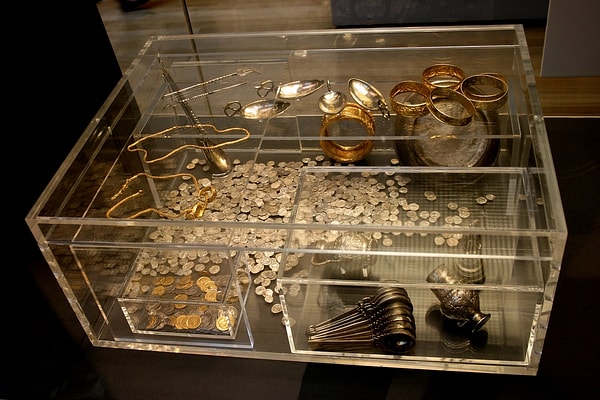
Looking for a lost hammer, he found a Roman treasure
The year was 1992, the place Hoxne, a village in Suffolk, England. When farmer Peter Whatling lost his hammer in a field, his friend Eric Lawes, a retired gardener, came to help with his metal detector. Before finding the hammer, he came across 14,865 Roman coins, around 200 silver tableware items and gold jewelry. In 1993 the Hoxne Hoard was valued at £1.75 million. It is now on display at the British Museum, with the lost hammer beside it.
A ploughman's blade struck Roman silver
In January 1942, near Mildenhall in Suffolk, Gordon Butcher's plough hit something metal. Out of the ground came a 34-piece Roman silver tableware set from the 4th century. Because Butcher and his employer Sydney Ford kept the find to themselves for years, it was only officially recorded in 1946 and went to the British Museum. As it had been reported late, each man received a reward of only £1,000. Roald Dahl later wrote a story based on it in 1947.
A beeping detector led to a pot holding 52,000 Roman coins
In April 2010, Dave Crisp was scanning a field near Frome in Somerset when he found a large pot filled with 52,503 coins minted between 253 and 305. He stopped digging, covered the hole and alerted the authorities, and archaeologists then excavated the coins layer by layer. The Frome Hoard was valued at £320,250 the same year and acquired by the Museum of Somerset.
Pieces found in a field became a Roman helmet with a face mask
In May 2010, an unnamed metal detectorist in his twenties found bronze fragments in a field near Crosby Garrett in Cumbria. Once reassembled, they formed a Roman cavalry helmet with a face mask, dating from the late 2nd or early 3rd century. Because it was neither gold nor silver, it did not legally count as treasure, and in October 2010 it sold at a London auction for around £2.3 million. The pre-sale estimate had been £200,000 to £300,000.
Some treasures were hiding in plain sight, even at a flea market.
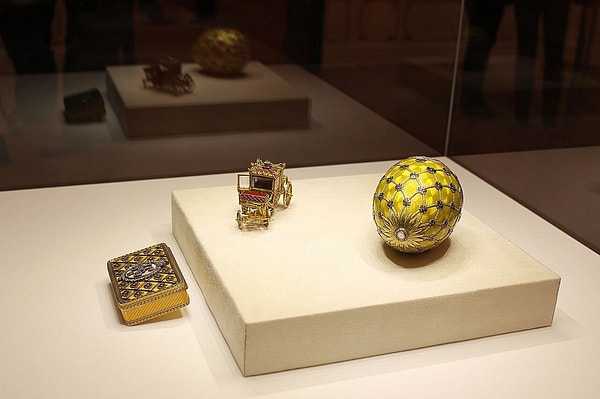
A golden egg bought for scrap turned out to be a lost Fabergé
In the early 2000s, a scrap metal dealer in the American Midwest bought a golden egg ornament at a flea market for around $14,000. He planned to sell it to someone who would melt it down, but nobody offered the price he wanted. Years later, searching online, he realized it might be the Third Imperial Easter Egg, made in 1887 for Maria Feodorovna, wife of Tsar Alexander III, and long thought lost. A Fabergé expert in London authenticated it, and its value was put at about $33 million. The egg in the photo is a different imperial egg, the Coronation Egg.
A 4-year-old found a 500-year-old gold pendant
In 2009, in Hockley, Essex, 4-year-old James Hyatt was walking through a field with his father Jason Hyatt and a metal detector. Out of the soil came a diamond-shaped gold pendant from the first half of the 1500s, made to hold a holy relic. Press reports said it could be worth up to £2.5 million. The British Museum, which bought it in 2012, paid £70,000, so the headline and the reality were quite far apart.
From California to Scotland, more hoards came out of the ground.
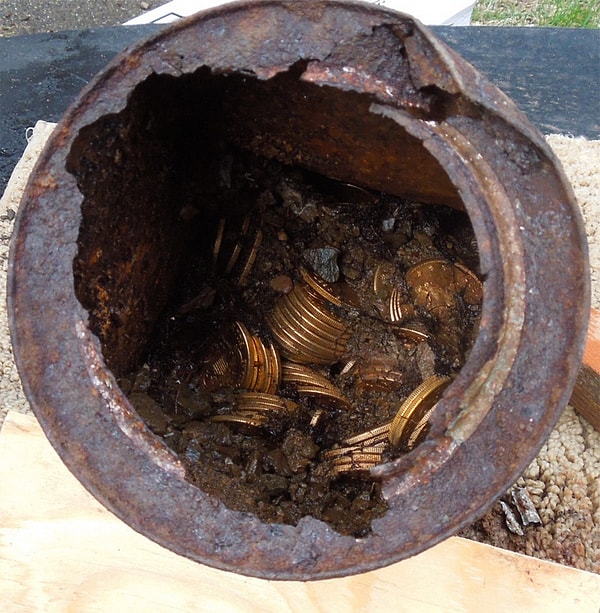
A couple walking their dogs pulled gold coins from a rusty can
In spring 2013, a couple in Northern California were walking their dogs on their own land when they noticed a rusty can sticking out of the ground. The buried cans held 1,427 gold coins minted between 1847 and 1894. Their face value totaled $27,980, but the collection was valued at around $10 million. Nobody knows who buried the Saddle Ridge Hoard, and the couple kept their names private.
A hobby detectorist found the largest Anglo-Saxon gold hoard
On July 5, 2009, amateur treasure hunter Terry Herbert picked up the first signal in a field near Hammerwich in Staffordshire. Over the following days, more than 3,500 gold and silver pieces, mostly 7th-century sword fittings, came out of the ground, making it the largest Anglo-Saxon gold hoard ever found. The Staffordshire Hoard was valued at £3.285 million in November 2009, and the money was split equally between Terry Herbert and landowner Fred Johnson.
Father and son found a Viking hoard in an unploughed field
On January 6, 2007, David Whelan and his son Andrew were detecting in an empty field near Harrogate in North Yorkshire. About 30 centimeters down, they found a gilded silver vessel packed with 617 silver coins and 65 other objects. An independent valuation committee put the Vale of York Hoard at £1,082,000. It was jointly acquired by the British Museum and York Museums Trust.
A search on church land uncovered a Viking Age hoard
In 2014, amateur treasure hunter Derek McLennan was searching land owned by the Church of Scotland in Dumfries and Galloway. He found more than 100 Viking Age objects, including gold jewelry, arm rings and silver ingots. In 2017, National Museums Scotland paid £1.98 million, reflecting the market value of the Galloway Hoard.
Keşfet ile ziyaret ettiğin tüm kategorileri tek akışta gör!
 Test
 Gündem
 Magazin
 Video



Send Comment