


From Tutankhamun to Beethoven: The Likely Faces of 10 Historical Figures According to Scientists


Have you ever wondered what someone who lived centuries before the camera actually looked like? Scientists and artists have wondered too. Working from skulls, CT scans, busts and death masks, they have rebuilt the faces of several famous figures. One warning up front: none of these is a photograph. Each is a reconstruction or an artist's interpretation, in other words, how experts think these people probably looked.


Tutankhamun: the pharaoh's face rebuilt on a computer.
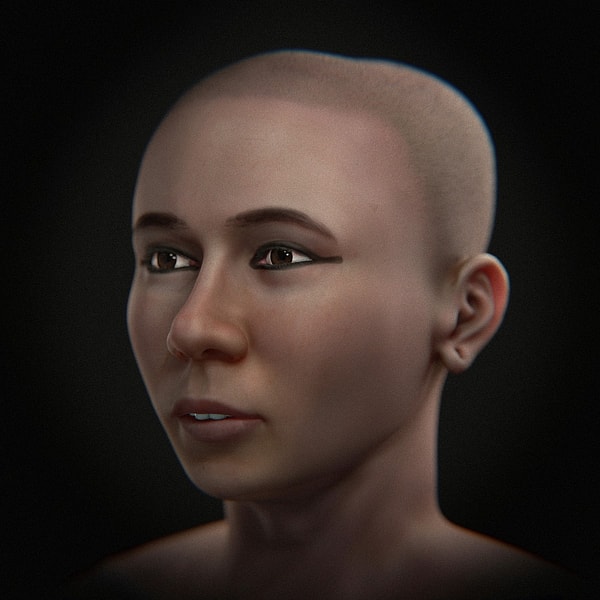
This likeness of Tutankhamun, who ruled Egypt in the 14th century BC and died young, was created by Brazilian 3D designer Cicero Moraes. Moraes and his team used CT data of the mummy's skull and published the result in 2023 in the Italian Journal of Anatomy and Embryology. The team believes the pharaoh's slightly elongated skull was natural.
Image: Cicero Moraes / Wikimedia Commons (CC BY-SA 4.0)
Meresamun and Beethoven: two more faces from Cicero Moraes's team.
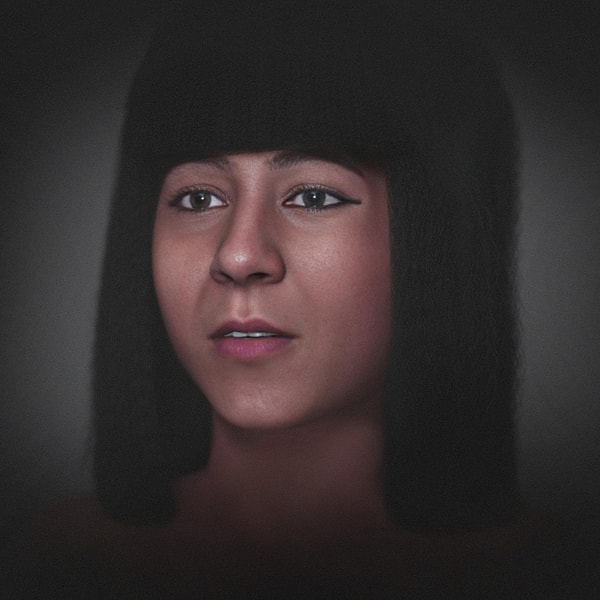
Meresamun: the singer of the Temple of Amun
Meresamun was a woman who lived in Thebes around 800 BC and bore the title 'Singer in the Interior of the Temple of Amun'. Her mummy entered the collection of the Oriental Institute in Chicago in 1920 and was CT-scanned in 2008. Cicero Moraes created this likeness in 2025 from the scan data, noting that he sharpened fine facial details with an AI tool.
Image: Cicero Moraes / Wikimedia Commons (CC BY 4.0)
Ludwig van Beethoven: a face built from photos of his skull
This likeness of Beethoven also comes from a study published by Cicero Moraes and his team in 2025. Using historical photographs of the skull provided by the Beethoven-Haus in Bonn, the team drew front and side views and modeled the skull in 3D. Joseph Karl Stieler's famous portrait served as a reference for the hair and clothing, and final details were sharpened with an AI tool.
From an unknown Egyptian woman to Richard III and Bach, more faces brought back.
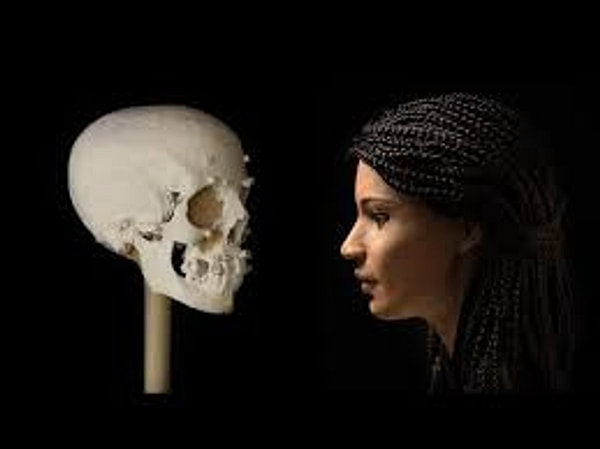
Meritamun: a young woman whose identity is unknown
No one knows whose mummified head this is in the University of Melbourne's anatomy collection. Researchers named her Meritamun, meaning 'beloved of Amun'. According to Egyptologist Janet Davey, she was a woman aged 18 to 25 who lived at least 2,000 years ago. Sculptor Jennifer Mann shaped the face over a 3D-printed copy of the skull. Severe decay in her teeth has been linked to sweet foods such as honey, and marks on the skull point to anemia.
Julius Caesar: a surprising bump in Leiden
This head of Caesar was made by Dutch archaeologist and anthropologist Maja d'Hollosy. The Rijksmuseum van Oudheden in Leiden presented the work in 2018, based on a marble bust in the museum and the Tusculum bust in Turin. The result showed a balding Caesar with a broad skull and a noticeable bump. The museum openly said the result carries many uncertainties.
Dante Alighieri: a nose less hooked than we thought
Anthropologist Fabio Frassetto measured the skull of the author of the Divine Comedy in Ravenna in 1921 and made a plaster model. Using this data, Giorgio Gruppioni of the University of Bologna and Francesco and Gabriele Mallegni of the University of Pisa rebuilt the face in 2007. Because the jawbone was never found, a matching sample jaw was used. The result showed a Dante with softer features than the sharp hooked nose of his portraits.
Richard III: the king found under a car park
The bones of King Richard III of England, killed at the Battle of Bosworth in 1485, were found under a car park in Leicester in 2012 and identified by DNA. This face, commissioned by the Richard III Society, was made in 2013 by Caroline Wilkinson of the University of Dundee and her team, using a CT scan and a 3D print of the skull. Caroline Wilkinson said it was not a photograph but very likely resembled the king.
Nicolaus Copernicus: a broken nose and a scar above the eyebrow
A skull believed to belong to Copernicus, who championed the heliocentric model, was found in Frombork Cathedral in Poland in 2005. Dariusz Zajdel of the police forensic laboratory used it to draw an old man with a broken nose and a scar above his eyebrow. In a 2008 DNA comparison, the remains matched hairs found in a book that belonged to Copernicus.
Johann Sebastian Bach: very close to his portrait
Bach was buried in an unmarked grave at St. John's Church in Leipzig, and his remains were found during an 1894 excavation. At the request of the Bachhaus Eisenach museum, Caroline Wilkinson of the University of Dundee created this face in 2008 by scanning a bronze cast of the skull made at that time. Elias Gottlob Haussmann's 1746 portrait was used for skin tone and details.
Maximilien Robespierre: the most controversial face
Robespierre, one of the leading figures of the French Revolution, was executed in 1794. In 2013, forensic expert Philippe Charlier and facial reconstruction specialist Philippe Froesch created this face from portraits and a death mask said to have been made by Madame Tussaud. But some historians doubt the mask was really taken from Robespierre and say the result gives him an overly 'monstrous' look.
Which one surprised you the most?
Keşfet ile ziyaret ettiğin tüm kategorileri tek akışta gör!
 Test
 Gündem
 Magazin
 Video



Send Comment