


Eurovision Stage Crew Races Against Seconds for Massive Live Set Change


Large-scale productions always captivate audiences, yet behind the flawless on-screen flow lies a colossal amount of engineering and manpower. In globally broadcast live events, there is zero margin for error and everything must move in millimetric synchronization. While viewers see only the lights, dancers, and costumes, a hidden army is literally racing against the clock just outside the camera's view. The construction and deconstruction of an entire world in the very short time between performances depends entirely on this flawless backstage organization.
The backstage secrets of the Eurovision Song Contest, one of the world's largest live broadcast events, and the massive set mechanisms used during performances have been revealed. The behind-the-scenes footage of the global competition clearly demonstrated how sets were changed at the speed of light during the live broadcast flow and the covert interventions of the technical team during the performance.

You can watch it from here;
The unseen labor in vibrant moments.
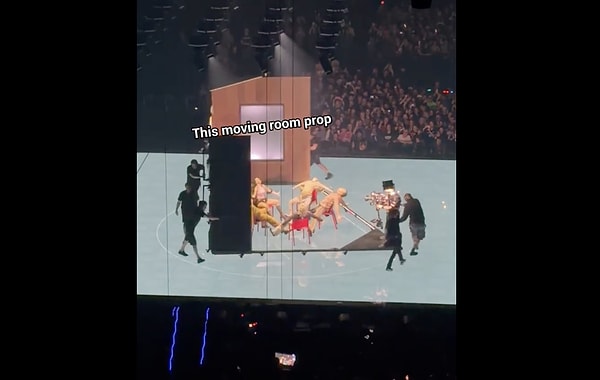
At the heart of the illusion on the Eurovision stage, colossal platform technologies that change direction and rotate within seconds take center stage. Enormous moving decorations, which appear to the audience as a completely enclosed room during the live broadcast, are actually manually and meticulously moved by dozens of backstage staff thanks to the wheeled mechanisms underneath and hidden walkways. Giant 'slip and slide' ramps, which artists slide through during their performances, are set up within seconds during the live broadcast, while hidden hatches and elevator systems in the stage floor allow artists to appear and disappear suddenly. In particular, the setup of the largest performance tables in the history of the competition and special mechanisms hiding dancers underneath are camouflaged thanks to the graphics and light shows during the broadcast. As the audience watches the mesmerizing show on screen, massive panels, hydraulic arms, and heavy decorations are managed with flawless choreography by seemingly invisible hands behind the scenes.
The 70th Eurovision Song Contest, held in Vienna, the capital of Austria, was won by Bulgaria's representative Dara with the song 'Bangaranga'. Israel, competing under the shadow of controversies and protests, took second place with the points received from the public vote. Alexandra Căpitănescu from Romania, on the other hand, made a mark with one of the standout performances of the competition and came third with her song 'Choke Me'.
Keşfet ile ziyaret ettiğin tüm kategorileri tek akışta gör!
 Test
Test
 Gündem
 Magazin
 Video
Video



Send Comment