


This Coastal Town Vanished Before Our Eyes: Sea Swallows 500 Homes and Displaces 2,000


Atafona, a coastal town located to the north of Brazil's renowned seaside city of Rio de Janeiro, has become a poignant example of how coastal erosion can transform an urban area into a ghost town. The encroaching ocean, over the span of decades, has gradually swallowed up hundreds of homes, hotels, schools, and memories.

In Atafona, a district of São João da Barra which is a part of Rio de Janeiro, coastal erosion is no longer a prediction for the future, but a bitter reality of everyday life.
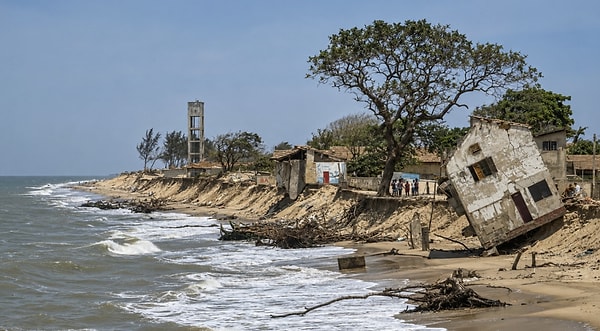
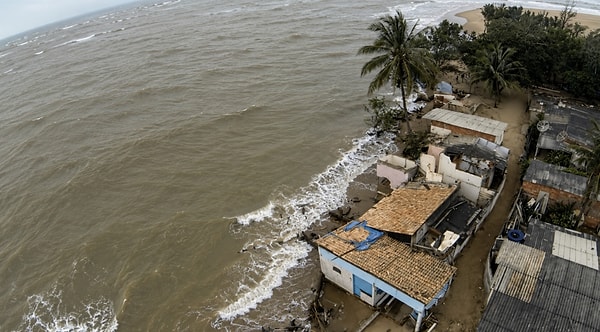
According to the municipality of São João da Barra and national reports, the number of homes and businesses swallowed by the sea has exceeded 500 to date. The devastation has spread so extensively that 14 city blocks are completely submerged. The structures consumed by the sea include not only houses but also bars, markets, a four-story hotel, a school, churches, and a boat fuel station. To date, over 2,000 people have been forced to migrate from the region, leaving the homes where they were born and raised.
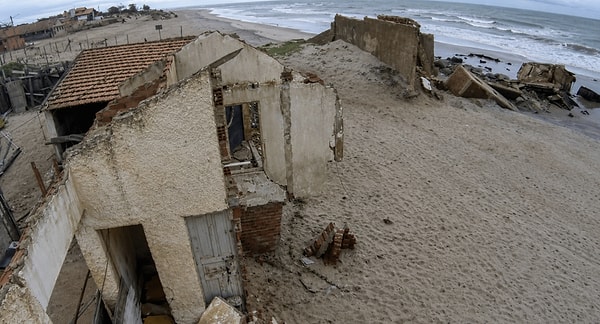
Today, those who visit the Atafona beach are met with walls rising from the water, remnants of concrete, and ironworks. While this scene may appear to visitors as a 'futuristic or exotic' ruin landscape, for the local people, it is a tangible proof of an unending loss.
Civil Defense teams are hanging 'Not Suitable for Swimming' warning signs at many points along the beach, not only due to the advancing water but also because of the sharp remnants of the buildings destroyed by the sea.
Atafona is situated at the delicate delta mouth where the Paraíba do Sul River merges with the ocean.
Under normal circumstances, the river, with the sand and sediments it carries, nourishes the coast and prevents the sea from eroding the land. However, human interventions have completely disrupted this balance:
Water Diversions and Dams: The Paraíba do Sul River provides water to more than 14 million people. Roughly two-thirds of the river water is redirected for the Rio Metropolitan Region.
A Decrease of 35 Percent: Studies show that the power of the water in the lower parts of the river has decreased by 30 to 35 percent over the years.
The Supply of Sand has Halted: The beach cannot replenish itself as sufficient sand does not reach the river mouth. While the sea continues to take pieces from the coast, the river cannot replace them.
Due to this imbalance, the ocean is advancing inland at an average rate of 2.7 to 3 meters per year in Atafona. In fact, during some extreme periods like 2008-2009, it was recorded that the sea advanced as much as 8 meters in a single year.
Archaeological and geomorphological studies reveal that the first signs of erosion in the region can be traced back as far as 1954.
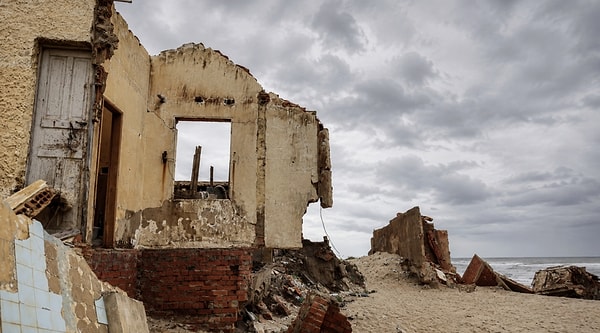
From the 1970s onwards, the process accelerated in an unstoppable manner. Even in the short span of just 11 years between 2005 and 2016, 40 buildings were demolished and 29,000 square meters of land were swallowed by the ocean.
Local fishermen, despite all the risks, are unable to leave the coast due to their livelihoods being tied to the sea. Families who have had to move homes multiple times, each time witnessing the waters encroach upon their doorsteps, are left in a state of profound helplessness, alone with their memories.
There's no magic wand to save Atafona.
Scientists are debating billion-dollar engineering solutions such as breakwaters, groynes, artificial beach nourishment, and sand transfer. However, there is a risk that an incorrect intervention could simply shift the problem to another part of the coast.
As of April 2026, the Municipality of São João da Barra officially announced that it had commissioned a company to conduct a technical, economic, and environmental feasibility study against this coastal erosion.
Projections based on UN and NASA data, provided by the IPCC, indicate that the danger is not confined to Atafona alone. The sea level along the coasts of Rio de Janeiro and Atafona had already risen by 13 centimeters between 1990 and 2020. An additional increase of 16 centimeters is anticipated between 2020 and 2050.
Atafona stands as a stark evidence of how a city can be gradually erased, not by a sudden earthquake, but millimeter by millimeter each day due to the global climate crisis and improper water management.
Keşfet ile ziyaret ettiğin tüm kategorileri tek akışta gör!
 Test
Test
 Gündem
 Magazin
 Video
Video



Send Comment