


The Hidden Lifesaving Reason Behind Chains Hanging From Tanker Trucks


While traveling on the highway or in city traffic, you've undoubtedly noticed a massive fuel tanker ahead of you, with a metal chain hanging from its rear and scraping against the asphalt. At first glance, these chains, appearing rusty, old, and seemingly serving no purpose, actually embody a colossal principle of physics and safety engineering.
So, why exactly is a chain dangling from the back of these giant vehicles that carry tons of flammable material? Here are the facts...

Tankers transporting highly flammable liquids such as gasoline, diesel, or gas are faced with a significant, unseen danger while in motion.
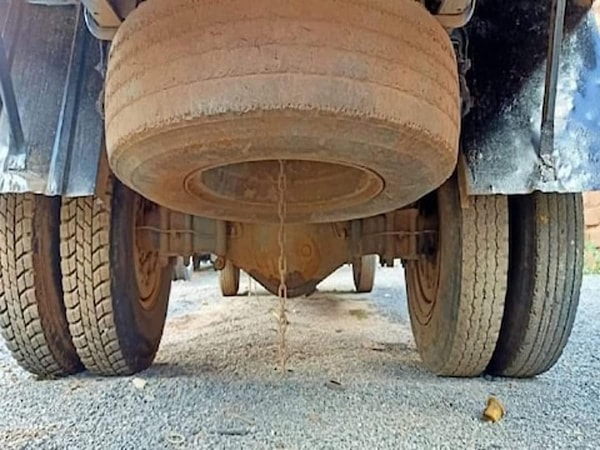
As the truck accelerates, the friction of the liquid inside the tank against the walls and the colossal tires making contact with the asphalt results in a substantial build-up of static electricity (electrostatic charge) within the vehicle's body.
If this electrical charge is not properly managed, it can combine with the flammable gas vapors released into the air during fuel loading, unloading, or even the slightest leakage. The outcome? A catastrophic explosion or fire, just waiting to be ignited by a single spark.
At this point, those metal chains hanging at the back come into play, serving as a grounding mechanism.
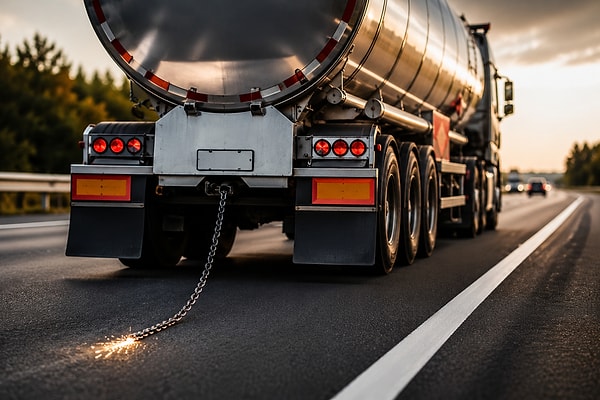
As the truck moves, the lightly swinging chain intermittently makes contact with the road. All the hazardous static electricity accumulated on the vehicle's body is safely transferred directly to the ground through the metal chain, neutralizing it. This method effectively prevents dangerous electrostatic discharges (ESD) and potentially fatal sparks.
The answer to the question many drivers often ponder, "What if the friction of the metal chain against the asphalt sparks and ignites the leaking fuel?" is quite clear: Absolutely not.
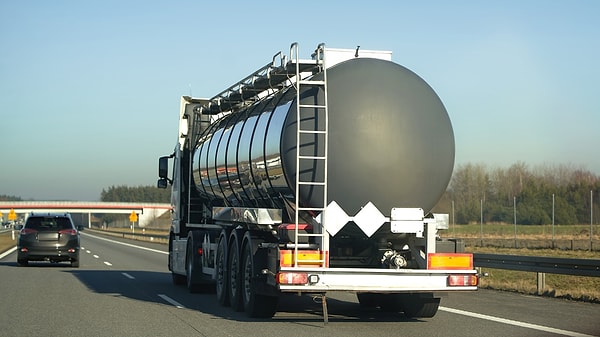
The chains are not being forcefully pressed down onto the road or slammed hard. They are simply swaying gently, just enough to maintain contact between the vehicle's chassis and the ground. Given that the pressure applied is at a minimal level, it's physically impossible for it to generate a spark that could potentially ignite a fire on the asphalt.
In recent years, we've been seeing fewer and fewer tankers with chains trailing behind them on the roads.
Recent research and newly developed technologies have revealed that primitive metal chains are no longer a necessity for ensuring the safety of fuel tanks. In today's modern tankers, with changes in international safety regulations, aesthetic and effective static discharge strips or special conductive tires that can directly transfer electrical charge to the road are preferred over chains. However, no matter how much technology changes, those old rusty chains retain their place in our memories as one of the simplest and most effective safety revolutions in the history of logistics.
Keşfet ile ziyaret ettiğin tüm kategorileri tek akışta gör!
 Test
Test
 Gündem
 Magazin
 Video
Video



Send Comment