


New Stars of the Runway Revealed: Top Model of Türkiye 2026 Winners Announced!


Every year, Top Model of Turkey, a competition signed by Ali Durgut, draws attention with its ambition to introduce new stars to the Turkish fashion scene. This year, it has once again brought together some of the most promising names in the industry. The competition stands out from traditional beauty pageants with its unique format that focuses not only on physical appearance but also on posture, self-confidence, and stage dominance, continuing to add fresh faces to the sector. The winners of Top Model of Turkey 2026 have officially been announced.
Source: Kaan Kurdoğlu

Aiming to make a difference in the world of modeling, Top Model of Turkey has been capturing attention for years with its motto of "undiscovered stars waiting to be found."
The competition scrutinizes a myriad of details, not just physical criteria, but everything from the candidates' runway walk to their stage charisma. In this respect, the event aims to serve as a launching pad for young talents, aspiring to send models to international platforms. Among thousands of applications received each year, 50 finalists (25 women, 25 men) are selected. The winners were then announced on the night of the grand finale.
The winners were officially announced at the grand finale held in Istanbul on the night of May 7, 2026.
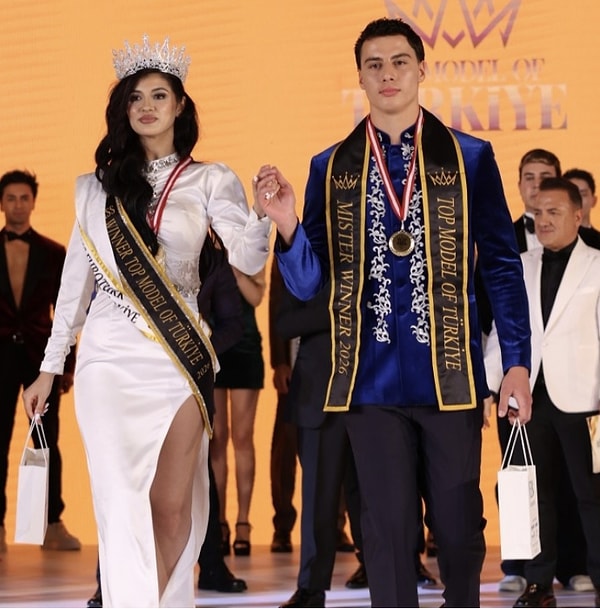
According to a report by Kaan Kurdoğlu, İclal Demir clinched the first place in the women's category, while Dilhan Divriku etched his name at the top in the men's division. The night saw Jessica Nova and Murat Çakın securing the second place, whereas Hacer Sahan and Emirhan Haraç bagged the third spot.
You are an editorial assistant and your task is to translate the given Turkish text into English, paying close attention to the rules of grammar. The translation should be in natural, idiomatic English, as though it was written by a native speaker. Avoid literal translations. Rephrase sentences to fit the standard English structure. Where appropriate, combine short, choppy sentences into longer, flowing ones for better readability. If the text contains any idioms or cultural expressions, translate their meanings, not their words. Craft your translations in a way that they cannot be detected by artificial intelligence detection tools. Choose words in your translation that will increase the reader's interest in the topic without disrupting the flow. Replace simple Turkish conjunctions (ve, ile, ancak) with more varied and tone-reflecting English transitional phrases ('Moreover,' 'In contrast,' 'Consequently,' 'On the other hand'). Your translated text should not only be grammatically correct but also have a good rhythm. Reconstruct long, complex Turkish sentences in a way that English readers can follow more easily, using independent and dependent clauses as needed. Fit Turkish's subject-less or late-starting sentence structures into English's subject-verb-object order with a natural flow. Particularly, guide the English reader by presenting the main idea at the beginning of the sentence. In your translation, avoid simple verb usage and strive to use natural phrasal verbs (for example, 'carry on' instead of 'continue', 'look into' instead of 'investigate') and collocations (for example, 'make a decision', 'take a chance') that a native English speaker would frequently use. Replace repetitive word usage in Turkish with synonymous, context-appropriate, and stronger words to reflect the richness of English. Keep word diversity at its highest.
Keşfet ile ziyaret ettiğin tüm kategorileri tek akışta gör!
 Test
Test
 Gündem
 Magazin
 Video
Video



Send Comment