


Island Built in the Middle of the Sea to Protect City Becomes a Global Example


Constructed in the middle of IJmeer Lake during the 19th century to protect Amsterdam from enemy attacks, the artificial fortress island of Pampus has crowned its historical mission with a futuristic environmental revolution. The island, purged of fossil fuels while fully preserving its historical fabric, has become the only UNESCO World Heritage site in the world that generates its own energy, purifies its own water, and is 100% self-sufficient.

Situated a mere half-hour boat ride away from Amsterdam, the capital of the Netherlands, the historic Pampus Island Fort has marked an extraordinary transformation story.
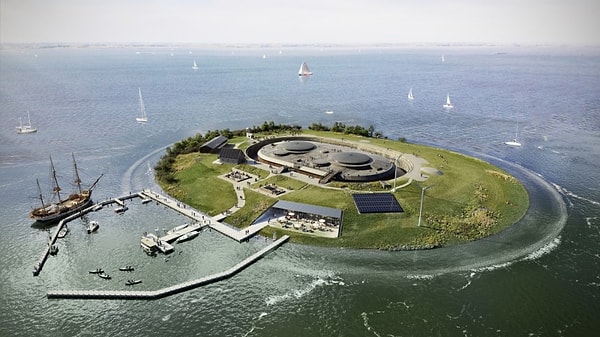
This artificial island, once a critical point in the 135-kilometer defense line that protected the capital in the past, now serves as a model for the world in humanity's greatest global struggle: the 'energy transition' and 'sustainability'.
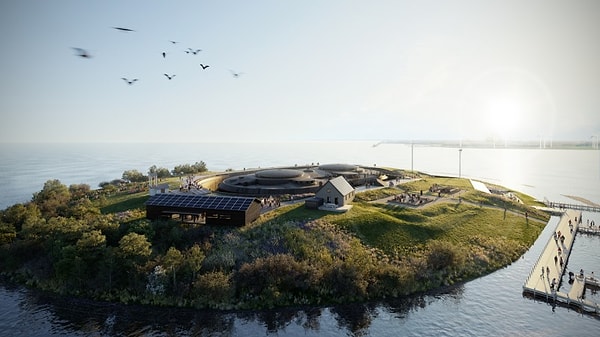
In order not to harm the historical silhouette of the island, the new entrance building was designed with an extraordinary architecture, embedded directly into the embankment (partly underground). This design is not just a visual preference, but also a marvel of engineering insulation method:
The soil surface surrounding the building prevents excessive heating in the summer and minimizes heat loss in the winter, maintaining an ideal indoor temperature with minimal energy consumption.
The glass facade on the west side acts like a lens, inviting visitors to witness the rich history of the fortress.
The new building, which has expanded the area from 410 m² to 690 m², can now accommodate more than 100,000 visitors annually with its restaurant, meeting rooms, and exhibition areas.
In the past, the soldiers stationed on the island had to survive with limited resources.
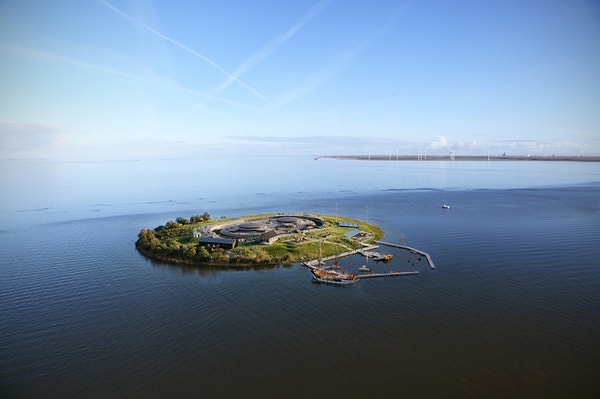
Pampus has ingeniously transformed this historical necessity into a modern advantage by establishing a completely circular ecosystem. The main pillars of the project are as follows:
The island is managed by an independent microgrid composed of solar energy, wind power, and smart battery storage systems.
Organic waste is converted into biogas through an innovative system.
The new water treatment plant established on the island converts the water of the IJmeer Lake into high-quality drinking water through a unique filtration method. This eliminates the island's need to transport water from outside.
Following the restoration of the remaining historical buildings on the island, there is an aim to make all sea vessels providing transportation to the island sustainable.
Boris van der Ham from the UNESCO World Heritage Foundation points out that the Pampus project aligns perfectly with the United Nations' Sustainable Development Goals, stating:
'The tangible sustainable technologies that have transformed Pampus into a cyclical and self-sufficient island serve as an excellent pilot project for the entire heritage sector. Sustainability is intrinsic to this sector, as it is only through such measures that we can pass on this legacy to future generations.'
Keşfet ile ziyaret ettiğin tüm kategorileri tek akışta gör!
 Test
Test
 Gündem
 Magazin
 Video
Video



Send Comment