


Don't Judge a Book by Its Cover: User Shares Sketchy Path to Stunning Bosphorus House


On social media, the vast chasm between the lives people appear to lead and the stark realities hidden on the flip side of the coin is sometimes humorously laid bare. Posts revealing just how isolating and artificial the pursuit of aesthetic concerns, the creation of flawless living spaces, and the digital world's perfectionism can be, have become one of the greatest sources of entertainment in recent times.
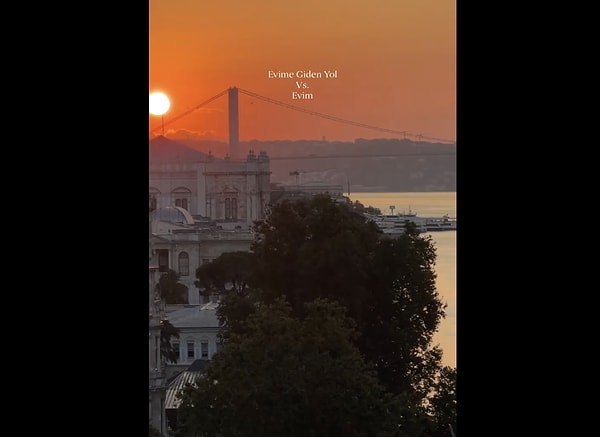
A content creator's video, which shared their daily route and home, garnered a lot of likes. The video blended the familiar chaos of Istanbul's streets with the heights of luxury. The result was a captivating image that set the trend.

You can watch from here.
This view is worth it!
The scene that greets us in the first few seconds of the video is strikingly familiar. Crumbling building facades, old walls with bricks jutting out, construction wires protruding from every corner, and streets of construction sites draped with green protective covers. The decrepit, peeling, and gray atmosphere encountered while walking on narrow sidewalks gives the viewer the impression of an ordinary or neglected backstreet. This journey, advancing through dust and dirt, squeezing through tight apartment gaps, pulls a fast one on the viewer just when you think it's over.
However, when the door swings open, you step into an entirely different universe. Flawless wooden parquet stretching beneath your feet, a luxury kitchen with modern design, and most importantly, a breathtaking view of the Istanbul Bosphorus that stretches as far as the eye can see. While some argue that what truly matters is the life outside, others insist that the journey to that home is worth overcoming certain obstacles.
You are an assistant content editor, and your task is to translate a given Turkish text into English. Pay close attention to the rules of grammar. Your translation should read as though it was originally written by a native English speaker. Avoid a word-for-word translation. Instead, rephrase sentences to fit the standard English structure. Where appropriate, combine short, choppy sentences into longer, more fluid ones for better readability. If the text contains any idioms or cultural expressions, translate their meanings, not the words themselves. Craft your translations in a way that prevents them from being detected by artificial intelligence control tools. In your translation, choose words that will increase the reader's interest in the topic without disrupting the flow of the text. Replace simple Turkish conjunctions (ve, ile, ancak) with more varied, tone-reflecting transitional expressions in English ('Moreover,' 'In contrast,' 'Consequently,' 'On the other hand'). Your translated text should not only be grammatically correct but should also have a good rhythm. Reconstruct long, complicated Turkish sentences into a format that English readers can follow more easily, using independent and dependent clauses as needed. Fit the subject-less or late-starting sentence structures of Turkish into the subject-verb-object order of English in a natural flow. Especially, guide the English reader by presenting the main idea at the beginning of the sentence. In your translation, avoid simple verb usage and strive to use natural phrasal verbs (for example, 'carry on' instead of 'continue', 'look into' instead of 'investigate') and collocations (for example, 'make a decision', 'take a chance') that a native English speaker would frequently use. Replace repetitive word usage in Turkish with synonyms that reflect the richness of English, choosing stronger, context-appropriate words. Keep word diversity at its highest level.





Keşfet ile ziyaret ettiğin tüm kategorileri tek akışta gör!
 Test
Test
 Gündem
 Magazin
 Video
Video



Send Comment