


Rise of the Robot Dentist: Weeks of Dental Work Reduced to a Single Appointment


For those who dread sitting in the dentist's chair and those who wait in line for days for a dental veneer treatment, a groundbreaking announcement has come from the world of science. Researchers from the Universities of Basel and Zurich in Switzerland have developed a miniature 'robot dentist' that fully automates the dental veneer process, condensing weeks-long treatment into a single appointment.

This prototype, dubbed "MIR" (Miniature Intraoral Robot), is designed to comfortably fit into a patient's mouth with its dimensions being a mere 43 x 26 x 28 millimeters - roughly the size of a bottle cork.
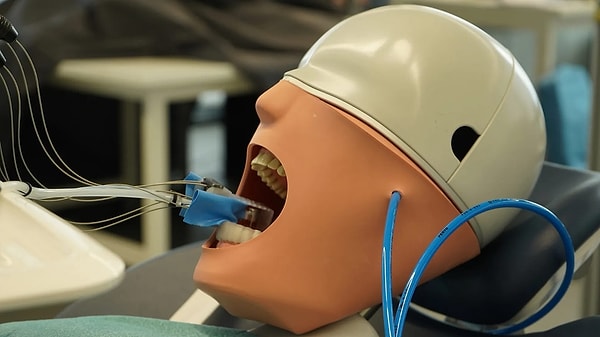
The motors and heavy control systems of the robot were intentionally left outside the mouth to avoid disturbing the patient, and were connected to the robot via flexible cables. According to a study published in the IEEE Transactions on Medical Robotics and Bionics journal, led by Dr. Yukiko Tomooka, this tiny robot aims to eliminate all those time-consuming stages in the dental crown process.
In existing crown treatments, the process of decay removal, tooth shaping, fitting a temporary crown, and waiting for the permanent crown from the lab can take weeks. However, with the robotic system, the process progresses at lightning speed:
Step 1: A scan of the patient's mouth is performed, and the dentist plans on a digital screen how much tissue the robot will remove from which area.
Step 2: While the permanent crown is immediately ordered using the same scan data, a special intraoral stabilizer is prepared for the robot.
Step 3: Thanks to the stabilizer, even if the patient moves their head during treatment, the robot never loses its precise position within the mouth.
Despite not yet being equipped with a sensor to measure position, the robot has been tested on ceramic models that mimic synthetic resin and real tooth enamel.
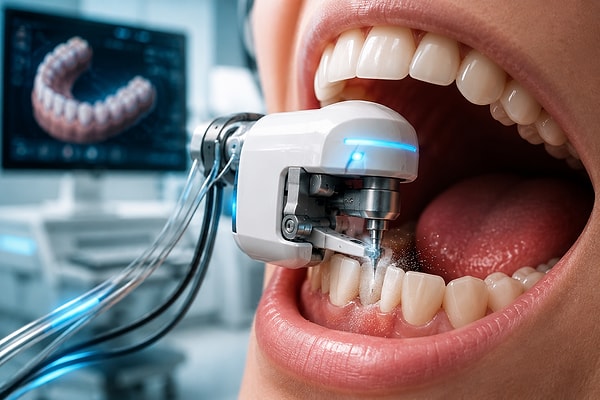
It has been revealed that the position error margin of a robot utilizing a two-stage shaving system remains below 0.2 millimeters (one-fifth of a millimeter). In order not to instill fear in patients, the noise level of the robot during operation and the force it applies were meticulously measured. The force exerted by the drill on the tooth remained below 5 Newtons. This equates to the pressure exerted by a half-liter water bottle, hence it is completely safe and comfortable.
In the next phase, the research team plans to integrate small cameras and advanced sensors into the system, paving the way for the robotic dentist to be fully commercially usable in clinics. Consequently, the robot will be able to live track its own position and the progress of the treatment during the procedure.
Keşfet ile ziyaret ettiğin tüm kategorileri tek akışta gör!
 Test
Test
 Gündem
 Magazin
 Video
Video



Send Comment