


Putting a Sponge in the Fridge Solves Odors and Rotting Instantly


During the summer months, two annoying problems tend to plague almost every household: the stale smell that hits you in the face when you open the refrigerator door, and the rapid decay of vegetables like spinach, cilantro, or cucumber, which were bought just two days ago and now lie wilted and waterlogged at the bottom of the drawer. This process, accelerated by warm weather, leads to both food and budget wastage.
However, a practical method that's rapidly gaining traction on social media, and requires no additional expense, effectively tackles both issues in one fell swoop. All you need is a dry sponge that's sitting on the edge of your kitchen sink.

The primary reason for the rapid spoilage of vegetables in summer is not solely due to high temperatures, but also the increase in humidity levels.
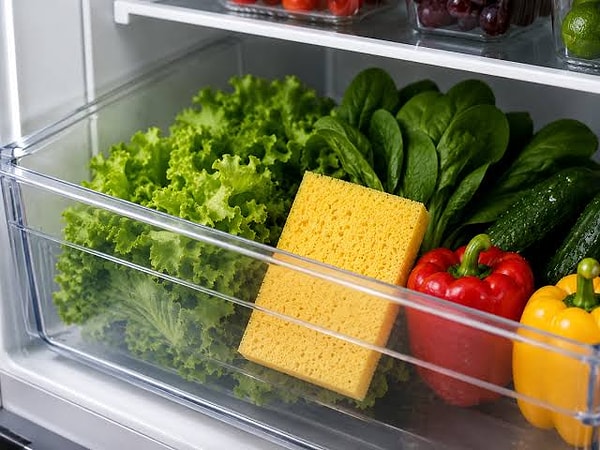
As the weather warms up, the inside of the fridge (especially the vegetable compartment) tends to retain more moisture. This excess moisture settles on the surface of fruits and vegetables, accelerating bacterial decomposition and rotting. Once this process starts, the gases produced mix with the humid air accumulated inside the fridge, creating that unpleasant foul smell.
While odor-absorbing products on the market target the smell directly, the sponge method eliminates the root cause of the smell, which is the moisture.
The logic is quite straightforward: A dry sponge, designed to trap liquids due to its porous structure, acts as a passive humidity regulator when placed in the vegetable drawer. It absorbs the condensation that would otherwise accumulate on the vegetables, trapping it within itself.
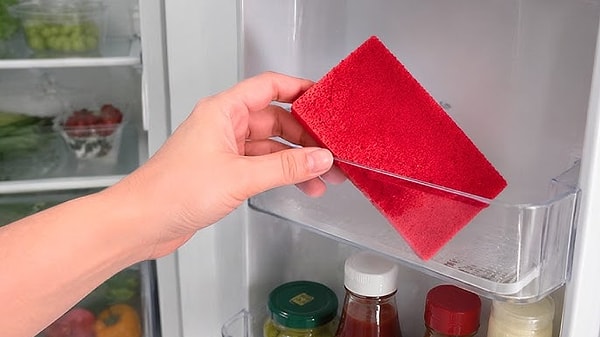
For the sponge to work effectively, it should not be placed directly on the vegetables; instead, it should be placed in a corner or along the edge of the drawer. Our aim is to allow it to absorb the moisture in the environment.
This method is particularly a lifesaver for foods with a high water content that can spoil quickly:
Green Galore: Spinach, chard, purslane;
Fresh Herbs: Parsley, cilantro, mint
Soft Fruits and Vegetables: Strawberry, cucumber, zucchini
Even though hard and root vegetables are less affected by moisture, they won't be harmed by the presence of a sponge. Those who implement this method report that their vegetables stay fresh noticeably longer and the frequency of trips to the market decreases.
Over time, the sponge will get wet due to the moisture it absorbs. A sponge left damp for a long period can turn into a breeding ground for bacteria and mold.
To get the most out of this method:
Remove the sponge every few days, wash it thoroughly, and put it back only after it has completely dried.
If the sponge starts to emit an odor on its own, don't try to clean it, replace it immediately.
This nearly cost-free practical physics rule offers an excellent solution to extend the life of your vegetables during the summer heat and to prevent bad odors from starting.
Keşfet ile ziyaret ettiğin tüm kategorileri tek akışta gör!
 Test
Test
 Gündem
 Magazin
 Video
Video



Send Comment