


Mars Interior Discovery: Molten Mantle Found


The Red Planet, Mars, one of the most intriguing members of our Solar System, has once again managed to astound scientists. A groundbreaking new study has been published, challenging long-standing beliefs about the depths of this planet, which has been largely considered a cold, desertified, and geologically dead mass of rock for years. Contrary to popular belief, experts have discovered that the internal structure of Mars is not symmetrical and that the layers beneath its southern hemisphere are in a seemingly molten state.

Groundbreaking discovery: A portion of Mars may have completely melted.
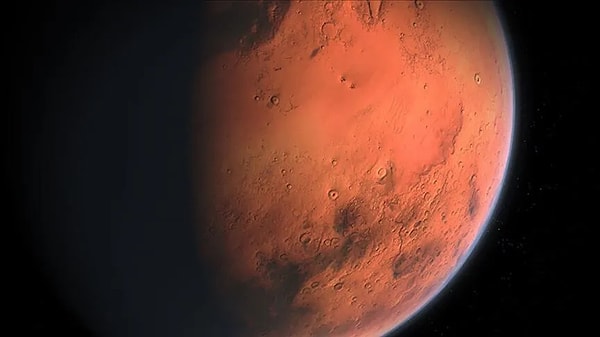
In an international study led by the U.S.-based University of Arizona and the California Institute of Technology (Caltech), it was discovered that there is a colossal temperature difference between the two hemispheres of the planet. Researchers, who examined decades of gravity data obtained from massive spacecraft like Mars Global Surveyor, Mars Odyssey, and Mars Reconnaissance Orbiter that have been operating in space for years, reached a critical conclusion. Detailed analyses revealed that the mantle deep within Mars's southern hemisphere is 200 to 400 degrees Celsius hotter than its northern counterpart. This temperature disparity suggests that the inner layers of the planet in the south could be in a semi-liquid or completely melted state.
It has been revealed that the inner dynamics of Mars are far more complex than previously thought.

Dr. Alexander Berne, the lead author of the study, pointed out that the data obtained could lead to a fundamental shift in planetary science. Berne emphasized that advanced gravity data allows for the creation of three-dimensional maps of celestial bodies. He conveyed that in the past, it was assumed that all planets had a flawless spherical symmetry in their internal structures. However, recent findings from Mars have disproved this theory, demonstrating that the dynamics within planets possess a much more complex structure.
This discovery has opened new doors to the mystery of Mars.
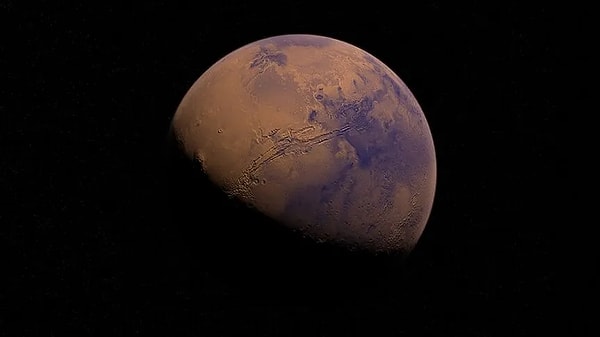
This extreme temperature imbalance captured in the planet's deep interior could potentially provide answers to another puzzle that scientists have been trying to unravel for a long time. The research team suggests that this massive heat difference detected could directly explain the intense magnetic field deviations observed in the south of Mars and the extraordinary seismic wave movements recorded by NASA's InSight spacecraft.
Amirhossein Bagheri, a researcher at Caltech and co-author of the study, stated that this asymmetrical structure between the north and the south carries traces of the liquid water and hydrological history that Mars once hosted on its surface. According to scientists, this unusual situation could be the result of a massive asteroid impact in Mars' past, or it could stem from the thick geological layers in the south trapping heat and continuing to melt the mantle from within. This critical discovery aimed at deciphering Mars' mystery has opened up a brand new chapter in understanding the formation and evolution processes of planets.
Keşfet ile ziyaret ettiğin tüm kategorileri tek akışta gör!
 Test
Test
 Gündem
 Magazin
 Video
Video



Send Comment