


From Waste to Walls: Orange Peels and Mushroom Roots Used for Building Insulation


The construction industry has been reliant on heavy industrial products like cement, steel, and concrete for centuries. However, a British biotechnology company has broken the mold with an innovative approach: orange peels, cocoa waste, and mushroom roots are being transformed into high-performance insulation panels for the buildings of the future.

While one third of the food produced globally goes to waste, the construction sector emerges as the industry that consumes the most raw materials in the world.
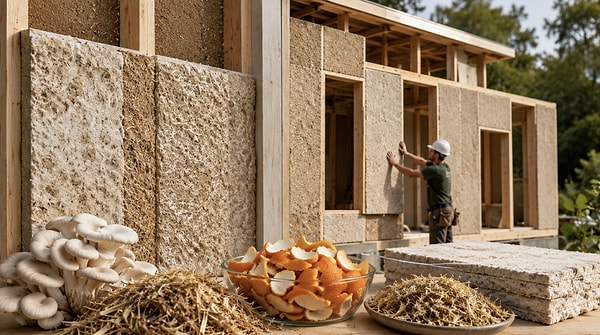
A UK-based company has managed to meld two major environmental issues into one solution. Orange peels, cocoa waste, and agricultural by-products collected from the food industry are being grown in labs as construction materials, rather than being processed in factories.
At the heart of the system lies the fibrous structure, known as mycelium, which functions like the underground root system of mushrooms.
Natural Adhesive: The mycelium grows on the organic waste composed of orange and cocoa peels. Without the need for any synthetic adhesive or petrochemical substances, it forms a strong, natural network that binds these particles together.
Heat Treatment to Halt Growth: When the material reaches the desired panel shape and size, the growth of the mushroom is halted with a special thermal process, and the product transforms into a stable, ready-to-use insulation board.
The small air pockets that form during the natural growth process of the mushroom provide both excellent thermal insulation and superior moisture regulation for buildings.
The company has developed a new material named ORB (Organic Waste Biocomposite), in addition to insulation panels.
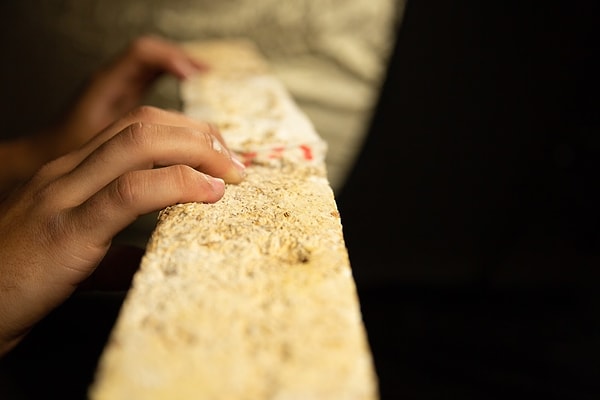
ORB, a product obtained by combining agricultural waste with a plant-based binder, offers a powerful alternative to traditional wood-based panels (such as particleboard, MDF, etc.) used in construction. It is 100% vegan and completely biodegradable.
According to data from the World Economic Forum, construction-related waste is expected to reach 2.2 billion tons annually, underscoring the vital importance of such biomimicry projects that mimic nature.
Instead of giant industrial ovens powered by fossil fuels, these next-generation panels, produced using the power of living organisms, can transform into fertilizer without causing any harm to nature once they have reached the end of their lifespan.
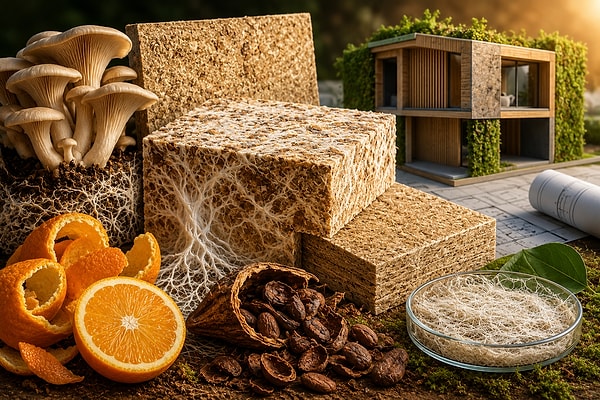
Experts assert that this technology will not be confined to insulation alone; in the near future, we can expect to see orange peels and corks in every aspect of architecture, from interior cladding to furniture, and even load-bearing wall panels.
Keşfet ile ziyaret ettiğin tüm kategorileri tek akışta gör!
 Test
Test
 Gündem
 Magazin
 Video
Video



Send Comment