


A Large Stone Was Lifted, Revealing a 3,800-Year-Old Treasure Beneath It


In the ancient city of Peñico in Peru, a 43-piece ritual offering made of wood and bone was unearthed from beneath a large stone. The find, approximately 3,800 years old, indicates that religious and ceremonial traditions persisted in the region even after the main cities of the Caral civilization lost their significance.

Hidden beneath the large stone was a space measuring only 22 centimeters.
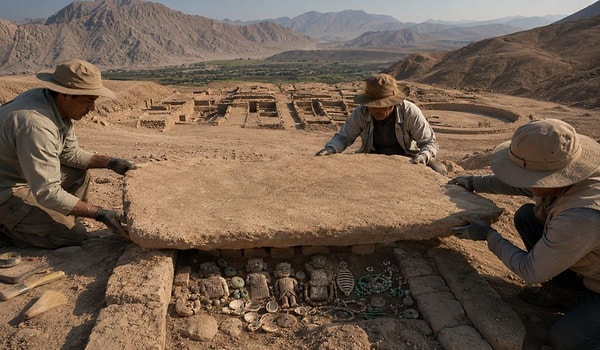
Archaeologists working in the ancient city of Peñico in Peru's Huaura region have uncovered a ritual area associated with the construction of a new platform in one of the city's most significant public structures. A small section, encircled in a semi-circle with round stones, was covered with a large stone that appeared to have been deliberately placed.
When the stone was removed, numerous objects were found carefully placed in a narrow area only 22 centimeters long. Despite the small size of the area, the extraction of 43 pieces made of wood and bone suggested that the objects were not randomly discarded; instead, they were thought to have been placed side by side as part of a specific ceremony.
According to the excavation team, this offering was buried under the ground during the creation of the building's new platform.
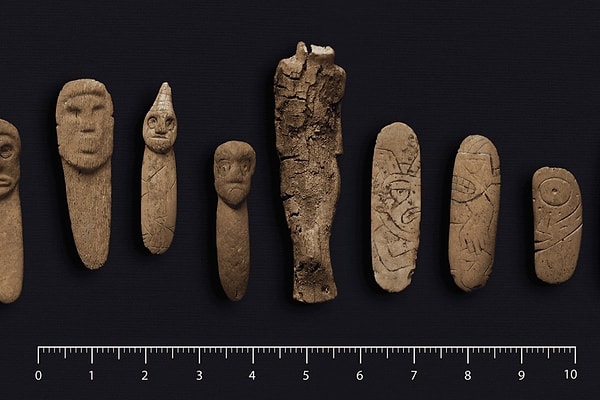
The pieces depict humans, animals, and mythological characters.
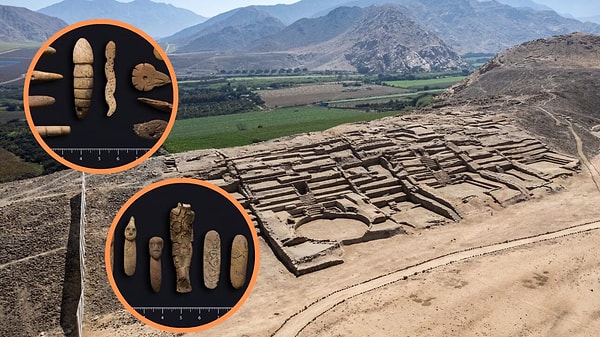
Detailed patterns created by the method of scraping are found on a portion of the 43 objects discovered. The collection includes depictions of human figures, thought to represent authority or leadership, alongside mythological characters and a female figure.
Among the animal-shaped pieces, birds, snakes, and frogs stand out. Some objects, instead of directly representing a living creature, employ geometric patterns and abstract shapes. Burn marks observed on some pieces suggest that fire could have been a part of the ceremonies they were used in.
Small cavities made for the placement of minerals or semi-precious stones were also identified on some figures. From the same area, three beads, three pieces of chrysocolla stone, remnants of beads made from black snail shells, and nine shell eyes, thought to be prepared for attachment to statues, were unearthed. Meanwhile, investigations continue on eight small pieces whose function has yet to be definitively determined.
The discovery suggests that the Caral tradition continued to thrive in Peñico.
Peñico, believed to have been established around 1800 BC and used until 1500 BC, sprawls over an area of 19.44 hectares. So far, 15 public buildings have been identified in this ancient city, which is located approximately 13 kilometers away from the main center of Caral, one of the oldest known civilizations in the Americas.
It is thought that Peñico was not just a settlement, but a hub that facilitated economic and cultural connections between the coastal regions and the Andes. The presence of goods in the city, seemingly brought from the Amazon region, suggests that this connection extended deep into the continent's interior.
Keşfet ile ziyaret ettiğin tüm kategorileri tek akışta gör!
 Test
Test
 Gündem
 Magazin
 Video
Video



Send Comment