


28 Years Ago Today, David Beckham Went from a Potential National Hero to a National Villain


Admittedly, the English have learned to be cautious, but every two years, they would present themselves with the claim, 'Football's Coming Home.'
Ever since 1966, both before the European Championship and the World Cup, England would arrive with dreams of lifting the trophy, only to depart each time with profound disappointment.
Prominently featured in this album of disappointments is Argentina.
The situation was no different in 1998.

A star is rising in England.
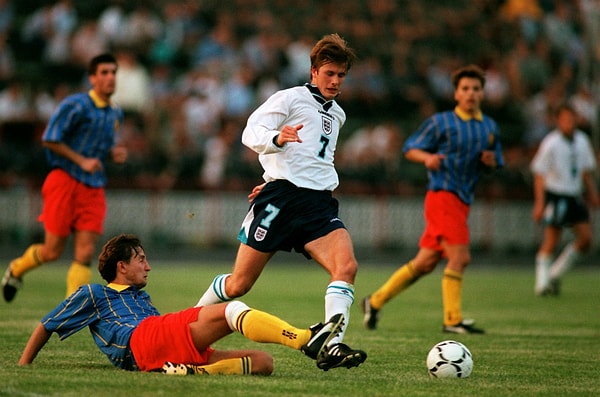
In England, Beckham emerged as the star the country had been eagerly searching for.
Having secured a spot in Manchester United's starting eleven the previous season, Beckham drew global attention at the start of the 1996/97 season with a goal that seemed to mock Wimbledon goalkeeper Neil Sullivan. He scored from his own half, as if he was casually playing around.
He won the Young Player of the Year award, graced the gossip pages with Victoria from the Spice Girls, and ascended to the national team with his performance. He found himself in the midst of a full-blown Beckham frenzy.
His hair, his smile, his goals, his set-piece ability - they all made him not just Victoria's darling, but the nation's sweetheart.
Yet, there were those who harbored doubts. George Best, perhaps the last icon before Beckham, criticized him:
'He can't shoot with his left foot, he can't head a ball, he can't tackle, he doesn't score many goals. Apart from that, he's not a bad player.'
Beckham arrives at France 98, filled with high hopes.
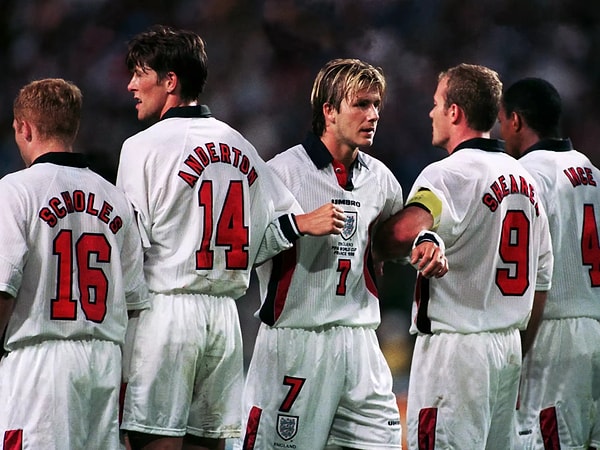
It was once again a time when the 'football's coming home' fairies visited England, as they kicked off the tournament with high hopes.
The English had flocked to the cup being held in France. In their group, they faced Tunisia, Romania, and Colombia. With football coming home, at least the first round might not have been too challenging.
The first match was against Tunisia, which they won 2-0, but Beckham was absent. According to the newspapers, the lackluster football had them missing Beckham.
The second match was against Romania, and again, Beckham was nowhere to be found. Had Paul Ince not been injured in the 32nd minute, Beckham might not have had a chance to put on the jersey. He stepped in to replace Ince. However, England lost 2-1 to Romania, the tournament's dark horse.
In the final match, they faced Colombia. Beckham, starting in the first 11 and even scoring a goal, played a significant role in England's 2-0 victory.
Romania advanced to the next round with 7 points, followed by England with 6 points.
In the last 16, the opponent is Argentina...
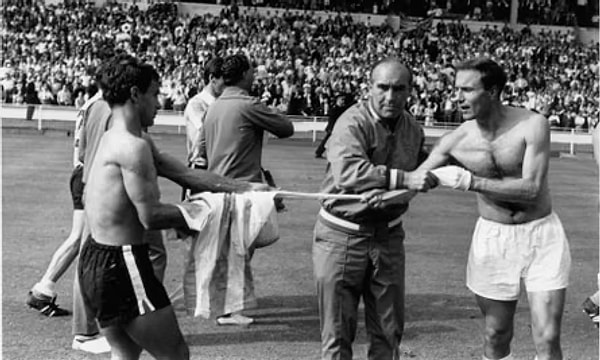
Argentina and England may not share the same continent, but they have managed to become key players in a fascinating football rivalry, the roots of which can be traced back to 1966.
In the 'ugly' quarter-final match between the two teams, which England won 10 times, West German referee Rudolf Kreitlein sent off Argentina's captain Antonio Rattin due to his protests. Controversies over a disallowed goal lingered until 1986.
Upon the final whistle, England's manager Alf Ramsey, disturbed by the rough tactics employed by the Argentine team, dashed onto the field to prevent the players from swapping shirts. He also insulted the Argentinians:
'Our best football will emerge against a team that comes to play, not to behave like animals.'
And so it was, 1986...
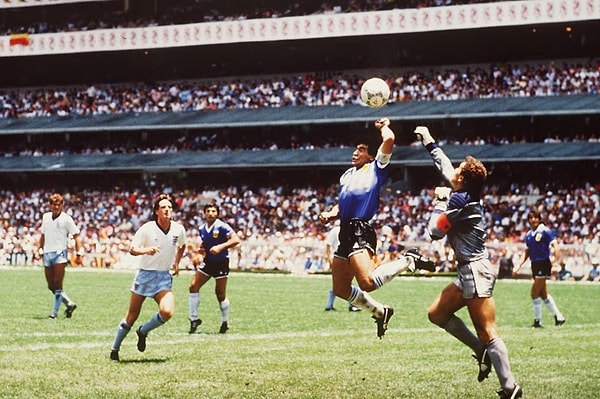
In 1982, Argentina and England found themselves locked in conflict during the 74-day-long Falkland War. England had become an object of intense hatred in Argentina. Their subsequent encounter in the World Cup further stirred the nationalistic sentiments of the Argentinians.
Maradona, having scored a brilliant goal and a controversial one, left the field known as the 'Hand of God', with England being eliminated from the competition.
Bobby Robson referred to this controversial hand as 'not the hand of God, but that of a cheat'. However, Maradona had a different perspective:
'It was like stealing the wallet of the English... It felt as if we had defeated a country, not just a football team. Even though we said before the match that football had nothing to do with the Falklands, we knew they had killed a lot of Argentine boys there, like little birds. And this was a form of revenge.'
The two rival national teams once again faced off in 1998...
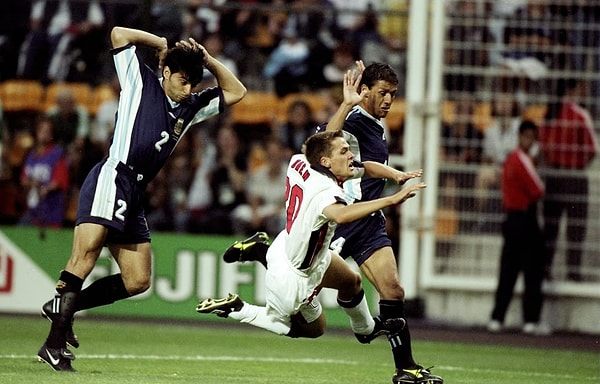
The technical director of England, who had been a player on the team that lost to Maradona in 1986, was Hoddle. This time around, by fielding Owen and Beckham simultaneously, he fulfilled the expectations of his country.
Things didn't get off to a great start for England. In the fifth minute of the match, following Diego Simeone being taken down by goalkeeper Seaman, Gabriel Batistuta scored a goal from a penalty. Almost immediately, at the other end of the field, England was awarded a penalty following a stumble by Owen. This time, Alan Shearer didn't miss, and the score was tied at 1-1.
In the 16th minute, Owen, receiving an excellent pass from Beckham, stormed into the Argentine half, slipping the ball past goalkeeper Carlos Roa and into the net, making the score 2-1.
A foolish foul by Sol Campbell on Claudio Lopez led to a free kick from which Zanetti equalized the match. The score at the end of the first half: England 2, Argentina 2.
That moment when everything came to an end...
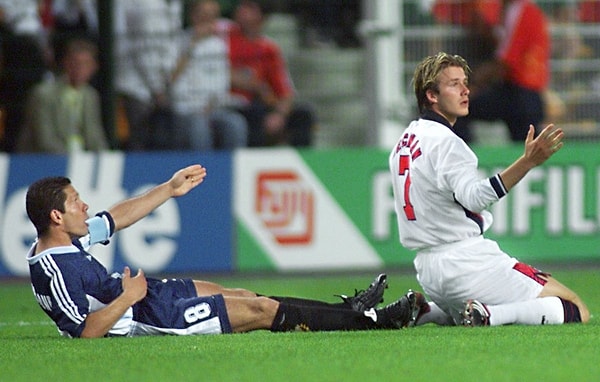
For the English, it was a moment of utter devastation just two minutes into the second half.
Beckham and Diego Simeone found themselves in a face-off over a ball in a relatively non-threatening area of the midfield. A move from behind by Simeone left Beckham on the ground. Simeone, too, stumbled slightly forward and, seemingly trying to avoid falling, pressed his hand onto Beckham's waist in a far from innocent manner. The referee was approaching the scene, seemingly about to show Simeone a yellow card. However, Beckham, whose right foot was often praised, did something he shouldn't have - he threw a small kick at Simeone while still on the ground. Simeone, in turn, made sure to showcase this to the approaching referee from the best angle possible. The referee's decision was clear, he was just waiting for the quarrel to end. A yellow card for Simeone, and a red card for Beckham. He didn't even protest, he simply hung his head and turned away.
The regular time of the match ended in a 2-2 draw. England made the most mistakes in the penalty shootout, and Argentina advanced to the next round.
The scapegoat was clear: England's golden boy, Beckham.
The press showed no mercy to Beckham.
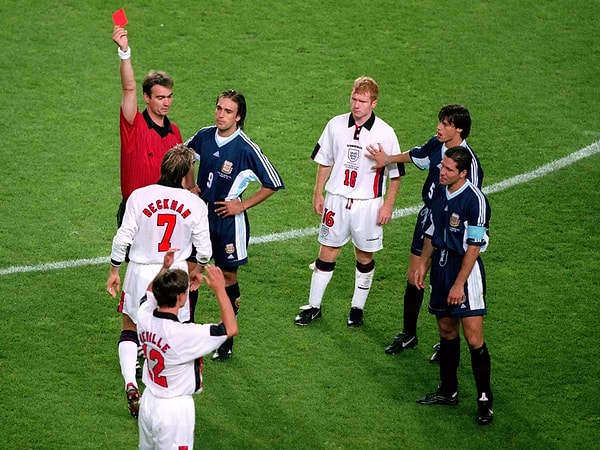
The Daily Mail had made light of the slogan 'Football's Coming Home' with their headline 'We're Going Home,' yet not everyone found this amusing. The Mirror went with '10 Heroic Lions, One Fool,' leaving no doubt as to whom the 'fool' referred. The photograph showed Beckham, bowing to the red card and heading for the changing room.
Daily Mail referred to it as 'a madness that cost us the cup.' Hoddle, after the match, had said 'this mistake cost us dearly.'
Puppets of Beckham were hung from pub signs, with the public presenting a sort of purification ceremony by shaking them. An underground mafia organization had threatened Beckham's family.
In London, a butcher shop had placed two pig heads in its window, with the names 'Victoria and David' written on them.
The first official match after that dark summer was in London against Arsenal. Every time Manchester's number 7 touched the ball, there was a roar from the stands. The matches where Beckham was booed did not end there.
As the pain of elimination eased, so did the reactions towards Beckham. But he was never forgiven.
Until that game...
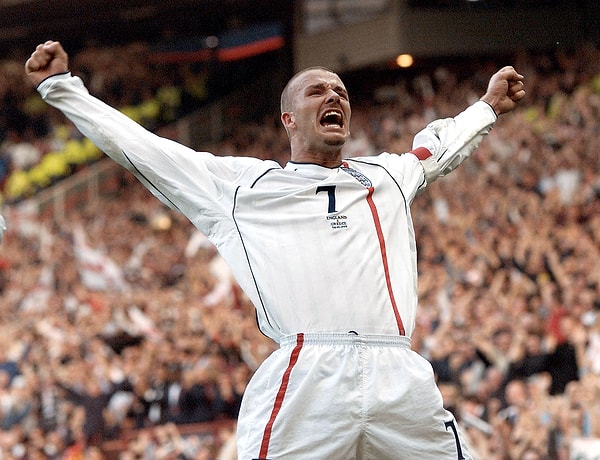
Beckham had long since shed his baby-faced persona, maturing into a footballer who was hammered by both the press and fans alike. His skin had thickened against criticism, and his famous hair was now a thing of the past. By shaving his head, he began to re-enter the public consciousness.
There came a moment when Beckham had to step up against Greece. Otherwise, his name could once again adorn the newspapers, and he could be metaphorically hung out to dry in the pubs.
The debt of the past was paid off three years later.
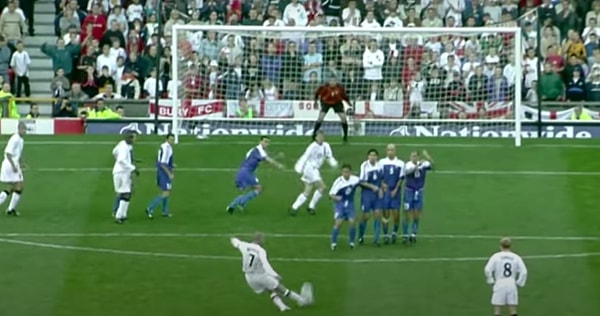
October 6, 2001. The setting: Old Trafford.
England is trailing 2-1 against Greece. A goal is desperately needed in the extra time to secure a direct ticket to the 2002 World Cup finals. Otherwise, a challenging playoff match against Ukraine awaits.
90+3...
Team captain and Manchester United's golden boy, David Beckham, steps up to the ball. From about 25 meters out, he executes a spectacular free kick that meets the back of the net, propelling England directly to the 2002 World Cup finals hosted by South Korea and Japan.
Beckham was paying the price for his past mistakes. He described the moment of that goal as follows:
'That was the moment when the England fans forgave me for what had happened a few years ago.
For me, it was also a way to make up for the past. Because up until that point, I was always under the shadow of that red card.'
He reinvented himself amidst the pressures.
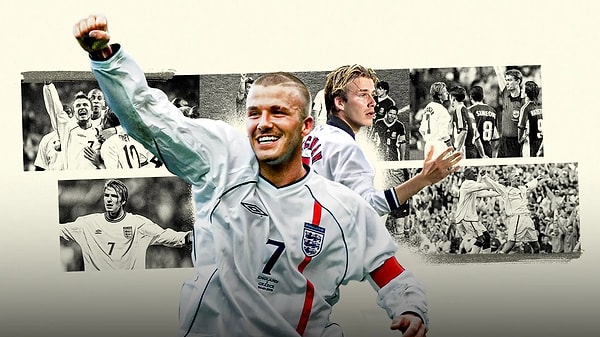
David Beckham experienced the most intense form of pressure. Threats were made against his family, his effigy was swung around in public squares and pubs, and he moved with unease wherever he went. Despite the humiliation he felt, he refrained from blaming anyone. His complaints were few and far between, save for expressing a sense of abandonment.
The same man who kicked Simeone became a national hero once again with the goal he scored against Greece with that very foot.
Keşfet ile ziyaret ettiğin tüm kategorileri tek akışta gör!
 Test
Test
 Gündem
 Magazin
 Video
Video



Send Comment