


The Aesthetic Power of Concrete: This Extraordinary Brutalist Home Will Leave You Speechless


Our living environment significantly influences our energy. Everything from the color of the walls to the height of the ceiling, the surface we step on, and the angle of incoming light, in fact, impacts our biology and mood. Therefore, it's incredibly important to decorate our living space in a way that suits us.
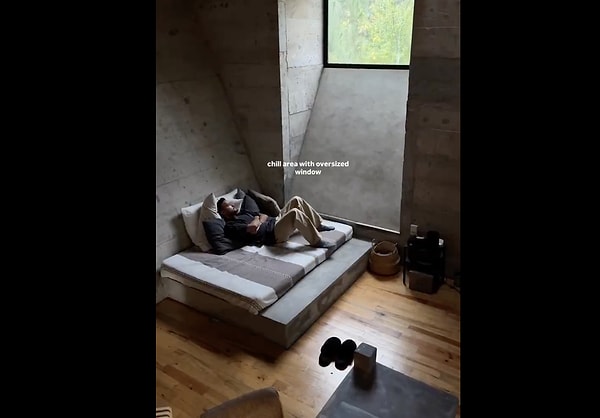
The house built by the renowned French-origin architect Ludwig Godefroy has gone viral on social media. This house, nestled in a pine forest about an hour away from Mexico City in Mexico, has been named Casa Alférez. Its Brutalist-style decor has been a hit with some, while others find it somewhat gloomy.

You can watch from here;
So, what exactly is this Brutalist style?
Brutalism is an architectural movement that possesses a philosophy much deeper than it initially appears. Despite its name sounding like 'brutal' (wild/cruel), it actually derives from the French term 'béton brut' (raw concrete).
The Principle of 'Honesty'
The biggest motto of Brutalism is honesty. Nothing is hidden in this style. Concrete is not painted or plastered. Even the marks of the molds are left on the wall. Ventilation pipes or electrical cables are sometimes not concealed, but left exposed as part of the structure. You can clearly see whatever is holding the building (columns, beams).
Raw and Massive Forms
Brutalist structures generally have a sculptural and heavy appearance. Geometric shapes are very sharp. As you can see in the house in the video, the exterior of the house looks massive and powerful, as if it were carved from a single block of stone.
Functionality is Foregrounded
Ornamentation (decorative carvings, colorful paints, ornate windows) is considered 'unnecessary' in this style. Everything serves a purpose. The logic of 'This is a kitchen and it is used for cooking, so a concrete countertop and stove are sufficient' prevails.
Historical Background
This movement became popular after World War II (between 1950 and 1970). It emerged from the need to build fast, low-cost, but also strong and lasting buildings in the post-war world. At that time, it was seen as 'the architecture of the future'.
Why is it Popular Again Now?
In the past, these structures were heavily criticized for being 'cold and soulless'. However, today, in a world where everything is smooth and plastic, people find the raw texture of stone and concrete 'real'. When the grey and hard appearance of concrete is combined with soft fabrics, plants, and wood (as in the video), a very chic and peaceful contrast emerges.
Keşfet ile ziyaret ettiğin tüm kategorileri tek akışta gör!
 Test
Test
 Gündem
 Magazin
 Video
Video



Send Comment