


New Radiant Cooling Systems to Replace AC Units


A new era has dawned in housing projects in Europe, coinciding with record-breaking summer heat. The 'Radiant Cooling' system, which is shaking the throne of traditional air conditioners and chilling homes without blowing air, quietly, is drawing attention with its energy efficiency.

For years, we had to endure air conditioners and the noisy, drafty air currents they create to keep our home cool during the summer months.

With the rise of high-performance homes and heat pump systems, a new, eco-friendly, cost-saving, and far more comfortable alternative to traditional air conditioning has emerged: Radiant Cooling.
The hydronic (water-based) concept, familiar to many from underfloor heating systems, is now being utilized to cool homes. Rapidly gaining popularity in luxury and new housing projects across Europe, this system operates on the principle of the natural coolness you feel when standing next to a concrete wall in the summer.
Radiant cooling is an advanced system that circulates cold water through special pipes embedded in ceilings, walls, or floors, rather than simply blowing cold air into the room.
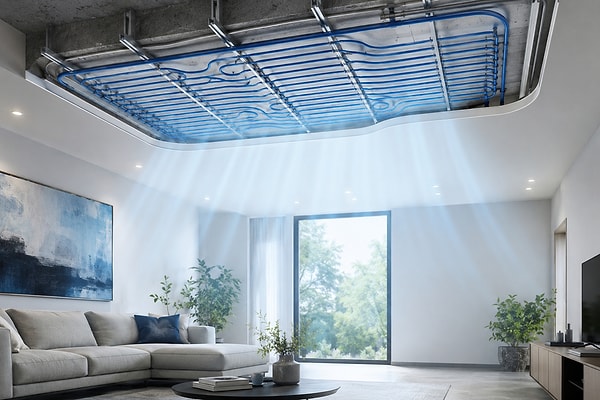
Instead of altering the air in the room, this system works by reducing the temperature of the surfaces. Given the nature of heat to move from warmer objects towards cooler surfaces, any excess heat in the room and your body is gently absorbed via radiation by these cooled ceiling or wall panels.
Traditional air conditioning systems create a strong airflow and draft by blowing cold air into the room through ducts. This not only leads to dust circulation in the house but also causes the environment to cool excessively in order to control humidity.
On the other hand, radiant cooling operates completely silently. It minimizes air movement, thereby preventing dust circulation, and ensures an even temperature distribution by warding off the formation of hot and cold spots within the room.
Advantages of the Radiant Cooling System
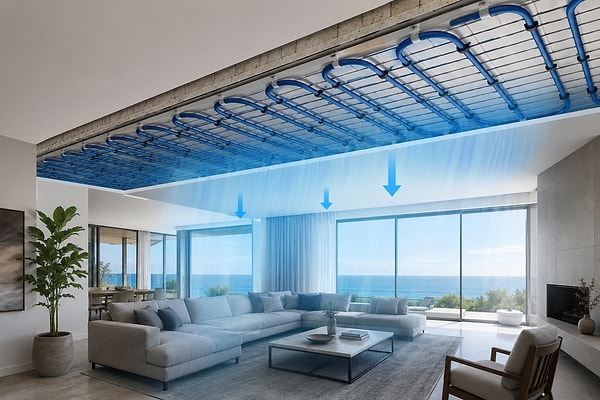
It operates at higher water temperatures because it carries water, not air, which multiplies the efficiency of the heat pump.
It doesn't require massive ventilation ducts or high-speed fans, and it's completely silent.
Since it doesn't create an air flow, it puts an end to the circulation of dust and pollen in the house, which is a boon for those with allergies.
The same pipe infrastructure can be used for heating in winter and cooling in summer (integrated with heat pumps).
Although this system can be applied to walls and floors, experts most often prefer ceiling application. There are three fundamental reasons for this:
The natural descent of cool air downwards,
Furniture not obstructing heat exchange,
Managing the risk of condensation is much easier on the ceiling.
Manufacturers like Warm Brothers Inc., initially designed these panel systems for radiant heating. However, with the right engineering, hydronic panels can now be seamlessly integrated into cooling systems as well.
Radiant cooling operates through two fundamental mechanisms:
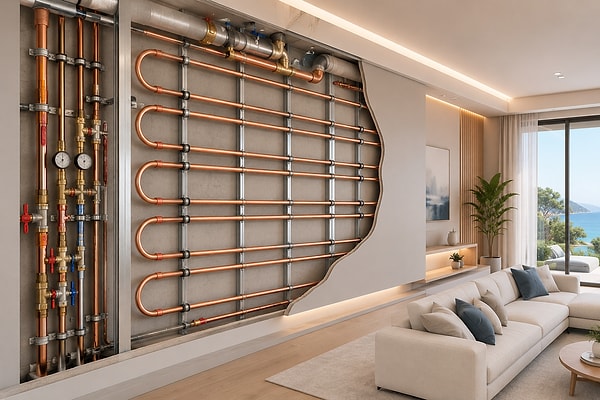
Radiation, primarily, is the process through which heat is transferred from warm surfaces to cold ceiling panels. Secondarily, there's Convection, which slightly impacts the surrounding air through cold surfaces.
However, experts emphasize a crucial point: This system does not eliminate humidity in the air; it merely removes perceptible heat. Consequently, it's vitally important to prevent condensation (or sweating) particularly in humid climates.
In order to establish this system, it is necessary for the houses to:
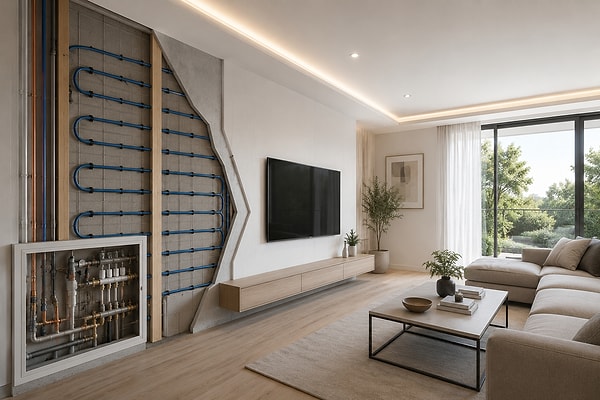
For a building to be well-insulated and have a tight exterior facade,
To possess a controlled ventilation system,
And to already utilize hydronic (water-based) infrastructures like air or ground source heat pumps are necessary.
This may not be ideal for old-fashioned apartments with extremely high humidity levels and without a specific dehumidification system. However, in modern and high-performance new generation homes, it appears to completely eliminate the noise and draft of air conditioning from our lives.
Keşfet ile ziyaret ettiğin tüm kategorileri tek akışta gör!
 Test
Test
 Gündem
 Magazin
 Video
Video



Send Comment