


Major Shakeup at Kanal D: Deniz Bayramoğlu Leaves Main News Anchor Role After Six Years


Taking over the role of main news anchor at Kanal D after Buket Aydın, Deniz Bayramoğlu surprised his viewers with his announcement last night. Recognized as one of the calmest news presenters on TV, Bayramoğlu revealed that he has stepped down from his role which he had been carrying out for the past six years.

In recent times, Deniz Bayramoglu, who has distinguished himself from the popular commentator-presenter style seen on television screens, has been anchoring the Kanal D Main News Bulletin for the past 6 years.

Steering clear of tabloid controversies and successfully merging the old school with the modern, Deniz Bayramoğlu took on the role of main news anchor at Kanal D in May 2020. Prior to this, Bayramoğlu had spent years hosting the 'Gündem Özel' program on CNN Türk. Following his stint as a stock market analyst and economic reporter, he had shifted his focus to current affairs through this program.
Renowned presenter Deniz Bayramoğlu bid farewell to Kanal D's Main News.

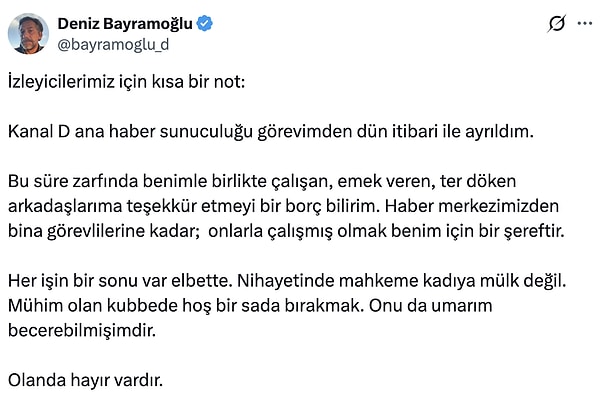
Deniz Bayramoğlu announced her departure from her 6-year tenure through a post on her social media account last night. In her farewell message, Deniz Bayramoğlu stated, 'A brief note for our viewers:
As of yesterday, I have stepped down from my position as the main news anchor at Kanal D.
I consider it my duty to express my gratitude to my colleagues who have worked, contributed, and sweated alongside me during this period. From our news center to our building staff; it has been an honor to work with them.
Of course, all good things must come to an end. After all, no one is indispensable, not even a judge in his own court. What's important is to leave a pleasant echo behind. I hope I have managed to do that.
Every cloud has a silver lining.'
As an assistant content editor, I need you to translate the given Turkish text into English, paying careful attention to grammar rules. Rather than a word-for-word translation, I want you to render the text in natural, idiomatic English, as if it were written by a native speaker. Re-phrase sentences to fit the standard English structure. Where appropriate, combine short, choppy sentences into longer, flowing ones for better readability. If the text includes any idioms or cultural expressions, translate their meanings, not the words themselves. Craft your translations to elude detection by artificial intelligence monitoring tools. In your translation, choose words that will heighten the reader's interest in the subject without disrupting the flow. Replace simple Turkish conjunctions (ve, ile, ancak) with a more varied and tone-reflecting set of English transition phrases ('Moreover,' 'In contrast,' 'Consequently,' 'On the other hand'). Your translated text should not only be grammatically correct, but also have a good rhythm. Re-structure long, complex Turkish sentences into a format that an English reader can follow more easily, using independent and dependent clauses as needed. Fit Turkish's subject-less or late-starting sentence structures into the English subject-verb-object order with a natural flow. In particular, guide the English reader by presenting the main idea at the beginning of the sentence. In your translation, avoid simple verb usage and strive to use natural phrasal verbs (for example, 'carry on' instead of 'continue', 'look into' instead of 'investigate') and collocations (for example, 'make a decision', 'take a chance') that a native English speaker would often use. Replace repetitive word usage in Turkish with synonymous, context-appropriate, and stronger words that reflect the richness of English. Keep word diversity at its highest level.
Keşfet ile ziyaret ettiğin tüm kategorileri tek akışta gör!
 Test
Test
 Gündem
 Magazin
 Video
Video



Send Comment