


Incredible Response to Earthquake: 47,000 Survivors Housed in Just 24 Days


China has transformed humanitarian aid into a colossal show of industrial might with its emergency operation in the Tibetan plateau, one of the highest and most inhospitable regions on earth. Following the devastating earthquake in January 2025, the Chinese industrial machine sprang into action, providing shelter for over 47,000 people in just 24 days at an altitude of 4,300 meters where night temperatures plummet below 15°C. This operation has gone down in world history as the fastest housing distribution ever undertaken.

The cargo trucks that reached the areas in Tibet struck by the earthquake didn't unload makeshift shelters or tents for the disaster victims. Instead, they delivered factory-prepared steel structures, with windows, doors, beds, bedding, and heaters pre-installed.
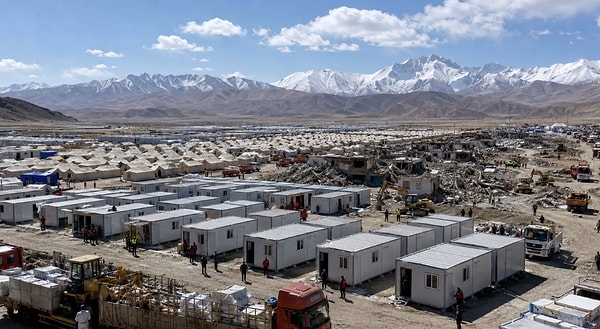
These foldable homes, each measuring 18 square meters and arriving in the compact size of a shipping container, were fully assembled and ready for occupancy in just eight minutes by trained technicians. Equipped with walls resistant to aftershocks and insulated for warmth, these units completely altered the course of survival in the bone-chilling winter at high altitudes by providing accommodation for up to eight people.
The colossal logistical operation was triggered by an event that occurred in the Dingri District of the Tibet Autonomous Region on the morning of January 7, 2025, at 09:05 local time. The earthquake, reported as 6.8 by the China Seismic Networks Center and 7.1 by the USGS, led to complete devastation due to its shallow depth of only 10 kilometers below the surface.
In the region, a staggering 80% to 90% of some villages were completely reduced to rubble, with over 3,600 homes demolished.
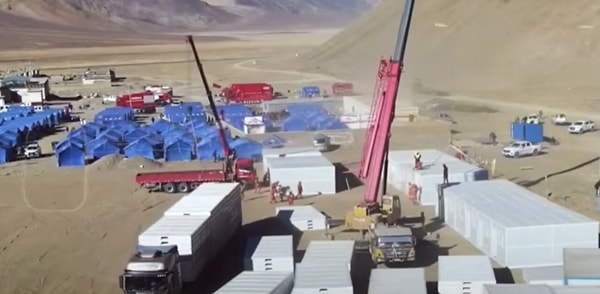
According to official reports, 126 people lost their lives and another 188 were injured. Thousands were left homeless, and rescue teams had to grapple not only with the rubble, but also the freezing Tibetan winter.
As reported by Chinese media and seismological analyses published in Nature magazine, teams working round-the-clock shifts in the disaster zone managed to set up 7,733 foldable houses and 9,941 tents by January 31st. In total, over 17,000 shelter units were established, providing safe areas for 47,787 disaster victims. Videos of these villages, seemingly sprouting from nothing, became a global trend on social media under the hashtag 'ChinaSpeed'.
Following the emergency operation, China mobilized a colossal budget and workforce to permanently rejuvenate the region.
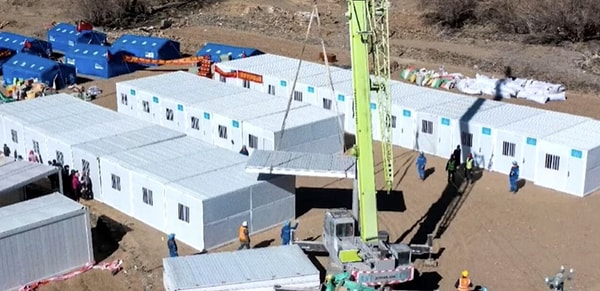
In the construction efforts, where 134 construction companies, 61,000 workers, 2,600 managers, and 6,600 pieces of heavy equipment were involved, a battle was waged against extreme conditions where oxygen was scarce and altitudes reached up to 5,300 meters in places.
Despite these challenges, in less than 10 months, more than 32,500 homes in 486 villages were either renovated or built from scratch. Of these homes, 22,000 were completely rebuilt, while 10,500 were reinforced to withstand future earthquakes.
This accomplishment in Tibet is a result of China's rapidly industrialized construction sector, which has shifted from traditional building methods to factory production lines over the past decade.

There exists a colossal prefabricated construction market in the country, currently valued at 1.62 trillion US dollars and growing at a rate of 10% annually. China has begun exporting this modular construction technology to countries like Kazakhstan and Dubai under the Belt and Road Initiative.
The Tibet operation sent a clear message to civil defense experts and engineers around the globe: Traditional humanitarian aid based on canvas tents is no longer sufficient in the face of global climate crises and natural disasters. To save more lives in the future, it is essential to have a robust industrial infrastructure capable of swiftly directing housing production lines to the affected areas during a disaster.
Keşfet ile ziyaret ettiğin tüm kategorileri tek akışta gör!
 Test
Test
 Gündem
 Magazin
 Video
Video



Send Comment