


Giant Sphere Built on Blasted Mountain Peak Set to Achieve a Miracle


Rising atop a mountain in the Atacama Desert of Chile, the world's largest telescope dome is under construction. This dome is set to house the Extremely Large Telescope (ELT), a project currently being carried out by the European Southern Observatory (ESO). Once completed, the telescope will be utilized in various fields of study, including the discovery of habitable exoplanets, the formation of galaxies, and the exploration of dark matter and dark energy.

The telescope is being installed on Cerro Armazones Mountain, which stands at an elevation of 3,060 meters in the Atacama Desert.
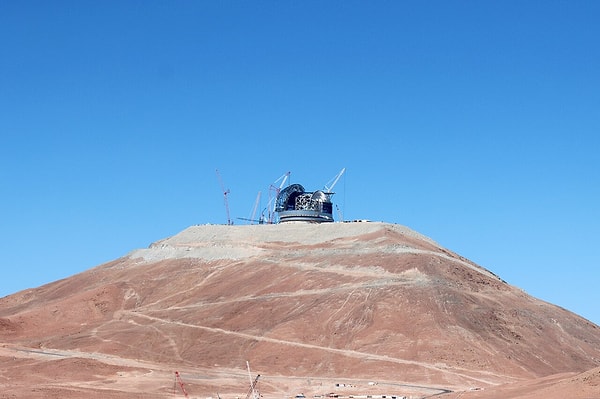
The mountain is situated approximately 130 kilometers south of the city of Antofagasta. The Chilean government donated a 189 square kilometer area surrounding the telescope to the European Southern Observatory (ESO), which is overseeing the project.
To make room for the structure, a portion of the mountain's peak was flattened by detonation.
The primary mirror will be formed by the combination of 798 hexagonal pieces.
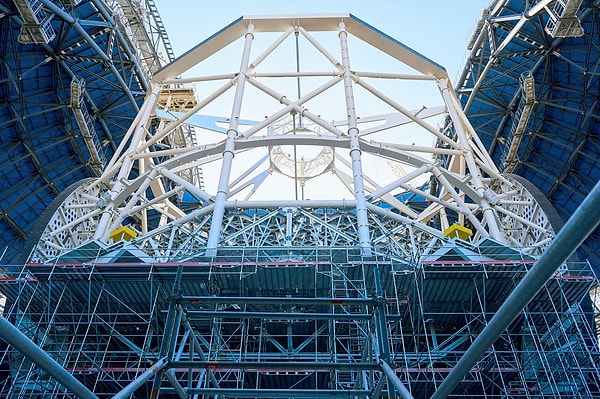
When the pieces are assembled, the diameter of the mirror will reach 39 meters.
The telescope will house a total of five mirrors. Among them, the second mirror, with a diameter of 4.25 meters, is the largest of its kind in the world.
The area covered by the dome is as large as a football field.
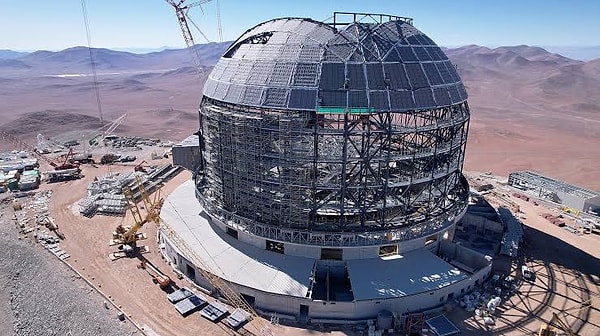
The dome, standing at an approximate height of 80 meters, has a diameter of 93 meters. Its top part is designed to rotate, enabling the telescope to view every direction of the sky. To protect the building against earthquakes, shock absorbers have been installed on the foundation.
The completion of the dome and the main body, which will carry the mirrors, is anticipated to be by 2027.
Due to delays, the telescope's initial observations have been pushed back to 2029 and 2030.
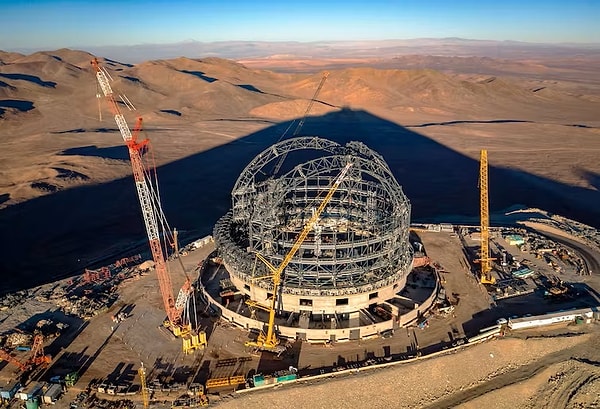
The job doesn't end when the dome and the main body are completed: The installation of mirror pieces will continue until 2028. The reasons for the schedule slip include challenging weather conditions at the construction site, technological work that took longer than expected, and equipment failures during production.
According to the new schedule, the telescope is expected to receive its first light in March 2029. Subsequently, scientific instruments will be installed and the first scientific observations will be made in December 2030.
Keşfet ile ziyaret ettiğin tüm kategorileri tek akışta gör!
 Test
Test
 Gündem
 Magazin
 Video
Video



Send Comment