


8 Ways Taylor Swift's Eras Tour Changed How The Music Business Works


Taylor Swift's Eras Tour was more than a run of concerts. It was a show of economic force that changed how parts of the music and entertainment business work, from ticketing and film distribution to crew pay and stadium production. Here are eight effects that shook the industry.

From ticket queues to cinema screens, the tour rewrote some of the business rules.

1. Ticketing giants faced legal scrutiny
When millions of fans tried to buy tickets at the same time, Ticketmaster's system crashed, and the fallout reached a hearing in the US Congress. The crisis brought ticketing monopolies in live music under government-level scrutiny on a scale rarely seen before.
2. Hollywood studios were cut out
To release her concert film, Taylor Swift skipped the traditional major studios and struck a deal directly with AMC Theatres as distributor. Keeping the bigger share of the revenue for herself and the cinemas, the move opened the door to a model where artists distribute without a middleman.
3. 'Swiftonomics' made it into an economic report
Spending on hotels, restaurants and transport rose so much in tour cities that the US Federal Reserve formally mentioned the boost in its economic report, the Beige Book.
4. Crew bonuses set a new bar
Everyone on the tour, from truck drivers to dancers, shared more than $55 million in bonuses in total. The figure put new pressure on the industry over the pay and rights of behind-the-scenes workers on big productions.
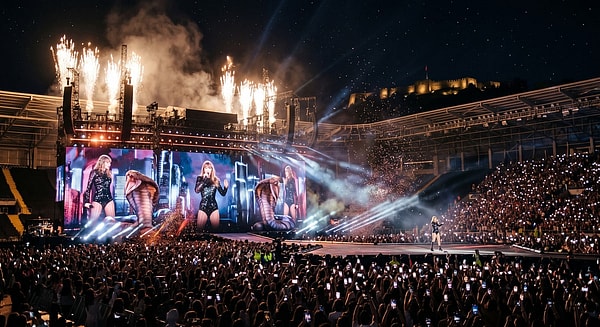
The show itself raised what fans now expect from a stadium concert.
5. Tours became a matter of diplomacy
World leaders such as Canadian Prime Minister Justin Trudeau and Chilean President Gabriel Boric publicly called on Taylor Swift via social media to bring the tour to their countries, citing the huge cash flow it would bring to their economies.
6. The crowd registered on seismographs
During the Seattle shows, fans jumping and the power of the sound system produced seismic activity that seismologists recorded as the equivalent of a magnitude 2.3 earthquake, nicknamed the 'Swift Quake.'
7. The idea of a 'concert' was redefined
Running for more than three and a half hours, with over 40 songs performed and each album era staged as a separate production, the show raised the standard for stadium concerts. Other major artists began revising their stage time and show concepts to meet this new expectation.
8. Merch sales took on a new form
Giant merchandise trucks set up outside stadiums long before show day created a new retail strategy, with fans camping out for days not only for the concert but also to buy merch.
Keşfet ile ziyaret ettiğin tüm kategorileri tek akışta gör!
 Test
 Gündem
 Magazin
 Video



Send Comment