


400-tonne Concrete Spheres Have Been Lowered To The Ocean Floor


One of the major challenges of renewable energy is the inability to utilize the produced electricity exactly when it's needed. There's an overabundance of energy when the sun is out, but production plummets when the wind dies down. However, scientists are currently exploring an intriguing solution to balance out these fluctuations. The idea? Deploying gigantic concrete spheres to the ocean floor. These spheres will function like enormous batteries, harnessing water pressure to store energy.

Concrete spheres will store energy at the bottom of the sea.
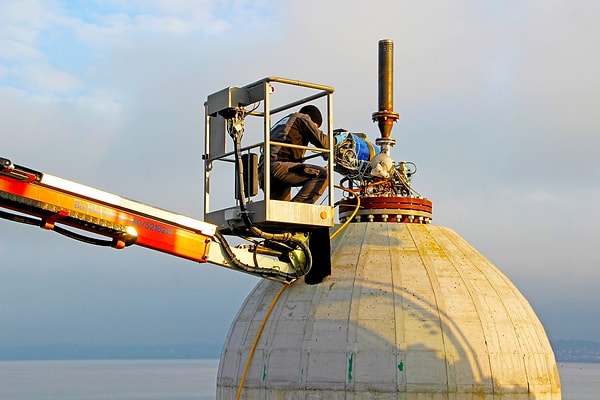
The StEnSea system, developed by the Fraunhofer Institute for Energy Economics and Energy System Technology, takes the traditional concept of pumped hydroelectric storage and moves it beneath the sea. Typically, these systems use excess electricity to pump water upwards, and when needed, the water flows downwards, spinning turbines to generate electricity.
However, in the case of StEnSea, instead of a mountain or dam, the natural pressure of the ocean is utilized. The Fraunhofer IEE indicates that this system is specifically designed to operate at depths of 600 to 800 meters.
At the heart of the system lies a hollow concrete sphere. When excess wind or solar energy is produced, the water inside the sphere is pumped out. When electricity is needed, a valve is opened, and the high-pressure seawater fills the sphere. This flow spins the turbine, thereby generating electricity again. In other words, the sphere is charged not when it's full, but when it's emptied. It has been reported that the prototype planned off the coast of California will be approximately 9 meters in diameter and weigh around 400 tons.
The first major trial will take place off the coast of California.
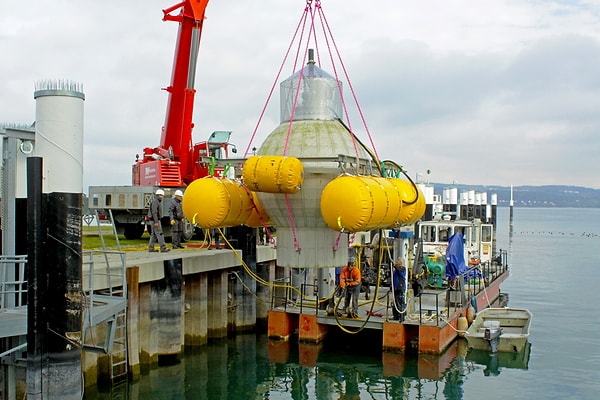
Plans are underway to deploy a concrete sphere off the coast of Long Beach for a new pilot study. The sphere, to be fabricated by Sperra using 3D concrete printing techniques, will house an underwater pump-turbine system developed by Pleuger Industries. According to a statement from Fraunhofer, this test represents a significant step towards scaling the technology for commercial use.
This concept was previously trialed on a small scale in Lake Constance in Germany. A concrete sphere with a diameter of approximately 3 meters was submerged to a depth of 100 meters, demonstrating the system's ability to operate using pressure differentials. The goal now is to test the same principle on a larger scale and in saltwater conditions.
If the trial in California proves successful, it could pave the way for the future use of numerous spheres as underwater energy storage parks. Fraunhofer's analysis suggests that this technology holds significant storage potential in suitable coastal regions. However, for now, we don't have a ready-made system that can power millions of homes, but a large-scale prototype aiming to move closer to this goal.
Keşfet ile ziyaret ettiğin tüm kategorileri tek akışta gör!
 Test
Test
 Gündem
 Magazin
 Video
Video



Send Comment