


The Planets Of The Solar System In Order Of Size, From Giant Jupiter To Tiny Mercury


The solar system is held together by gravity: the Sun, eight planets and their moons, plus dwarf planets, asteroids, comets and countless smaller bodies. Planets give off no light of their own; they shine by reflecting sunlight as they orbit the Sun. Only five of them, Mercury, Venus, Mars, Jupiter and Saturn, can be seen from Earth with the naked eye. So how do the eight planets rank by size? Here is the full list.


From largest to smallest: Jupiter, Saturn, Uranus, Neptune, Earth, Venus, Mars and Mercury.
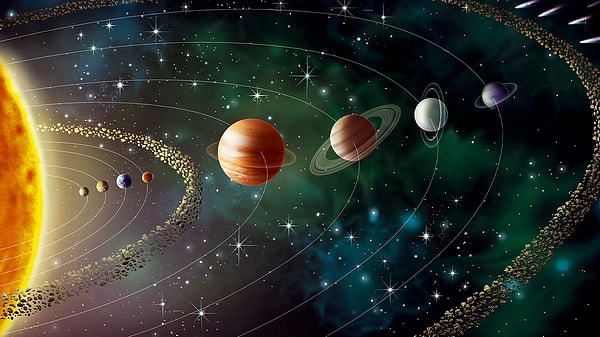
Rocky planets and giants
The planets fall into two broad groups. The inner, terrestrial planets, Mercury, Venus, Earth and Mars, are made mostly of rock and metal and have solid surfaces. The outer planets are far bigger: Jupiter and Saturn are gas giants made mostly of hydrogen and helium, while Uranus and Neptune are known as ice giants. Pluto, once counted as the ninth planet, is now classed as a dwarf planet because of its small size and because it shares its orbital zone with many other objects.
The four giants
1. Jupiter (about 139,820 km across): The largest planet in the solar system, made mostly of hydrogen and helium. Its famous Great Red Spot is a giant storm that has been raging for centuries.
2. Saturn (about 116,460 km): Best known for its spectacular rings, which are made of chunks of ice and rock.
3. Uranus (about 50,724 km): Roughly 63 Earths could fit inside it. Uniquely, it spins on its side, with its axis tilted almost at a right angle to its orbit. It orbits nearly 2.9 billion km from the Sun.
4. Neptune (about 49,244 km): An ice giant with no solid surface to stand on, famous for winds faster than the speed of sound. It is the farthest planet from the Sun.
Diameters are mean values based on NASA figures.
The rocky planets are much smaller: Earth is the biggest of them, Mercury the smallest of all.
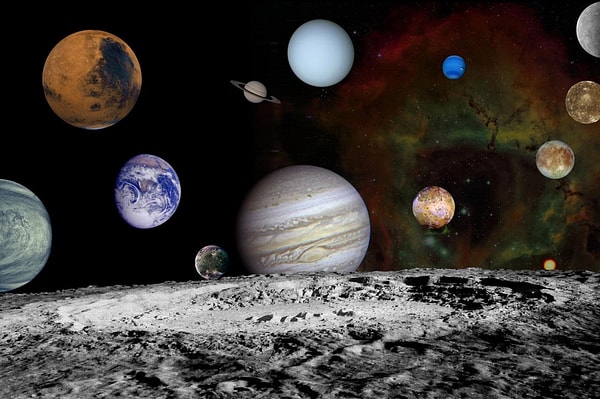
5. Earth (about 12,742 km): The largest of the rocky planets and the only place known to host life. It sits about 150 million km from the Sun, and roughly 70% of its surface is covered by oceans.
6. Venus (about 12,104 km): Very close to Earth in size, it orbits about 108 million km from the Sun. Thanks to its thick atmosphere it is even hotter than Mercury. It also spins slowly and in the opposite direction to most planets.
7. Mars (about 6,779 km): A cold, dusty world about 228 million km from the Sun on average. Scientists think it was once warmer and wetter.
8. Mercury (about 4,879 km): The smallest planet and the closest to the Sun, only slightly larger than our Moon. Daytime temperatures can reach around 430°C, while the night side drops far below freezing. Like the Moon, its surface is covered in craters.
Keşfet ile ziyaret ettiğin tüm kategorileri tek akışta gör!
 Test
 Gündem
 Magazin
 Video



Send Comment