


Hidden 1,000 Meters Below: Why Japan Stores 50 Million Liters of Pure Water Under Mountain


Buried a thousand meters deep, the Super-Kamiokande facility, with its 50 million liters of ultra-pure water and thousands of giant sensors, is shedding light on the origins of the universe by hunting for nearly 'invisible' neutrino particles.

Nestled a thousand meters deep in a mountain in Hida, a city in Japan's Gifu Prefecture, the former Kamioka mine serves as the host to one of the world's most effective and extraordinary scientific facilities.
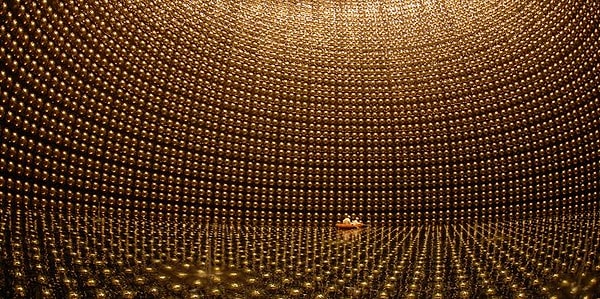
Tucked away underground, the Super-Kamiokande, with its massive stainless steel tank and approximately 50 million liters of ultra-pure water, is ceaselessly working to unravel the mysteries of the universe.
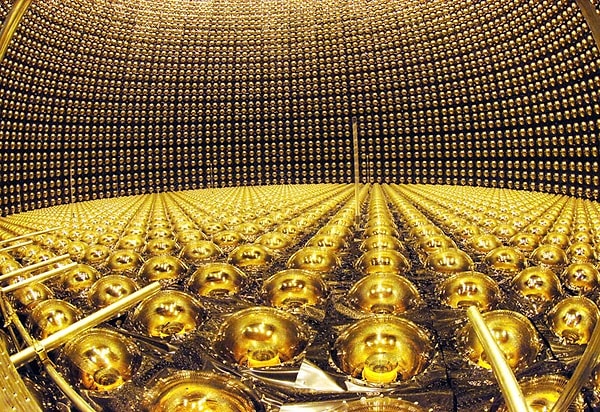
This subterranean observatory, housing around 13,000 giant light sensors (photomultiplier tubes) within its inner and outer walls, has been specifically designed to capture neutrinos, one of nature's most elusive particles.
Situated at the heart of the facility, the 50 million liters of water are constantly filtered to remove even the smallest dust particle, bacteria, or microscopic ion that could scatter light.
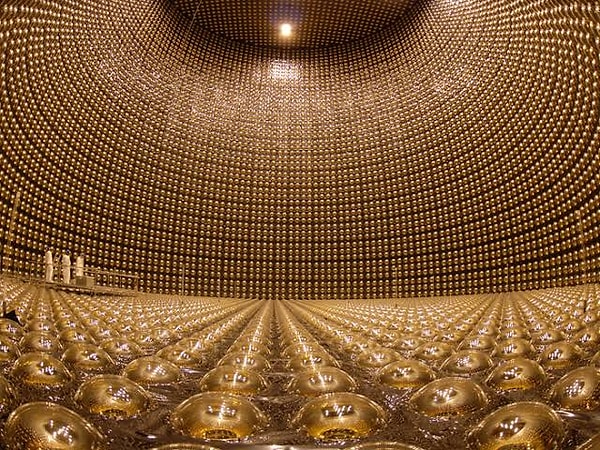
This ultra-pure water, which tends to dissolve the components on the surfaces it comes into contact with due to its low ion concentration, takes on an aggressive and abrasive structure. Starting from 2020, within the scope of the 'SKGd' project, gadolinium sulfate was added to the water, elevating its ability to identify neutrinos and neutrons left over from supernova explosions to a higher level.
Trillions of neutrino particles pass through the human body and the Earth every second without leaving a trace. However, on rare occasions, when a neutrino interacts with the nucleus of water atoms in the tank, it produces a charged particle that moves faster than the speed of light in water.
The blue light cone that emerges during this process, known as 'Cherenkov radiation,' is recorded by sensitive sensors arranged on the walls. Thanks to the geometry and timing of this light, scientists can determine the energy, direction, and type of the neutrino. The reason for the facility being 1000 meters underground is to use the rock mass as a natural shield and block the cosmic noise on the surface.
Super-Kamiokande made a mark in the history of science with the discovery of "neutrino oscillation" by the team led by Takaaki Kajita in 1998.
This groundbreaking study, which proved that neutrinos are not massless and that they change identities while traveling, was crowned with the Nobel Prize in Physics in 2015.
Japan is now taking this technology a step further. Currently under construction, the colossal HyperKamiokande, which will have an effective volume about 8.4 times larger than SuperKamiokande, is being built with a whopping water capacity of 260,000 tons. The underground excavation work for the new facility, which was completed in July 2025, is expected to have its tanks filled by the end of 2027 and to start collecting large-scale scientific data by 2028.
HyperKamiokande will investigate why there is more matter than antimatter in the universe, examine proton decay, and by monitoring potential supernova explosions, it will seek to answer unresolved questions about the birth of the universe.
Keşfet ile ziyaret ettiğin tüm kategorileri tek akışta gör!
 Test
Test
 Gündem
 Magazin
 Video
Video



Send Comment